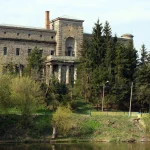
Perched on a hill amid the forests of the Lviv region stands a castle that does not look abandoned — but does not look alive either.
Pidhirtsi Castle is often called the “Galician Versailles.” But behind this phrase lies not only a beautiful facade, but also four centuries of owners, wars, fires, and restorations — most of which the castle has survived, though not without losses.
People come here not only for the architecture. They come here for the experience.
General Information
| What? | Description |
|---|---|
| Name | Pidhirtsi Castle (Pidhirtsi Palace) |
| Location | Pidhirtsi, Zolochiv District, Lviv Oblast |
| Object type | palace-and-castle complex, “palazzo in fortezza” style |
| Years of construction | 1635–1640 |
| Style | Late Renaissance and Baroque |
| Architects | Andrea dell’Acqua (palace), Guillaume Levasseur de Boplan (fortifications) |
| Status | a national architectural landmark; a museum-reserve that is part of the B. Voznytskiy Lviv National Art Gallery |
The History of the Castle: Four Families and Four Centuries
The castle was built by Stanisław Koniecpolski, Crown Hetman of the Polish-Lithuanian Commonwealth — one of the wealthiest magnates of his time. He invited two experts: the palace section was designed by Andrea dell’Acqua from Venice, and the fortifications by the French military engineer Guillaume Levasseur de Boplan, the same man who left behind the famous cartographic descriptions of Ukraine. A Latin inscription once adorned the castle’s entrance: “The crown of military labors is victory; victory is triumph; triumph is rest.”
The castle has endured four periods of ownership:
- The Konetspolskys (1635–1682). Founding and first heyday. Even during the Khmelnytsky Uprising, the castle was stormed by Cossacks and Tatars — it was damaged and restored several times.
- The Sobieskis (1682–1720). After the Konetspolskys, the castle passed to the Polish King Jan III Sobieski. In 1688, the Tatars caused damage again. In 1711, Peter I visited the castle and took several sculptures from the park. Two of them (statues of Jan Sobieski and his wife) still stand in Peterhof.
- The Żewuski family (1720–1865). The most culturally vibrant period. Wacław Żewuski undertook a massive renovation: he added a third floor, a theater, an orchestra, a printing press, and an art gallery housing thousands of paintings. It was here that the estate earned the nickname “Galician Versailles.” The legend of the White Lady is associated with this family.
- The Sangushko family (1865–1939). The last owners opened a private museum here, accessible to all visitors. Before the start of World War II, Roman Sangushko transported most of the collection abroad—it became the foundation of an art collection in São Paulo (Brazil).
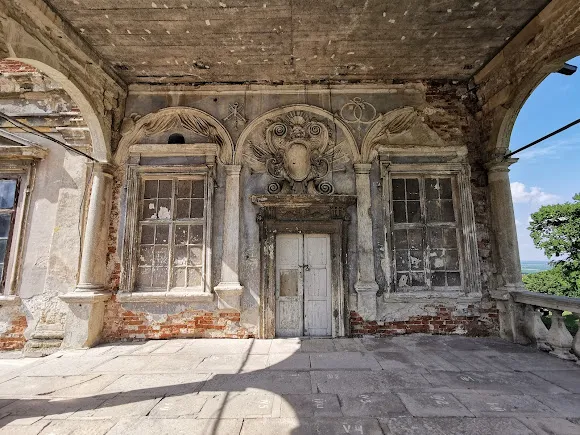
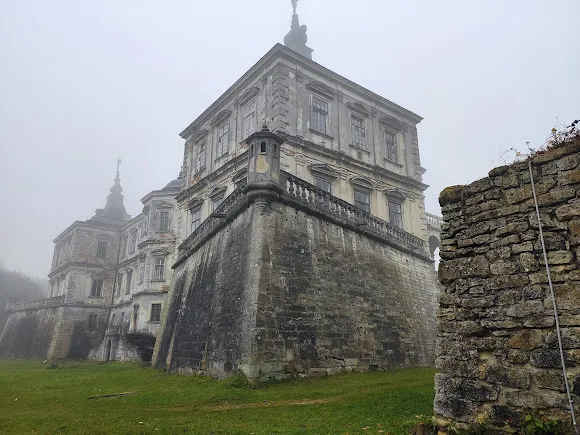
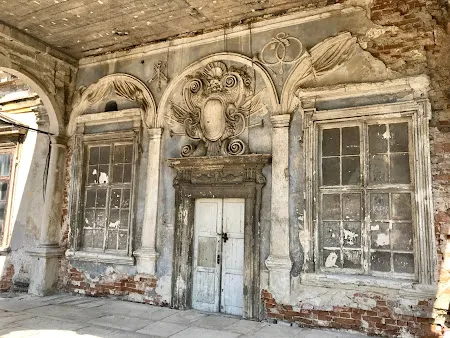
The Soviet and post-Soviet periods. After 1945 — a museum, then a tuberculosis sanatorium (from 1947). In 1956, a major fire destroyed most of the interiors: the parquet floors, frescoes, ceiling medallions, and carved walls. What we see today is a shell without substance. In 1997, the castle was transferred to the Lviv Art Gallery, and a gradual restoration began.
Architectural Features
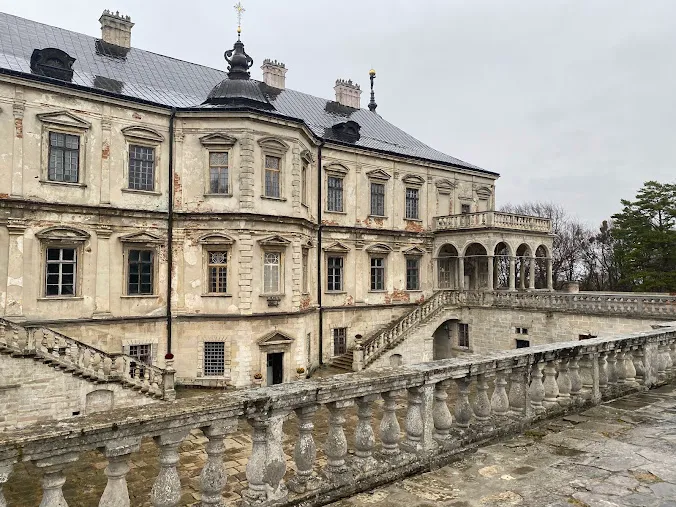
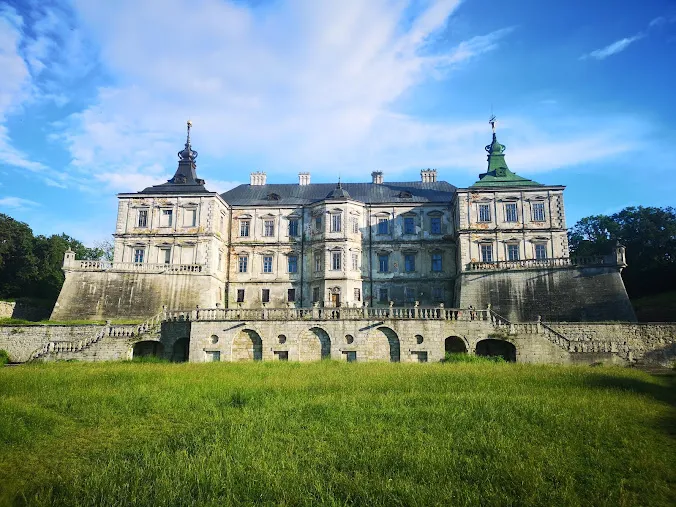
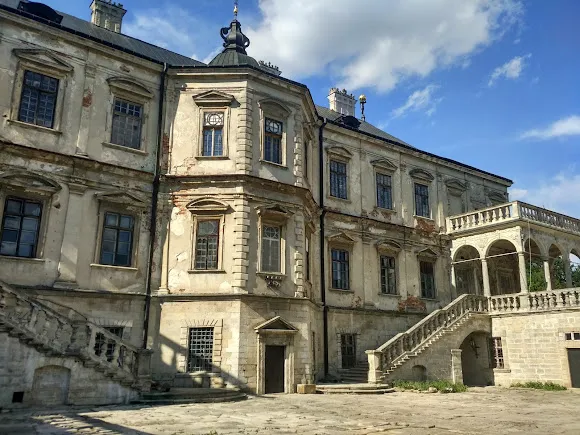
The castle has a square layout with sides measuring approximately 100 meters. At the corners are four pentagonal bastions. The northern section is the palace, featuring three stories and terraces overlooking the Brody Plain; on clear days, the view extends for dozens of kilometers.
The side pavilions are adorned with sculptures of Atlanteans holding a globe and the solar system—symbols of the Earth and the Universe. A deep moat once surrounded the castle on three sides; there used to be a drawbridge in front of the entrance gate.
Surrounding it is a park, laid out by Konetspolski in the 1640s, one of the few surviving examples in Ukraine of an Italian-style park with terraces. According to Wikipedia, it is a monument of landscape architecture of national significance.
Nearby stands the Church of the Exaltation of the Holy Cross and St. Joseph (1752–1766), built in the form of a Baroque rotunda, which serves as the family mausoleum of the Zhevusky family.
The Legend of the White Lady
The castle’s most famous mystical feature.
According to legend, one of the owners — a member of the Żewuski family — had his young wife walled up in a wall out of jealousy. Since then, the ghost of a woman in white has been wandering the corridors. Most versions point to Wacław Żewuski and his wife, who was 40 years younger than him. There is also a version involving Severin Żewuski and a hypothetical elixir of youth. None of the versions of the legend has any documentary evidence.
In 2010, the film crew of “Battle of the Psychics” visited the site, and the American team “Ghost Hunters International” spent several days exploring the dungeons with their equipment. No findings that could be independently verified were published.
But the fact remains: even skeptics speak more softly at Pidhirtsi Castle.
The Castle in Film
In 1978, the Soviet film “D’Artagnan and the Three Musketeers” was filmed here — the castle served as the Louvre. Other films shot here include “Bohdan Khmelnytsky”, “The Deluge”, “King Stach’s Wild Hunt”, and “Honoré de Balzac’s Mistake”.
Current Condition and Restoration
As of 2025, the castle is in a partially dilapidated condition. The comprehensive restoration planned since 2022 has not yet been carried out due to the full-scale war.
Latest news (April 2025): The Polish Ministry of Culture has allocated ~7 million zlotys (~77 million UAH) for the restoration of the northeast bastion, which required urgent intervention following damage. Work is scheduled for 2025.
The gallery’s collection preserves 85% of the castle’s artifacts — they are scheduled to be returned after the restoration is completed.
What to See Nearby
Pidhirtsi Castle is part of the “Golden Horseshoe of Lviv Region” route, which includes three castles:
- Olesko Castle (~20 km west) — fully restored, currently a museum
- Zolochiv Castle (~17 km east) — also restored and open to the public
- Church of Saint Joseph — located right in Pidhirtsi
You can easily visit all of these in one full day. Also nearby is the “Residences of Ukrainian Magnates” route, of which Pidhirtsi Castle is a central feature.
Practical Information
⚠️ Important: During martial law, the opening hours have been changed. The castle is open only on Saturdays and Sundays, from 11:00 AM to 6:00 PM (ticket office closes at 5:30 PM). Closed on Mondays. Please check the current schedule before your visit.
- Admission: paid.
- Guided tours: available; it is best to book in advance
- Parking: available near the castle
- Cafes: none on site — bring your own food and water
- Time needed for a visit: 1.5–2.5 hours (castle + park + church)
How to get there
From Lviv — ~85–90 km, take the M06 “Kyiv–Chop” highway to Olesko Castle, then turn toward Zolochiv. The first village is Pidhirtsi; the castle is visible from the road.
Alternative route: M09 highway “Ternopil–Rava-Ruska” → Zolochiv → toward Brody → 17 km to Pidhirtsi.
Public transportation: Lviv–Brody bus, “Pidhirtsi” stop. The castle is a 2–3-minute walk from there.
Little-known facts
- In 1711, Peter I removed two marble sculptures — statues of Jan Sobieski and Maria Kazimiera — from the castle park. They still stand in Peterhof today.
- 85% of the items from the castle’s collections are preserved in the holdings of the Lviv Art Gallery—and await return after restoration.
- During World War I, the headquarters of the Austro-Hungarian corps was stationed here, and the castle was threatened by artillery. It was General Brusilov who ordered the building to be spared, though he allowed yet another looting to take place.
- The castle is among the 100 world heritage sites in need of immediate restoration, according to several international organizations.
- Part of the Sangushko collection, evacuated in 1939, now forms the basis of the art collection in São Paulo (Brazil).
Conclusion
Pidhirtsi Castle isn’t about fear. It’s about absence.
About the halls where theatrical performances were once staged — and fell silent after the fire of 1956. About the park where Peter I selected sculptures “as souvenirs.” About the windows that have been looking out at the same landscape for four centuries.
This is a place for those who can read ruins — and who don’t mind stopping by on a Saturday or Sunday, since the castle is closed on weekdays.