At the narrowest point of the Kerch Strait, where the Black Sea gives way to the Sea of Azov, stands a fortress that blocked enemy ships for more than 70 years.
Yeni-Kale (Crimean Tatar: Yeñi Qale, Turkish: Yenikale — “New Fortress”) is not simply an Ottoman fortification. According to Wikipedia, it is “the only monument of military and defensive architecture on the territory of Ukraine that reflects the level of Western European fortification art of the early 18th century.”
General Information
| What? | Description |
|---|---|
| Name | Yeni-Kale (Yeñi Qale — “New Fortress”) |
| Location | Kerch, Autonomous Republic of Crimea (temporarily occupied territory) |
| Construction | 1699–1706 (main works completed 1703) |
| Built by | Ottoman Empire |
| Architect | Goloppo (an Italian who converted to Islam and entered Ottoman service) |
| Technical assistance | French military engineers |
| Type | coastal bastion fortress |
| Distinction | the only monument of Western European bastion art in Ukraine |
Why and How It Was Built
In the late 17th century the balance of power in the Black Sea region began to shift. In 1696 Muscovite forces seized Azov. In 1699 a Muscovite flotilla appeared before the Kerch garrison — a show of force at the entrance to the strait.
The Ottoman response was swift: in 1699 construction began on a new fortress intended to seal the passage from the Sea of Azov to the Black Sea permanently.
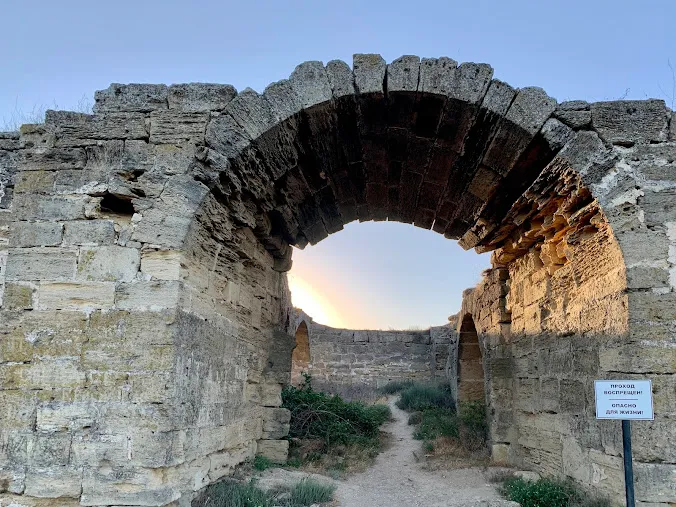
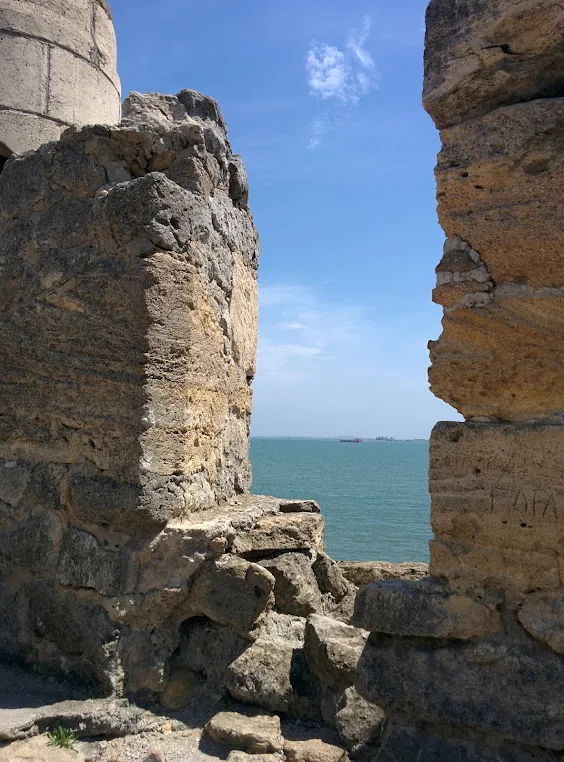
The site was chosen with strategic precision: a steep bluff opposite the Chushka Spit, at the narrowest point of the Kerch Strait. A ship passing here could not manoeuvre — and came directly under fire from the shore batteries.
The construction was entrusted to Goloppo — an Italian who had converted to Islam and entered Ottoman service. French military engineers provided technical assistance. This combination explains the uniqueness of Yeni-Kale: a fusion of French and Italian fortification schools found nowhere else in Ukraine.
By 1703 the main works were complete. From that point the fortress became the principal headquarters of Ottoman defence in the Black Sea region.
Architecture: Five Bastions and Three Gates
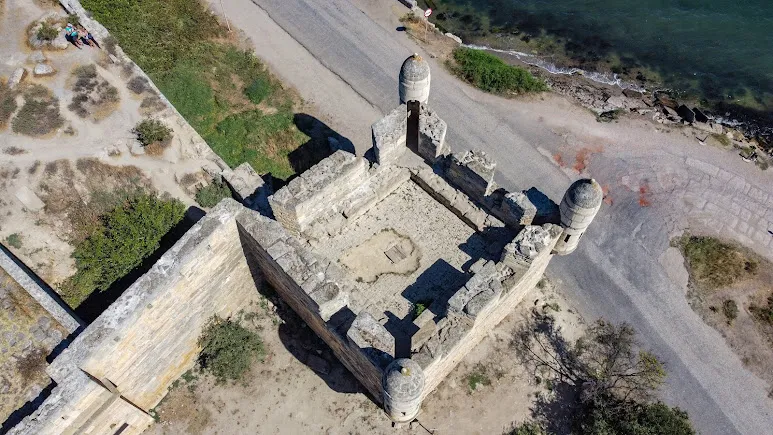
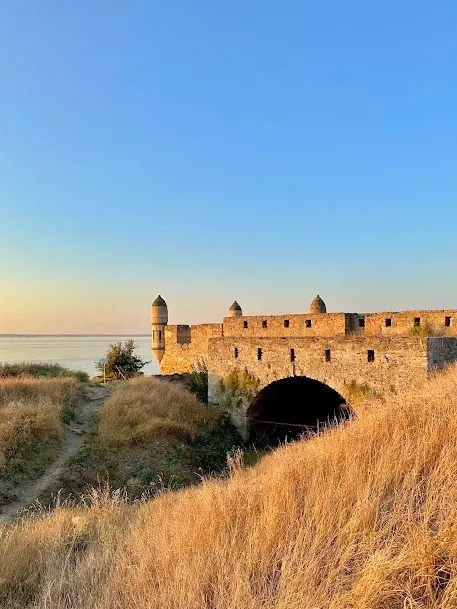
Yeni-Kale was built on the advanced principles of bastion fortification — considered the most effective defensive system in Europe during the 17th and 18th centuries.
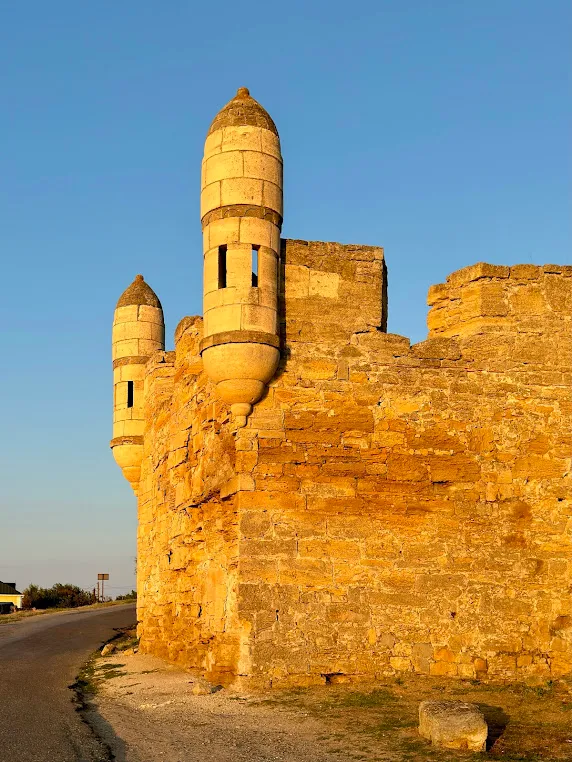
Plan: an irregular pentagon. The fortress is built on several levels, following the steep coastal terrain.
Five bastions:
- South-eastern and south-western — facing the strait
- North-eastern and north-western — facing the steppe
- Fifth — in front of the Azov Gate
Three gates:
- Azov Gate (to the east)
- Kerch Gate (to the west)
- Arabat Gate (to the north)
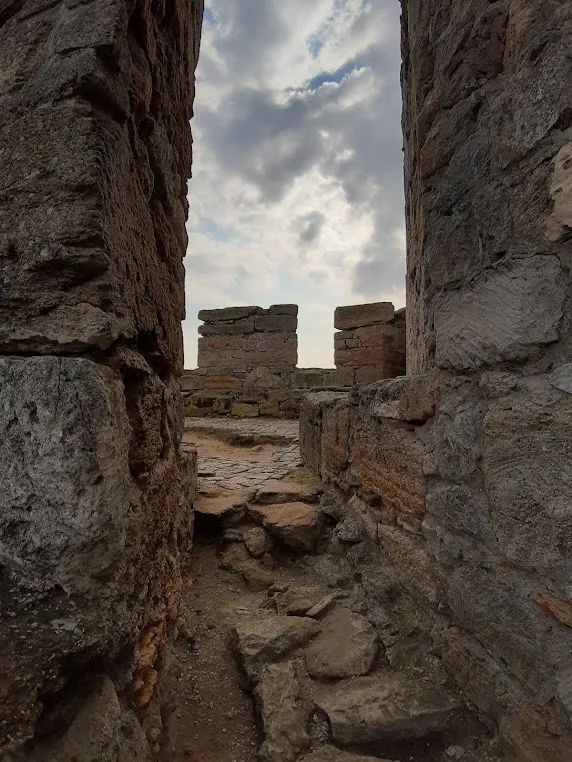
Walls: up to 10 ft (3 m) thick at the base; broad wall-walks (chemin de ronde) allowed artillery to be positioned along the curtain walls.
Moat: enclosed the fortress on three sides.
Masonry walls were supplemented by earthen ramparts.
Infrastructure: a Fortress-Town
Inside was a fully functioning fortified settlement:
- barracks (garrison of ~1,000 — Ottoman soldiers and Crimean Tatars)
- residence of the Turkish pasha
- powder magazines and arsenal
- mosque and bathhouse (hammam)
- water cistern
- water conduit — carrying water from springs several kilometres away
1771: Taken Without a Fight
In 1771, during yet another Russo-Turkish war, the fortress was occupied by Russian forces — almost without resistance. Under the Treaty of Küçük Kaynarca of 1774 it passed definitively to the Russian Empire.
Its strategic significance began to decline.
The Crimean War: Obsolete Guns Against a Squadron
Yeni-Kale was not untouched in the 19th century either.
1835 — a military hospital was opened within its walls.
1855 (Crimean War) — the fortress was partially repaired and coastal batteries were installed. On 12 May 1855 the Russian garrison engaged a British naval squadron. The old guns, however, could not find their mark. The command ordered the powder magazines to be blown up and the position abandoned.
1880 — Yeni-Kale lost its military significance entirely.
What Survives
Despite more than three centuries and several wars, the fortress has retained its main defensive structures: walls, bastions and remnants of towers and gates. In the second half of the 20th century it was listed among the protected architectural monuments.
Little-Known Details
- Goloppo was not simply an “architect” but a renegade: an Italian convert whose expertise the Ottoman Empire turned against Russia.
- The fortress blocked the Muscovite and later Russian Empire’s access to the Black Sea for over 70 years — a strategic achievement that explains why Russia was so determined to take it.
- After the 2014 occupation, Russia unlawfully declared Yeni-Kale a “monument of the cultural heritage of the peoples of the Russian Federation of federal significance.”
- The British squadron of 1855 entered the Kerch Strait through the very narrows the fortress had been built to guard. By then, however, the weapons had changed — and the fortress was powerless.
- According to Wikipedia, Yeni-Kale is the only monument of its kind in Ukraine — of Western European bastion art at the level of the early 18th century.
Conclusion
Yeni-Kale served its purpose well: it held the strait for 70 years. Then technology moved forward and the fortress was left behind. That is how it goes.
Today it stands on occupied land — and the best we can do is remember it and wait for de-occupation.
⚠️ TEMPORARILY OCCUPIED TERRITORY
The Yeni-Kale Fortress is located in the city of Kerch, which is on the territory of the Autonomous Republic of Crimea temporarily occupied by Russia. Since February 2014, Crimea has been illegally occupied by the Russian Federation. Visiting is impossible and dangerous for Ukrainian citizens. This article is purely informational and documentary in character — to preserve the memory of Ukrainian heritage sites.
Following the 2014 occupation, Russia unlawfully declared Yeni-Kale an “object of the cultural heritage of the peoples of the Russian Federation of federal significance.”