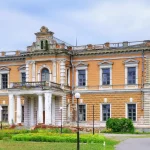
34 miles from Kyiv, almost right up against the Zhytomyr highway, stands an estate that remembers two great artists.
Pyotr Tchaikovsky was a guest here in 1889 and 1890, writing enthusiastic letters home. Mikhail Vrubel also visited — the estate’s owner bought his paintings and paid for his medical treatment.
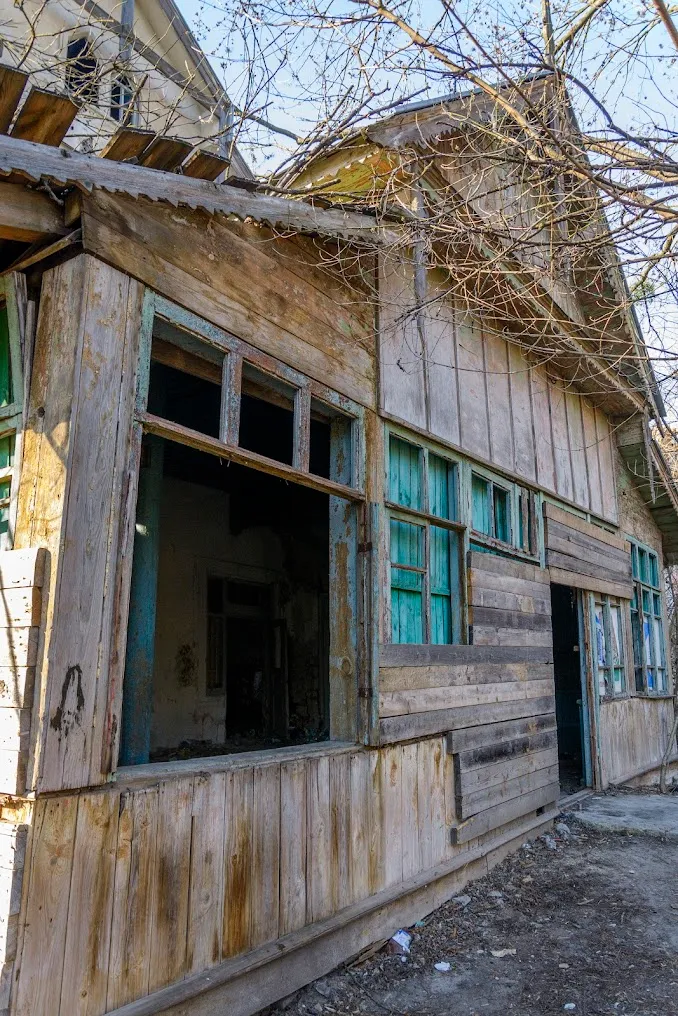
Today the house is structurally unsafe. But the spruce alley, planted with trees hauled in by oxen, still stands.
General Information
| What? | Description |
|---|---|
| Name | The von Meck Estate (the Kopyliv Estate) |
| Location | Kopyliv village, Makariv urban community, Bucha district, Kyiv Oblast |
| Distance from Kyiv | ~34 miles (~54 km, the M06 highway, Kyiv–Chop) |
| Estate purchased | 1882 |
| First house | 1888 (burned down in 1898) |
| Current house | early 1900s |
| Owner | Nikolai Karlovich von Meck (1863–1929) |
| Style | “dacha art nouveau” |
| Park | ~22 acres (9 ha) |
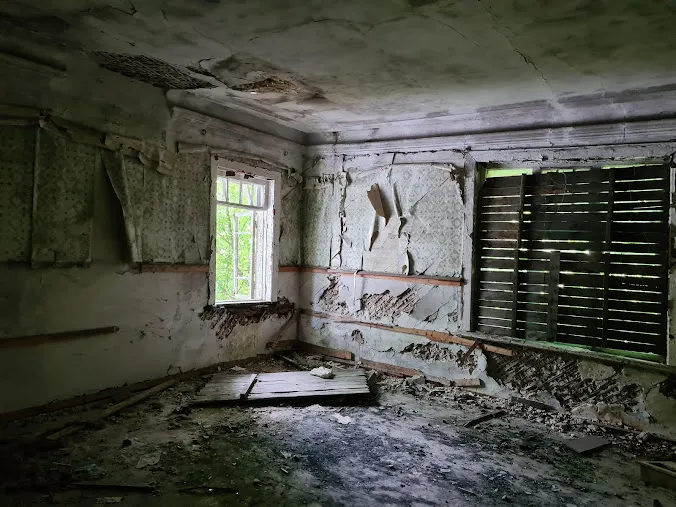
| Condition | structurally unsafe |
Nikolai von Meck: a Railway Baron and Patron
The estate’s owner was Baron Nikolai Karlovich von Meck (1863–1929), a member of a “dynasty of railway barons.” His father Karl built the first Moscow–Riazan railway. Nikolai himself also built and managed railways, and, alongside that, supported artists and musicians.
His mother, Nadezhda Filaretovna von Meck (1831–1894), is known as a patron and Tchaikovsky’s secret pen-friend: the two never met in person but corresponded for years. Tchaikovsky dedicated his Symphony No. 4 to her.
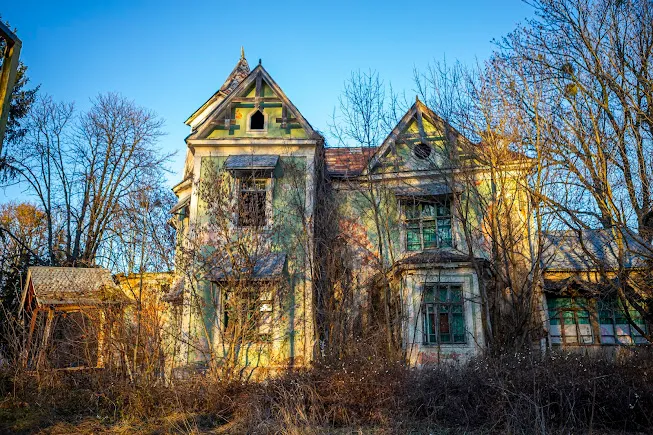
When Nikolai bought the Kopyliv estate for 150,000 rubles in 1882, his mother wasn’t pleased: in a letter to Tchaikovsky, she called it an “extraordinary expense” and worried Nikolai would “get completely tangled up in his estate.” Construction went ahead anyway, and in 1888, the first wooden house rose on the site, in a “dacha art nouveau” style: small towers, gables, bay windows, a large terrace, and an exterior staircase to the second floor.
Tchaikovsky in Kopyliv: Two Summers
In 1889 and 1890, Pyotr Tchaikovsky was a guest of Nikolai von Meck in Kopyliv. The composer came as a relative of the baron’s wife, Anna Davydova, and as someone close to the family through his long correspondence with Nadezhda.
Tchaikovsky was delighted:
“I liked Kopyliv immensely! The new house is extremely pleasant; the upper floor offers a charming, thoroughly rustic view” — he wrote in a letter.
And after his second visit: “I’ve come here almost directly from Kopyliv, where I spent about two days most pleasantly. Kopyliv pleased me this time just as much as it did last year.”
Vrubel and the Davydovs
Mikhail Vrubel also visited Kopyliv — Nikolai von Meck supported the artist financially, buying his paintings and paying for his medical care.
The estate also has ties to the Davydov family — descendants of the Decembrist Vasily Davydov, related to the von Mecks by marriage. This is the same family whose Kamianka estate Tchaikovsky frequently visited as a guest.
What Stood on This Land
The first house, built in 1888, burned down in 1898. A new brick house went up in the early 1900s — the one that still stands today.
The estate included:
- a house with towers and a metal-tiled roof
- a 22-acre (9 ha) park with spruce and linden alleys (the trees were hauled in wooden barrels by oxen)
- a fountain, an artificial pond with swans, a rose garden
- a summer theater, where musical evenings and performances were held
- a riding arena, a dairy farm, a horse-breeding operation, a mill, and a water tower
- two wells — one for farm use, one for residents
From the estate to the Brest-Litovsk highway (today’s M06), Nikolai built a road lined with poplars: their roots absorbed moisture and served as natural drainage.
Chronicle After 1910
1910 — Nikolai von Meck sold the estate to the Durasov family. More than thirty young people from Kopyliv followed the baron to Russia — he had arranged jobs for them at his enterprises.
After 1917 — nationalization. A succession of functions followed:
- an agronomy school
- a German headquarters (during the occupation years)
- a military hospital (1943–1945)
- a central district hospital (until 1954)
- Kopyliv secondary school (1954–1973)
- a branch of a music school, and the village council
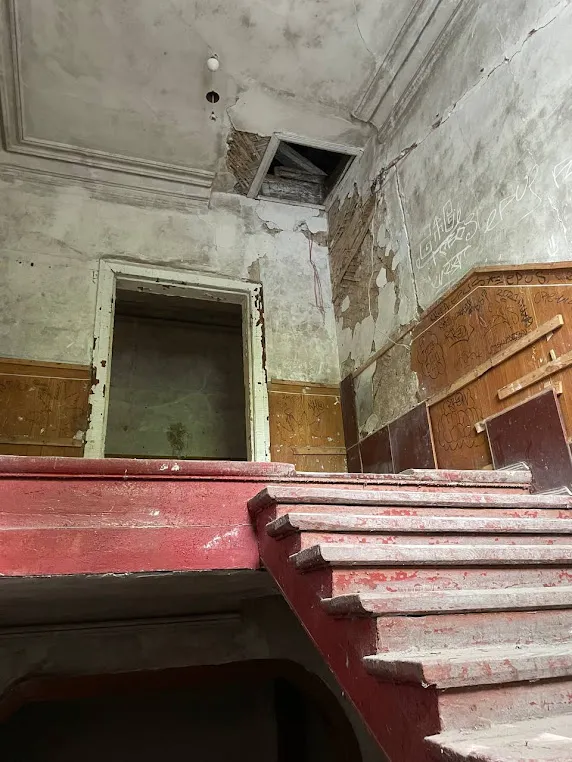
Traces of Soviet propaganda are still visible on the walls today.
What Survives Today
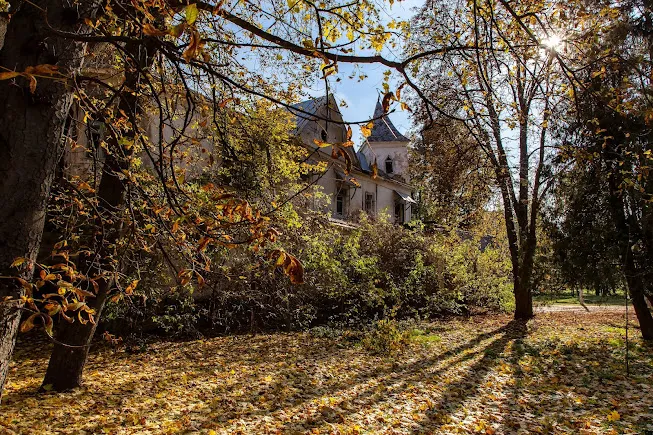
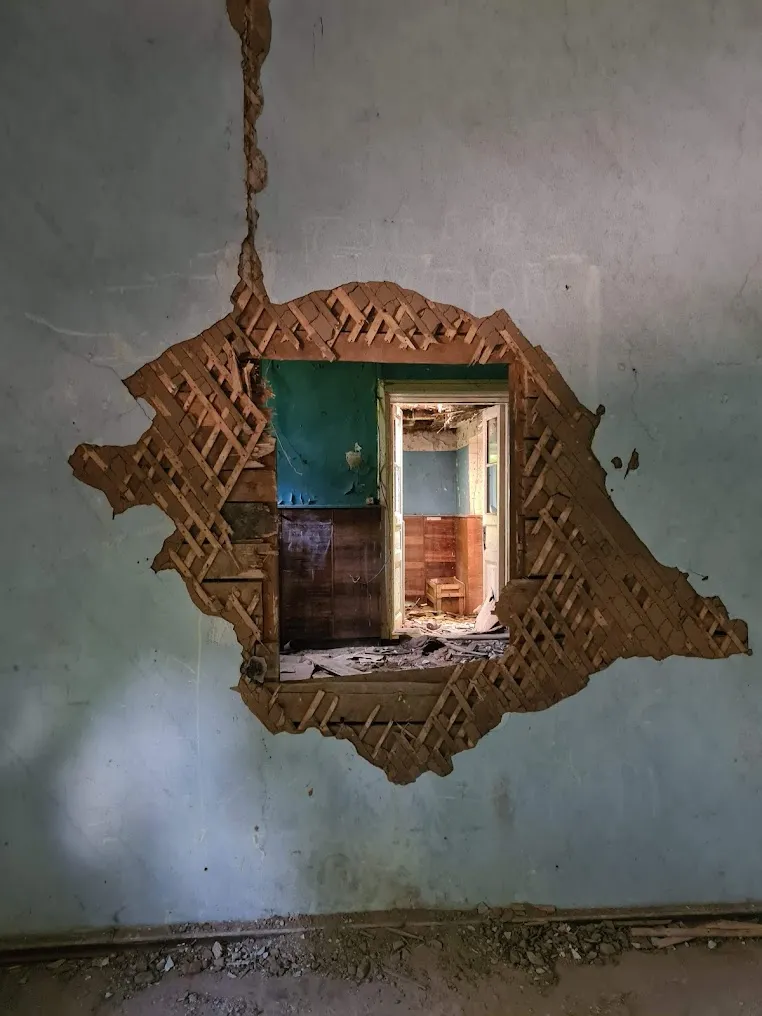
The house is structurally unsafe, but still standing. You can get inside, but understand the risks: the floors are unstable, and the ceilings could collapse.
In the park, the spruce and linden alleys survive, along with individual old trees. The ruins of the fountain and the manor pond remain. Of the dairy farm, only ruins remain; of the horse-breeding operation, nothing at all.
What to See Nearby and How to Fit It Into a Route
Kopyliv combines conveniently with other estates in the Makariv and Bucha districts. Rude Selo (~25 miles / ~40 km), with the Zaleski Palace, is a natural continuation of the route.
Practical Information
- Admission: free
- House: structurally unsafe; entry possible, but take care — unstable structures
- Park: accessible, the alleys survive
- Time needed: 30–60 minutes
- Coordinates: ~50.378967, 29.920639
How to Get There
- From Kyiv: the M06 highway (Kyiv–Chop), ~34 miles (~54 km); turn toward Kopyliv, then through the village
- Minibus: from the Kyiv bus station or Akademmistechko metro station
- Parking is on the roadside near the estate
Little-Known Details
- Nadezhda von Meck was the owner’s mother, not his wife — and she was against the purchase, as she wrote to Tchaikovsky.
- Tchaikovsky visited Kopyliv twice (1889 and 1890), leaving enthusiastic impressions both times, preserved in his letters.
- Vrubel also spent time here — Nikolai supported the artist financially.
- The first house, built in 1888, burned down in a 1898 fire. Today’s house is the second on this site.
- More than 30 local residents followed the baron when he sold the estate in 1910 — a sign of what kind of employer he had been for Kopyliv.
- The estate ties together three notable families at once: von Meck, Davydov (Decembrists), and Tchaikovsky.
Conclusion
The Kopyliv estate doesn’t impress with scale — it impresses with its connections.
A railway baron who built roads and supported artists. Tchaikovsky, who came here twice and praised the view from the window. Vrubel. A spruce alley hauled in by oxen in barrels.
A structurally unsafe building beside the M06 highway. But the alley still stands.