Krasnosilka sits on the left bank of the Southern Buh, in the southeast of the Vinnytsia region. An ordinary village. The railway stop “Henrykhivka” — a name that has kept its owner’s memory alive for 150 years after his death.
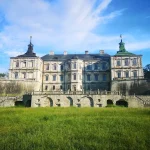
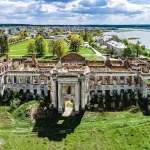
And the palace. Two stories, with terraces, a conservatory, and columns. One of the largest estates in the Bratslav district of its era.
General Information
| What? | Description |
|---|---|
| Name | The Lipkowski Palace |
| Location | Krasnosilka village, Bershad urban community, Haisyn district, Vinnytsia Oblast |
| Bank | left bank of the Southern Buh |
| Construction began | ~1820–1822 |
| Rebuilt | 1873 |
| Style | “Italian baroque” (per contemporary accounts) |
| Commissioned by | Henryk Lipkowski (1801–1871) |
| Status | architectural monument of local significance; structurally unsafe |
The Lipkowskis in Krasnosilka: Two Generations
The Lipkowski family, bearing their own coat of arms, has been documented in Poland since the 16th century. They came to Podillia in the early 19th century.
In 1812, Józef Adolf Lipkowski bought Krasnosilka, Khmarivka, and Zavadivka. The estate’s true builder was his son — Henryk Lipkowski (1801–1871).
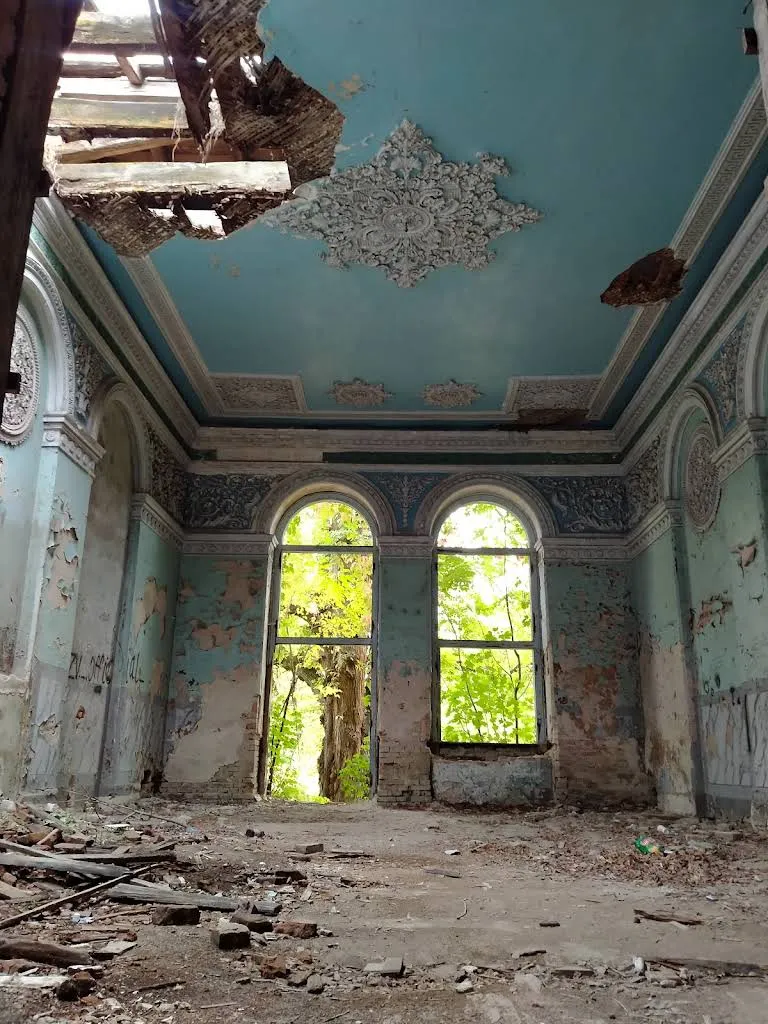
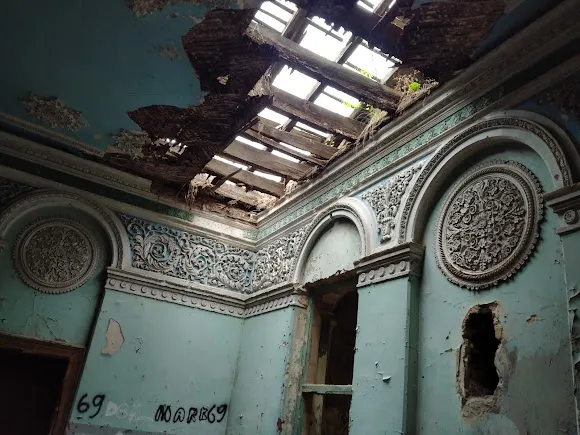
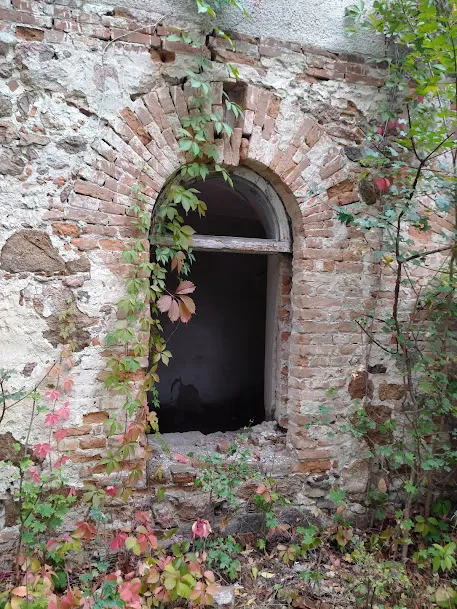
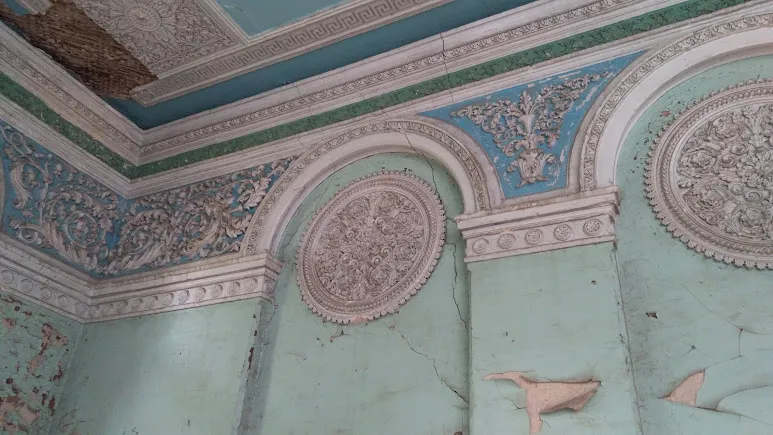
Henryk married in 1823 and settled in Krasnosilka, but he had begun building the estate even before his wedding — around 1820–1822. On a rise above the Buh, a two-story brick palace went up, in what contemporaries described as “Italian baroque”: a gabled roof over the main building, a single-slope roof over the veranda, columns on the veranda and the left side of the façade, arched spans, and an enclosed terrace.
In 1873, the estate underwent a rebuild. A conservatory was installed behind closed windows in the right wing of the house.
The Sugar Refinery and the Estate’s Rise
Henryk Lipkowski was not just a landowner but an industrialist.
In 1844, he built a sugar refinery in Krasnosilka — an enterprise that shaped the region’s social infrastructure right up to today. The refinery was repeatedly rebuilt and long outlived its founder.
Thanks to the combination of his agricultural holdings, the refinery, and family connections, by the second half of the 19th century, the Lipkowski estate had become the largest in the Bratslav district, and a symbol of the family’s local standing.
In the owner’s honor, the railway stop near Krasnosilka was named “Henrykhivka” — a name it still carries today.
After Henryk
After Henryk’s death, the estate passed to one of his sons, who led a more dissolute life. Eventually he sold the palace to another family member, gifting the collections to his sister-in-law. Researchers attribute this to financial difficulties.
The Lipkowski family lived in Krasnosilka right up until the revolutionary events of the early 20th century.
Soviet and Wartime Fate
After the Bolsheviks came to power, the palace building was used for educational and official institutions.
During the Nazi occupation, it housed a command post. During the fighting for Krasnosilka, a burning Soviet bomber crew directed their aircraft toward that command post — and it crashed beside the palace. The airmen are buried in the estate park — the site is preserved to this day.
In the postwar period, up to the 1980s, the estate served as a school. After that, the building began to decline.
An Attempted Revival in the 1990s
In the late 1990s, the then-head of the local collective farm, Borys Dementiiovych Bulka, began restoring the palace with his own funds and effort: reroofing it, repairing rooms, and installing a heating system.
This attempt remains the only real restoration effort of the entire post-Soviet period. It was never continued.
Current Condition
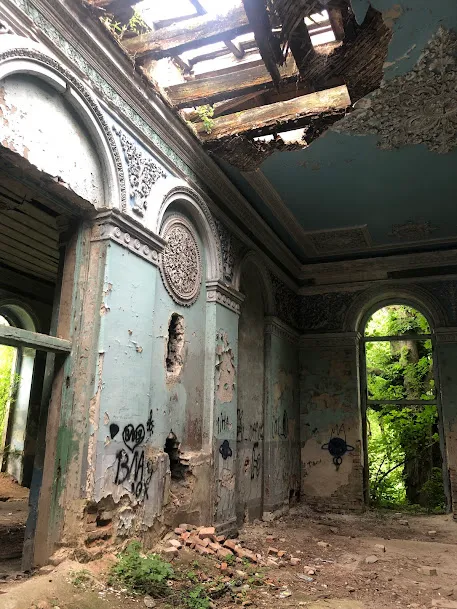
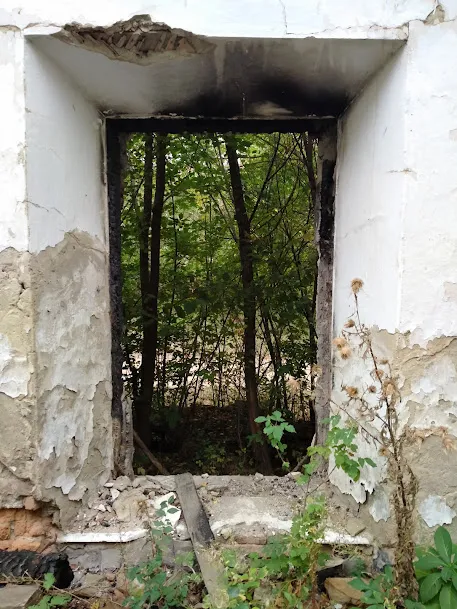
As of 2026, the building is effectively structurally unsafe — ruins, though the structure is still standing. No windows remain. The park survives in part.
What to See Nearby
Krasnosilka lies in the Bershad area, a remote corner of the Vinnytsia region. Nearby:
- Bershad (~14 miles / ~22 km) — the district center, with its own landmarks
- The Southern Buh River — a scenic floodplain, fishing, natural landscapes
- The “Henrykhivka” railway station — a detail of the era in its own right
Practical Information
- Admission: free, unfenced
- Condition: structurally unsafe; exterior viewing is safe, going inside is not
- Park: partly accessible
- Time needed: 20–40 minutes
- Rail: the “Henrykhivka” station has a suburban train to Vinnytsia 4 times a week
How to Get There
- From Bershad: ~14 miles (~22 km) north, along the Buh
- By rail: Vinnytsia → Henrykhivka station (~14 miles / ~22 km from Krasnosilka)
- The road to Krasnosilka is paved; parking is on the roadside near the palace
Little-Known Details
- The railway stop “Henrykhivka” carries Henryk Lipkowski’s name, preserving 150 years of memory of its owner.
- The Soviet airmen who crashed nearby during the fighting are buried in the palace park — an unusual combination of a noble estate and a wartime memorial.
- Henryk began building the estate before his marriage — meaning he was already constructing his own residence as a young man of about 20.
- The 1844 sugar refinery outlived every owner and kept operating well into the 20th century, repeatedly rebuilt.
- The only real restoration attempt was a private individual’s initiative (the collective farm chairman) in the late 1990s, not a state program.
Conclusion
The Lipkowski Palace isn’t the Vinnytsia region’s most striking landmark. But it holds a few details that make it worth the stop: the name of a railway station, the graves of airmen in the park, and a 19th-century sugar refinery that outlived both its owner and the estate itself.
A quiet village on the bank of the Buh — and a palace missing only one decision: to restore it.