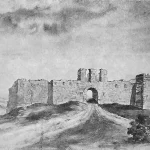
From the mid-15th century to the late 18th century — 350 years — Chornokozyntsi Castle served as the summer residence of the Catholic bishops of Kamianets.
Not princes. Not magnates. Bishops.
They came here in summer to rest away from the city — and kept a garrison at the castle so that their rest wouldn’t be interrupted by Tatars.
When Catherine II confiscated the castle from the Church in 1795, she gave it to Skavronska, niece of Potemkin.
General Information
| What? | Description |
|---|---|
| Name | Chornokozyntsi Castle |
| Address | Chornokozyntsi village, Kamianets-Podilskyi district, Khmelnytskyi Oblast |
| Coordinates | 48°39′33″N, 26°16′55″E |
| Setting | on a rise above the left bank of the Zbruch |
| Built | late 14th–early 15th century |
| Material | marble stone |
| Two baileys | an older and a newer one, separated by a wall with a gate |
| Owner for 350 years | the Kamianets Roman Catholic episcopal see (mid-15th–late 18th century) |
| 1795 | confiscated by Catherine II, gifted to Skavronska |
| 1578 | granted Magdeburg Law (as a town at the time) |
| Condition | ruins |
Marble Above the Zbruch
Chornokozyntsi Castle is one of the oldest in Podillia: late 14th–early 15th century.
A rare detail: the castle was built of marble. Podillia’s castles are mostly sandstone or limestone — marble is uncommon here. The material points to serious resources and serious intent.
The castle stands on a rise above the Zbruch River. The Zbruch isn’t just a scenic river — it’s a historical border: between the Polish-Lithuanian Commonwealth and Turkey, then between Russia and Austria, then between the USSR and Poland. Whoever held the castle above the Zbruch controlled the crossing.
Structure: two baileys — an older and a newer one, separated by a wall with a large gate. The castle is surrounded by a deep moat.
350 Years as an Episcopal “Dacha”
From the mid-15th century, Chornokozyntsi became the property of the Kamianets Roman Catholic episcopal see. The bishops didn’t live here permanently — it was a summer residence: cooler than the city, quieter, with a view of the Zbruch.
Even so, the castle remained defensive: a garrison, fortifications, a moat. The bishops didn’t forget that 17th-century Podillia wasn’t the safest place for a holiday.
1578 — Chornokozyntsi received Magdeburg Law. A town at the time, not a village.
1672–1699 — along with all of Podillia, Chornokozyntsi fell under Ottoman occupation. The castle survived.
1699 — return to Poland. The bishops came back.
Catherine, Potemkin, and Skavronska
1795 — the Third Partition of Poland. Podillia passes to Russia. Catherine II carries out secularization: church estates are confiscated.
Chornokozyntsi Castle, with all its lands, went to the treasury, then was immediately gifted to Skavronska, niece of Grigory Potemkin, Catherine’s favorite.
1815 — the castle becomes a private family estate. It remains one until 1917.
From the bishops, to Potemkin’s clientele, to private owners. Each transfer was a consequence of major geopolitics, not personal choice.
What Remains
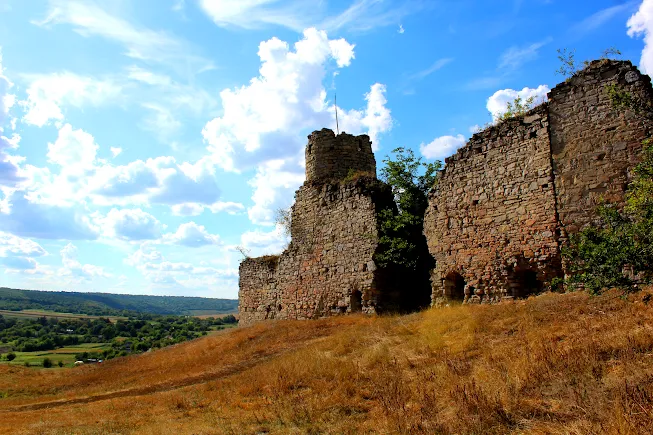
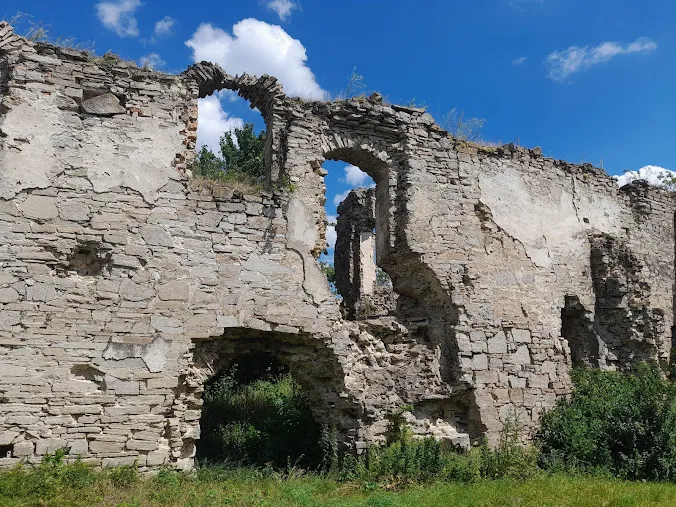
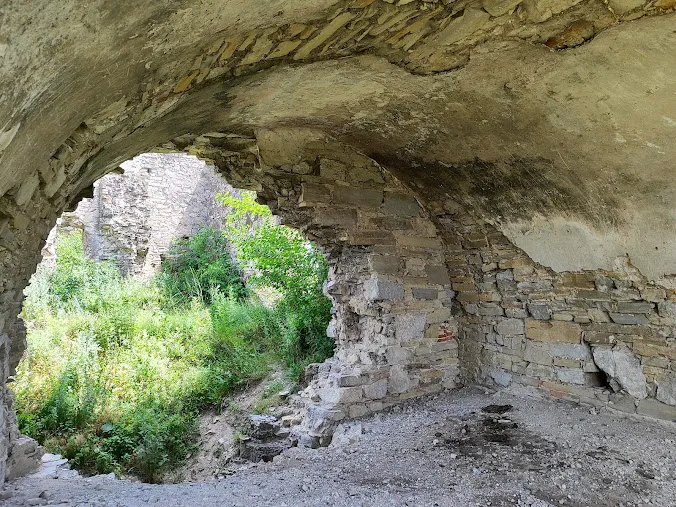
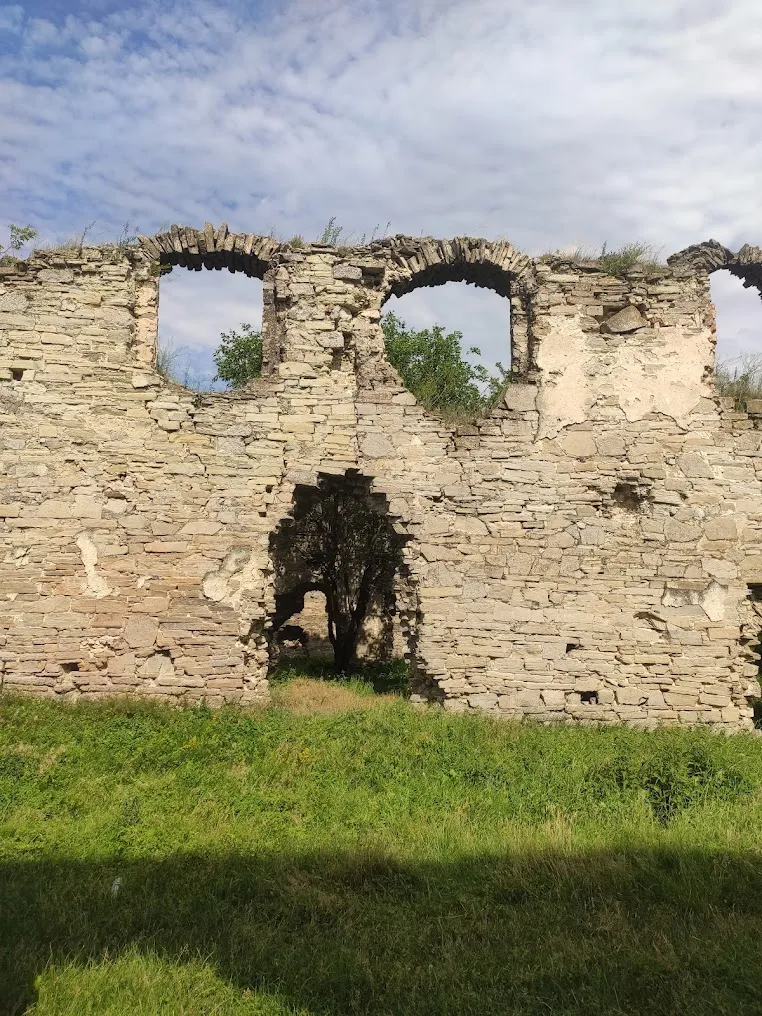
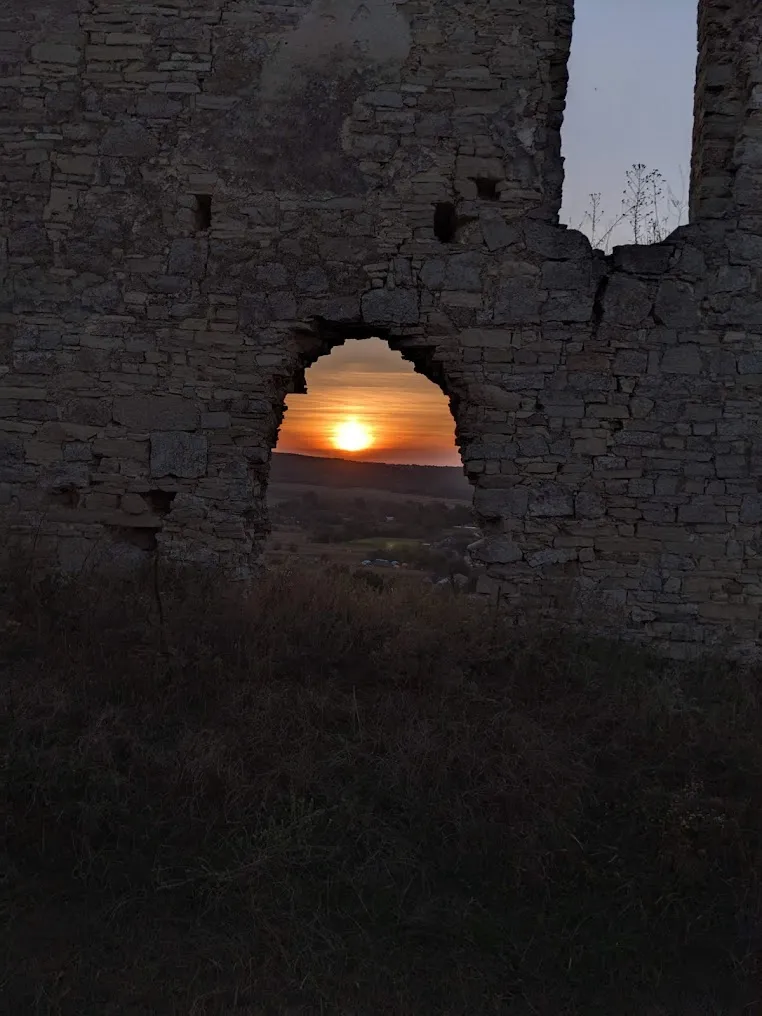
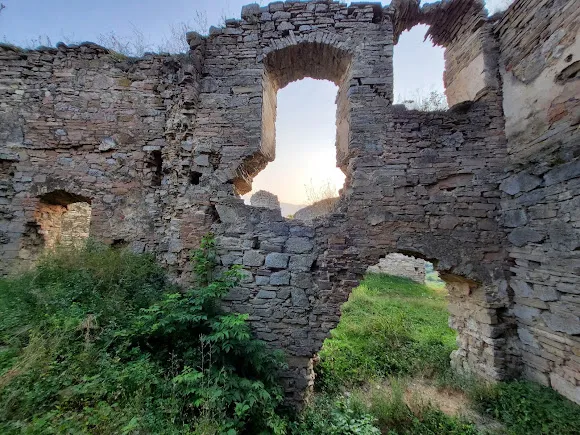
Ruins. Fragments of the walls of both baileys. The outline of the moat.
The castle stands on a hill above the Zbruch — and the site alone is enough to impress, even without restored walls.
What Not to Expect
No museums, no plaques, no ticket booth. Open ruins on a hill. If you’re coming for a “castle,” you’ll see walls. If you’re coming for the view of the Zbruch, you won’t be disappointed.
What to See Nearby and How to Fit It Into a Route
Chornokozyntsi is 12 miles (20 km) from Kamianets-Podilskyi, along the Zbruch.
- Kamianets-Podilskyi Fortress (~12 miles / ~20 km) — 11 towers and the Smotrych canyon
- Skala-Podilska (~16 miles / ~25 km) — a castle and ruins above the Zbruch
- Medzhybizh (~31 miles / ~50 km) — the Sieniawski castle and the grave of the Baal Shem Tov
Practical Information
- Admission: free
- Condition: ruins
- How to get there: from Kamianets-Podilskyi, bus or car, ~12 miles (~20 km)
- Time needed: 20–40 minutes
Conclusion
For 350 years, bishops came here in summer. One visit from Catherine II — and the castle went to Potemkin’s niece.
Marble above the Zbruch. A border that shifted five times.
The castle still stands. The bishops no longer come.