Sumy region is not about palaces — and that’s true.
It’s about forests, sugar factories, and long roads between villages of Sloboda Ukraine. That’s why when a brick two-story house with a marble slab on the facade appears among the trees of Rogizny, it feels strange. It’s as if you’ve stumbled upon someone’s completed, but not yet lived, story.
General information
| What? | Description |
|---|---|
| Name | The Pryanishnikov estate |
| Location | Rogizne village, Sumy district, Sumy region. |
| Arrangement | on the banks of the Rogizna River |
| First mention | April 24, 1703 |
| The first manor house | 1851–1857 (Kukol-Jasnopolski) |
| The current palace | completed in 1890 (O.P. Pryanishnikov) |
| Composition of the complex | palace, servants’ house, farm buildings, park, church, crypt, sugar factory, distillery, mill, cattle shed |
Three Families and One Place
Rogizne was first mentioned in 1703, when Andriy Gerasymovych Kondratiev bought a fish pond and a farm here. Until 1765, the estate was located in the territory of Sloboda Ukraine.
In the 1840s, the owner was a landowner, Guard Captain Ivan Andriyovych Kukol-Yasnopolsky. His family owned 5,872 dessiatines of land in the county – in Pavlovka, Kuyanivka, Vorozhba and other villages.
During Kukol-Yasnopolsky’s reign, the first manor house was built here (1851–1857) – a stone two-story house with two balconies, 31 arshins long. And in 1857 – a brick church of Ivan the Warrior, where a parish school was opened in 1889.
After Ivan Andreyevich’s death, the estate passed to his widow Eleonora Kukol-Yasnopolskaya. In 1859, she leased the sugar and brick factories to Ivan Gerasimovich Kharytonenko, a man who would become one of the most famous sugar magnates of the Slobozhanshchyna region in a few decades.
The next owner was Alexander Petrovich Pryanishnikov, a nobleman from Kuyanivka, who married Elizaveta Ivanovna Kukol-Yasnopolskaya (1861–1942). The estate came with her.
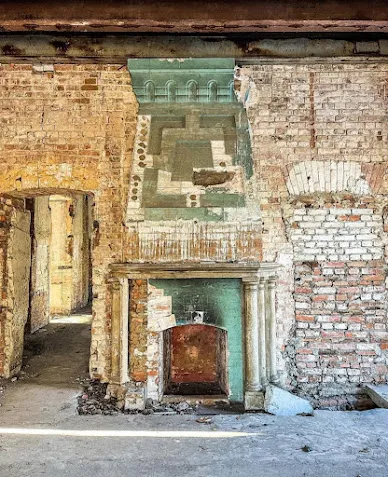
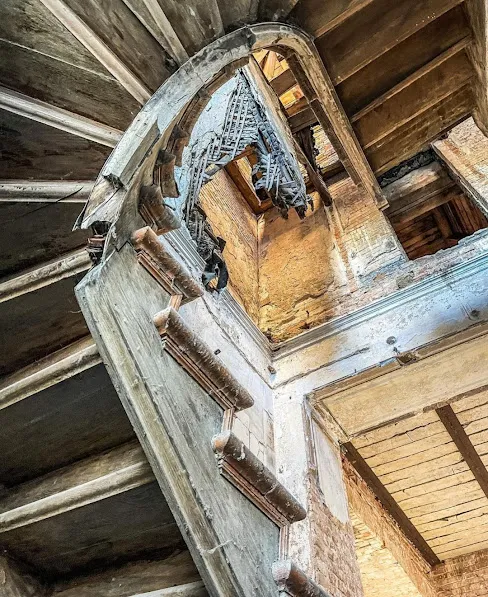
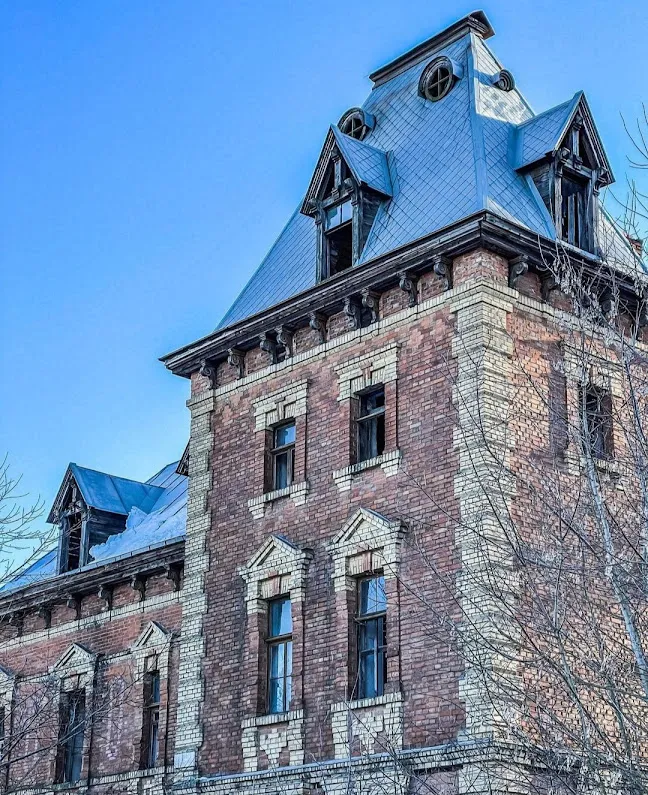
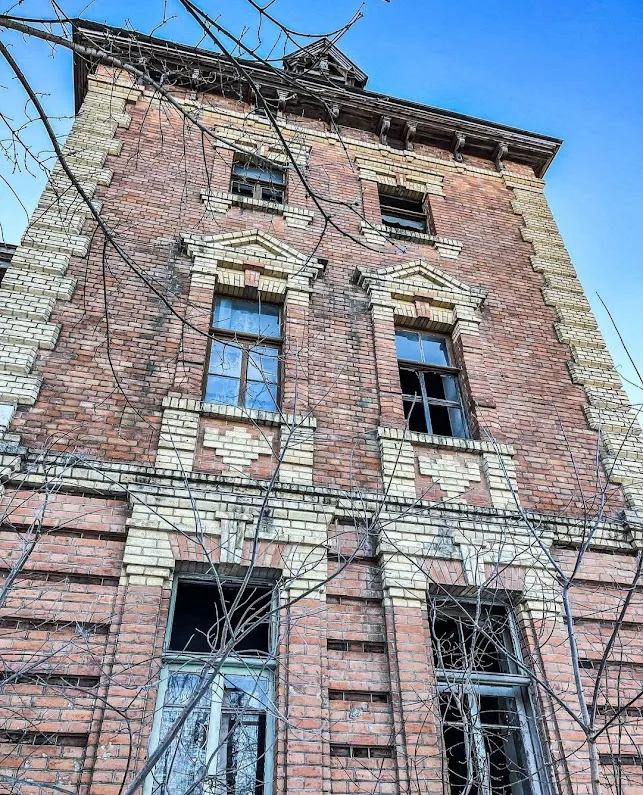
Pryanishnikov built a new palace, completed in 1890. This is evidenced by a marble plaque on the main facade: “Pryanishnikov is a builder.” The building is brick, two-story with a basement.
The estate composition: not just a palace
The estate in Rogizne is not just a residential residence. It is a full-fledged industrial and estate complex:
- palace (1890)
- house for servants
- outbuildings
- park
- church of Ivan the Warrior (1857)
- family crypt
- sugar factory – in the first year it produced 20 thousand poods of sugar and attracted attention at the World Exhibition; later 25 thousand poods, 300–400 permanent workers
- distillery
- cattle farm
- steam mill
- saltpeter factory
- brick kiln
It was a farm that kept the entire environment in operation.
What happened in the 20th century?
1917–1920 — the church and cemetery were looted.
1919 — the estate was looted and nationalized.
1932–1933 — a sanatorium for Jewish children operated in the buildings.
1941–1943 — a sanatorium for German pilots.
Postwar period — a 24-hour kindergarten, then recreation centers of the “Hunters’ Association” and the “Fishermen’s Association”. Later, the facility was transferred to the balance of the OJSC “SSPA named after M.V. Frunze”.
What to see nearby and how to include it in your itinerary
Rogizne is located in the Sumy district, near the regional center. The estate can be included in the itinerary of tourist estates of the Sumy region:
- Trostyanets (~60 km) — Nataliya Park, Koenig Estate, Chocolate Museum
- Yunakivka (~30 km) — Lishchynsky Estate
- Sumy (~20 km) — Sukhanov Estate, Local History Museum
Practical information
- Entrance: free for external inspection
- Condition: partially preserved; building is used or abandoned – check on site
- Park: passage possible
- Time for inspection: 20–40 minutes
- Distance from Sumy: ~20 km
Little-known details
- The marble plaque on the facade of the palace “Pryanyshnikov – builder” is one of the rare examples when the owner left his name on the building as a builder, and not just a landlord.
- Ivan Kharitonenko – the future sugar magnate and the greatest patron of Sumy region – rented a sugar factory here in 1859, even before his fame.
- The estate was successively a sanatorium for Jewish children (1932–33) and a sanatorium for Nazi pilots (1941–43) – polar roles over the decades.
- The first manor house was built by the Kukol-Yasnopolskys in 1851–1857 – Pryanishnikov built a second building on the same site.
- Rogizne is first mentioned in 1703 – that is, the estate has existed for over 320 years in one form or another.
Висновок
The Pryanishnikov estate is not about splendor. It is about what management looks like over time: the first bought a pond, the second built a church and a factory, the third put up a marble plaque with his own name. Then others came – and each decade left its own layer.
Rogizne – a quiet stop on the way to and from Sumy.