From 1540 to 1726 — nearly 200 years — Medzhybizh belonged to one family: the Sieniawskis.
During that time, the Tatars stormed the castle dozens of times. Not once did they take it.
In 1672, the Ottomans occupied the town — but not by battle, through Poland’s external surrender. The castle survived that too.
And 44 miles away, as the crow flies, stands the Kamianets-Podilskyi Fortress — between them, in the 16th–17th centuries, ran a real line of Podillia’s defense.
General Information
| What? | Description |
|---|---|
| Name | Medzhybizh Castle (“the White Swan”) |
| Address | 1 Zamkova St., Medzhybizh urban-type settlement, Khmelnytskyi district, Khmelnytskyi Oblast |
| First fortifications | 14th century (the Lithuanian period) |
| Stone castle | formed in the 15th–16th centuries |
| Type | bastion-type defensive castle-residence |
| Towers | 5 |
| Wall thickness | up to 13 ft (4 m) |
| Main owners | the Sieniawski family (1540–1726), the Czartoryski family (after 1726) |
| Status | architectural monument of national significance; the “Medzhybizh” State Historical-Cultural Reserve |
| Admission | paid |
Why Exactly Here
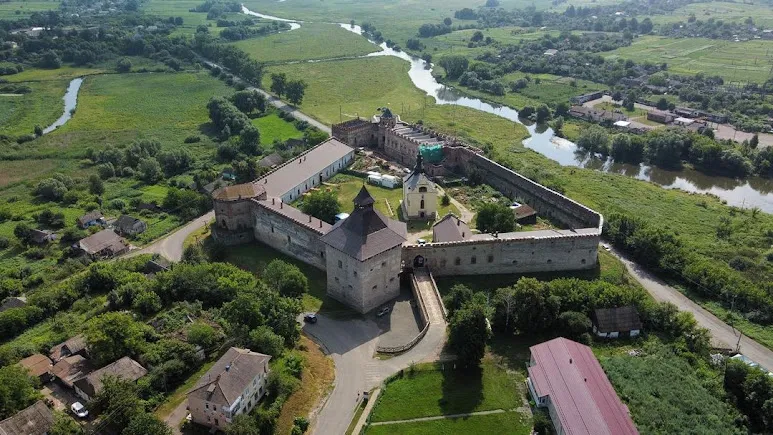
Medzhybizh stands where the Southern Boh receives the Buzhok. Water closes off the space on three sides — a natural fortification hard to plan on purpose. The castle “seals” the single accessible approach by land.
This wasn’t just a convenient location. In the 15th–17th centuries, one of the main routes of Tatar raids into Podillia — the so-called “Black Road” — passed through here. Whoever controlled Medzhybizh controlled that artery.
The Sieniawskis: 200 Years on Guard
From 1540 to 1726 — nearly two centuries — the castle and town belonged to the Sieniawski family, one of the most powerful magnate dynasties of the Polish-Lithuanian Commonwealth.
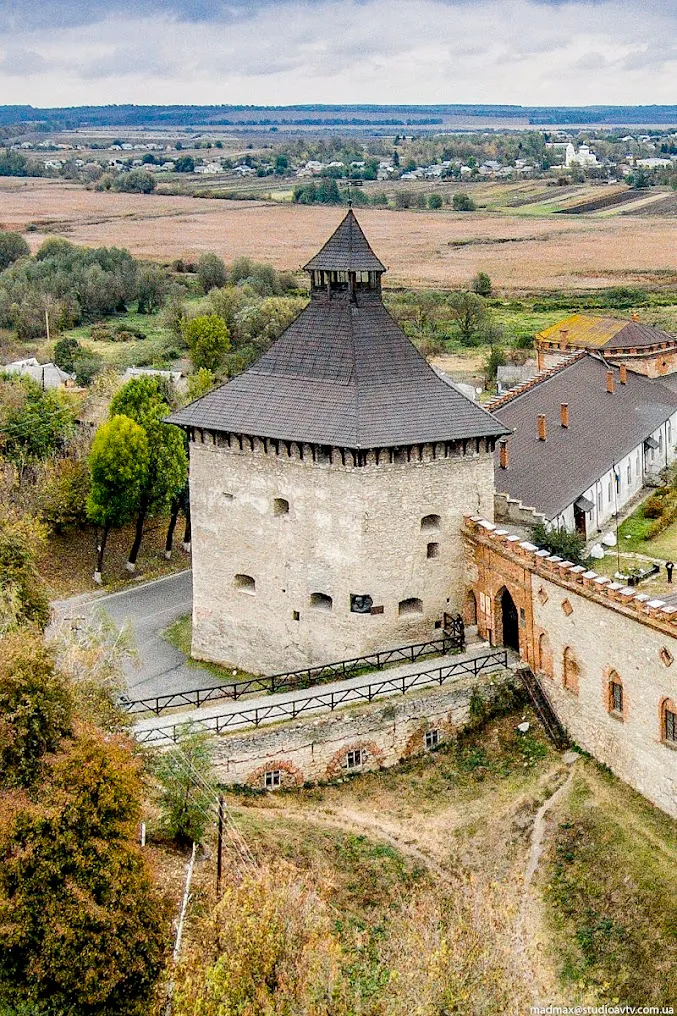
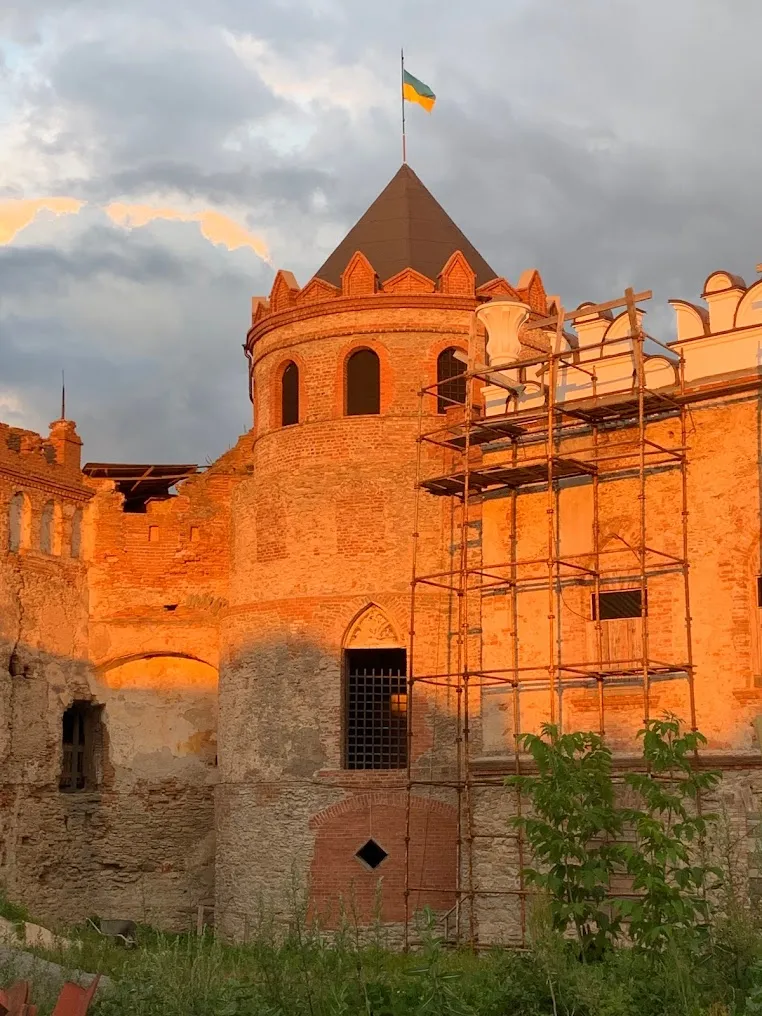
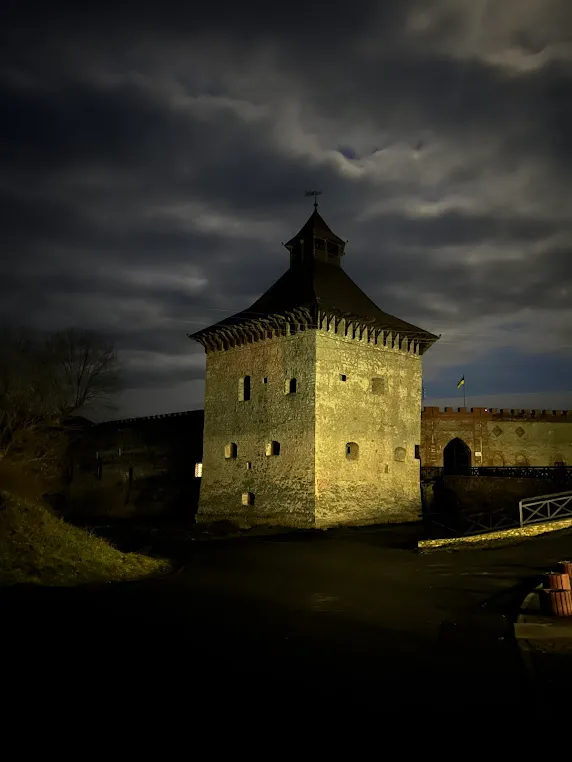
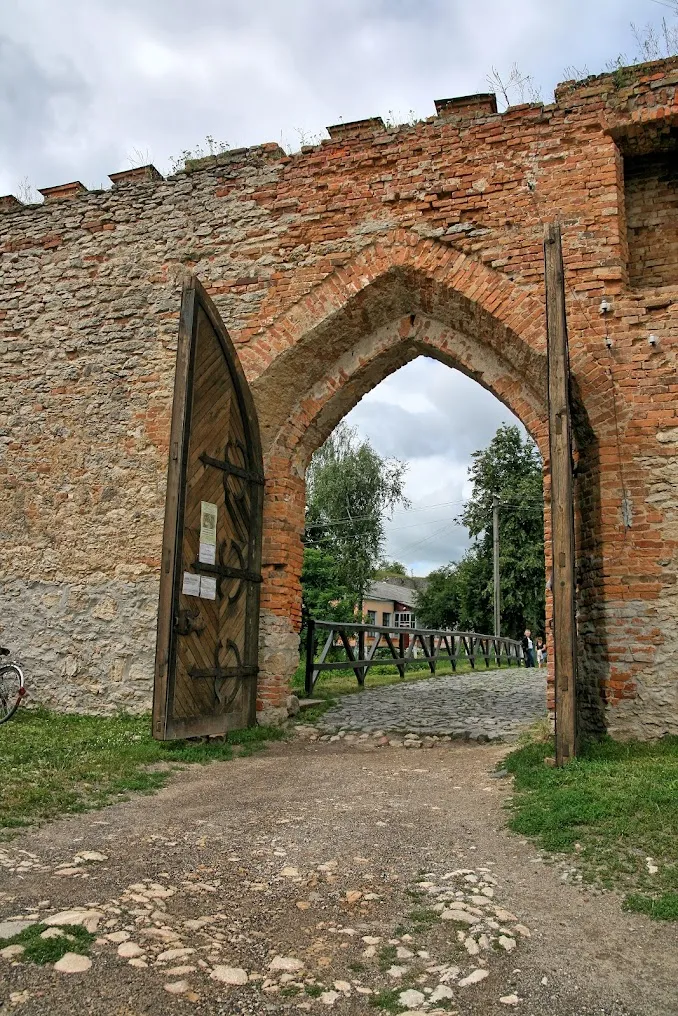
Under their rule, the castle took its final form: five towers, massive walls up to 13 ft (4 m) thick, a bastion system. It maintained a permanent garrison.
In 1648, Bohdan Khmelnytsky’s Cossack army captured Medzhybizh. The town suffered, but the castle held.
In 1672, under the Treaty of Buchach, Poland ceded Podillia to Turkey. Medzhybizh — along with all of Podillia — became Ottoman territory for 27 years. Again, not by storm, but by diplomacy.
In 1699, under the Treaty of Karlowitz, Podillia returned to Poland.
When the male line of the Sieniawski family died out in 1726, Medzhybizh, along with dozens of other estates, passed to the Czartoryski family through Maria Sophia Sieniawska. From then on, the castle became less a fortress and more a residence.
The Baal Shem Tov: an Unexpected Neighbor
Around 1740, Israel ben Eliezer — a spiritual teacher known as the Baal Shem Tov (Besht) — came to Medzhybizh. He settled here with his disciples, founded a community, and died in Medzhybizh in 1760.
His grave in the Jewish cemetery became one of the most important sites of Hasidic pilgrimage. Every year on Shavuot, thousands of Hasidim travel here from around the world.
So one small town holds all at once: the Sieniawski fortress, the ruins of a church blown up by the Bolsheviks in 1962, and the grave of the founder of Hasidism. Three civilizations within a few hundred meters of each other.
What’s Inside Today
The castle functions as the “Medzhybizh” State Historical-Cultural Reserve. Most of the complex is open:
- towers and walls (partly accessible for climbing)
- the Museum of the History of Medzhybizh (weapons, artifacts, maps)
- the Museum of Cossack History
- the inner courtyard
- restored sections of the buildings
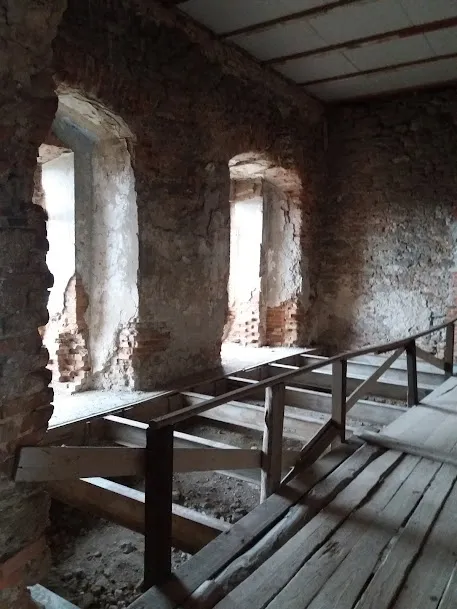
Part of the buildings are still under restoration — some rooms remain closed.
What Not to Expect
The castle isn’t dramatic ruins, nor a fully restored site. It’s something in between: parts rebuilt and open as a museum, parts still in a “raw” state. If you’re looking for a “toy-like” restored castle in the Polish or Czech style, this isn’t it.
One more thing: Medzhybizh is a small town. There are almost no restaurants near the castle. Better to bring food, or eat in Khmelnytskyi before or after.
What to See in Medzhybizh and Nearby
Medzhybizh itself is a half-day route on its own:
- the Grave of the Baal Shem Tov and the Jewish cemetery — ~660 ft (~200 m) from the castle; thousands of pilgrims during Shavuot, quiet otherwise
- the synagogue and pilgrims’ guesthouse (built in the 2000s)
- the ruins of the Holy Trinity Church (~330 ft / ~100 m from the castle) — blown up in 1962, only the walls remain
From Medzhybizh, a natural route continues to: Kamianets-Podilskyi (~50 miles / ~80 km), Skala-Podilska (~25 miles / ~40 km), Khotyn (~75 miles / ~120 km).
Practical Information
- Address: 1 Zamkova St., Medzhybizh urban-type settlement
- Admission: paid; separate tickets for the grounds and the museums
- Hours: confirm on the reserve’s website (seasonal changes)
- Time needed: 1.5–3 hours (castle only); 3–4 hours (castle plus cemetery plus church)
- Parking: large, free, near the castle
- From Khmelnytskyi: ~19 miles (~30 km) via the Vinnytsia highway (~35 min)
- From Vinnytsia: ~44 miles (~70 km)
Conclusion
Medzhybizh Castle resists easy summary. It isn’t the best preserved, nor the most dramatic to look at. But it’s one of the few places in Ukraine where one family held the defense for two centuries straight, where the grave of the founder of Hasidism stands, and where, a few steps away, lie the ruins of a church blown up under Soviet rule.
Three layers of the same land, impossible to capture in a single phrase.