In 1685, Austrian forces surrounded Palanok Castle.
The defense was led by a woman — Ilona Zrínyi, widow of Ferenc I Rákóczi. The Austrians waited outside the walls for three years. She never surrendered.
When the castle finally fell in 1688, the terms of capitulation were relatively lenient. Ilona Zrínyi was exiled along with her children. One of those children was Ferenc II Rákóczi.
Fifteen years later, in 1703, he returned and stormed the same castle in response.
General Information
| What? | Description |
|---|---|
| Name | Palanok Castle (Mukachevo Castle) |
| Address | Zamkovyi Lane, Mukachevo, Zakarpattia Oblast |
| Coordinates | 48°25′50″N, 22°41′15″E |
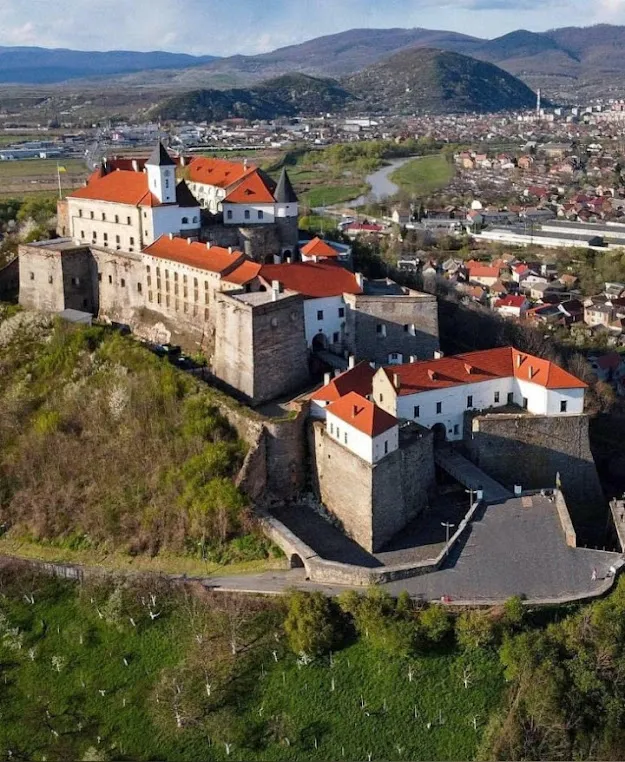
| Hill height | 223 ft (68 m), of volcanic origin |
| Area | ~3.4 acres (13,930 m²) |
| Three levels | Upper, Middle, and Lower Castle |
| Rooms | 130 |
| Well | 279 ft (85 m), cut into the rock |
| Status | architectural monument of national significance (No. 168); Mukachevo Historical Museum |
| Admission | paid |
| Hours | daily 9:00 a.m.–6:00 p.m. (until 7:00 p.m. in summer) |
Names and Origins
“Palanok” isn’t the name of an owner. It’s a type of defensive structure: a wooden palisade enclosing a moat around a fortification. Exactly this kind of palanok once surrounded the castle hill in Mukachevo, before stone walls replaced it.
“Mukachevo,” by tradition, comes from the word “muka” (“torment”). When the volcanic hill was cut to dig the well and level the terraces, workers reportedly “suffered” in the literal sense. A folk legend, but an evocative one.
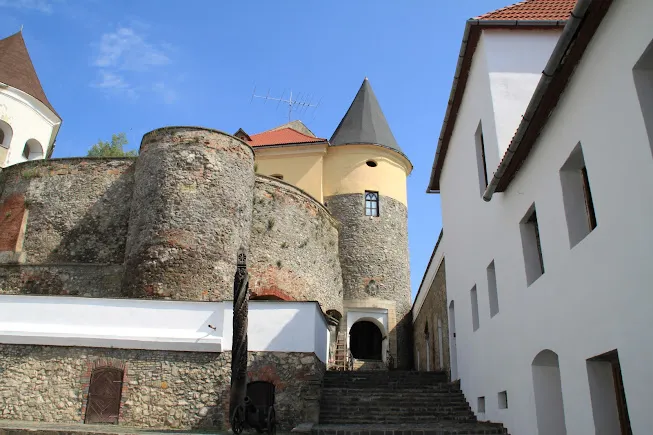
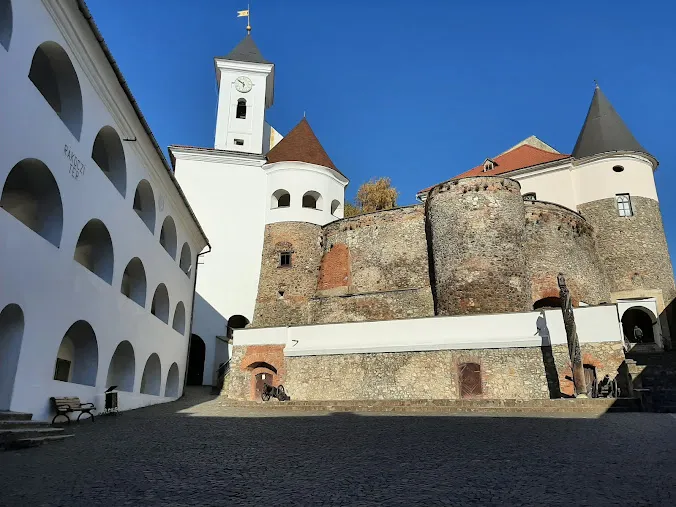
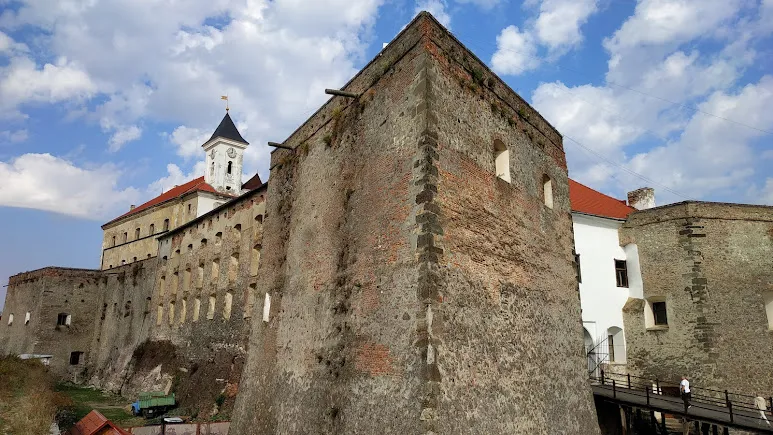
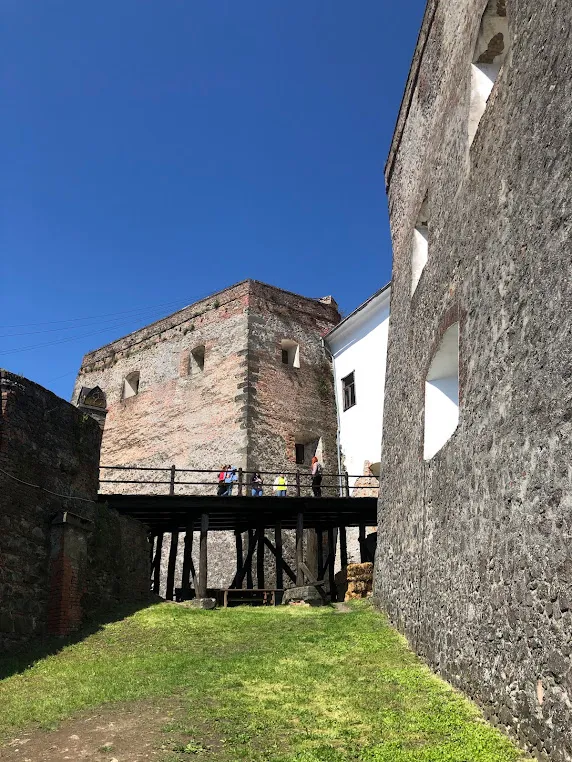
The castle is mentioned as early as the 11th century, in the era of Hungarian king László I. A stone keep-tower stood at the summit of the volcanic hill. It was expanded upon in every century since.
Fedir Koriatovych and the 279-Foot Well
In 1394, Fedir Koriatovych, a Podillia prince driven from his lands, arrived in Mukachevo. Hungarian king Sigismund granted him the town.
Koriatovych governed for nearly 20 years — and left behind something still striking today: a 279-ft (85 m) well, cut through solid volcanic rock at the heart of the castle hill. Inside, steps were carved so people could descend into it. According to tradition, a secret passage led from the well to the town. This well kept the castle supplied with water through the longest sieges.
He also built the Upper Castle, mounted 164 cannons, and raised a 33-ft (10 m) defensive wall around the perimeter.
After the Koriatovych line died out between 1414 and 1418, the castle passed to János Hunyadi — a Hungarian military commander and father of the future king Matthias Corvinus.
The Rákóczis: a Century of One Family
In 1633, the castle was acquired by the Transylvanian prince György I Rákóczi. His dynasty ruled here for nearly 100 years.
György’s wife, Zsuzsanna Lorántffy, after his death (1648), completed the Middle and Lower Castles. The architect was Sébastien Le Prestre de Vauban — the same engineer who built fortifications for Louis XIV.
In 1649, negotiations took place at the castle between envoys of Bohdan Khmelnytsky and György II Rákóczi over joint action against Poland. Two major powers came to terms beneath these walls.
Then came Ilona Zrínyi’s defense (1685–1688), the Austrian capture, reconstruction, and a new siege — this time by Ferenc II Rákóczi, from 1703 to 1711.
In 1711, Ferenc II lost and fled — ironically, to Turkey, where he died. A man born in the castle spent his entire adult life fighting for it, and ended his days in Constantinople.
Prison: 20,000 in 100 Years
After 1711, the castle lost its defensive importance.
In 1782, a political prison of the Austrian monarchy opened here. Over more than 100 years, it held more than 20,000 prisoners.
In July 1847, the prison-castle was visited by Sándor Petőfi — Hungary’s most celebrated poet. He came to see where rebels had been held.
In 1848, during the Hungarian Revolution, the residents of Mukachevo stormed the castle and freed all its prisoners.
What’s Inside Today
The castle now operates as the Mukachevo Historical Museum, with a collection of more than 8,000 items.
- Upper Castle — princely chambers, a knights’ hall, a small chapel (an ecumenical church)
- Middle Castle — the main museum exhibitions: archaeology, weapons, ethnography
- Lower Castle — a crafts village hosting workshops
- The cellars — a wine-tasting hall for the “Chizay” brand
- The interactive “Chronicles of Palanok Castle” hall — thoroughly modern, multimedia-based
There’s also a café and a souvenir shop.
What Not to Expect
Palanok isn’t a quiet museum for a solitary stroll. It’s a lively tourist complex: craftspeople, exhibitions, tastings, tour groups. In summer, it’s crowded and loud.
If you want the castle “to yourself,” come early in the morning or outside the season. November through February offer an entirely different atmosphere.
What to See Nearby in Mukachevo
Mukachevo is a town worth a full day on its own:
- the Rákóczi Palace (“the White House”) in the town center — the Rákóczi family’s 17th-century town residence; cross-vaulting and a marble fireplace survive inside
- Armenian, Greek Catholic, and Orthodox churches in the center
- the Latorytsia embankment — for a walk
From Mukachevo, a natural route continues: Uzhhorod (Uzhhorod Castle) → Mukachevo (Palanok) → Berehove (wineries). Three distinct characters in a single day.
Practical Information
- Address: Zamkovyi Lane, Mukachevo
- Admission: paid
- Hours: daily 9:00 a.m.–6:00 p.m. (until 7:00 p.m. in summer)
- From the center: ~1.9 miles (~3 km); minibus from the bus station or by car; parking available
- From Uzhhorod: ~28 miles (~45 km), ~40 minutes
- Café and shop: on site
Conclusion
Palanok is a castle where every century left something of its own: Koriatovych’s well, Rákóczi’s cannons, three years of a woman’s defense, 20,000 prisoners, wine tastings in the cellars.
Ferenc II was born here. He died in Turkey.
The castle still stands.