The town of Nadvirna got its name from the castle.
The Kuropatwa magnates lived in the fortress — and their “dvirnia” (servants) settled nearby. The servants’ settlement gradually became a town. The name stuck.
In a similar way, a castle gave rise to the town of Ternopil. But there, it was a hetman and a king. Here, it’s feudal lords of Hungarian origin and their household staff.
General Information
| What? | Description |
|---|---|
| Name | Pniv Castle (Nadvirna Castle) |
| Location | Pniv village / Nadvirna town, Nadvirna district, Ivano-Frankivsk Oblast |
| Coordinates | 48.62267°N, 24.55487°E |
| Mountain | the Strahora (Starhora) massif |
| Built | late 15th–16th century |
| Commissioned by | the Kuropatwa family (of Hungarian origin) |
| Shape | an irregular pentagon |
| Five towers | of varying shapes: round, semicircular, two hexagonal, and a gate tower |
| Wall thickness | up to 6 ft (1.8 m) |
| Material | large hewn blocks of gray mountain stone, with red brick inside |
| Status | architectural monument; restoration paused (2022) |
| Admission | free |
The Kuropatwa Family: Hungarians on the Carpathian Route
The Kuropatwa family were Polish feudal lords of Hungarian origin, who gradually gained control of a large part of the Pokuttia region. The castle was built in the late 15th to 16th century, at the foot of the Strahora massif.
The site was chosen with strategic precision: the trans-Carpathian trade route passed through Pniv. The Kuropatwas quickly grasped what that meant — and established a customs post. The fortress became not just a defensive outpost, but a source of steady income.
In 1589, the first written mention of the castle at Pniv appears.
Architecture: Five Towers, Each a Different Shape
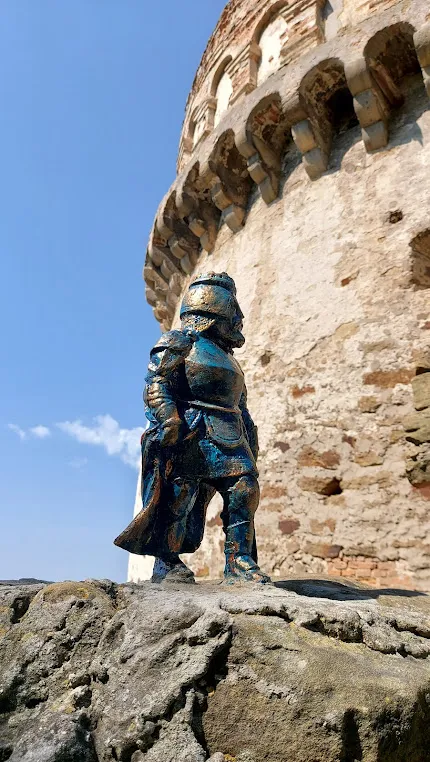
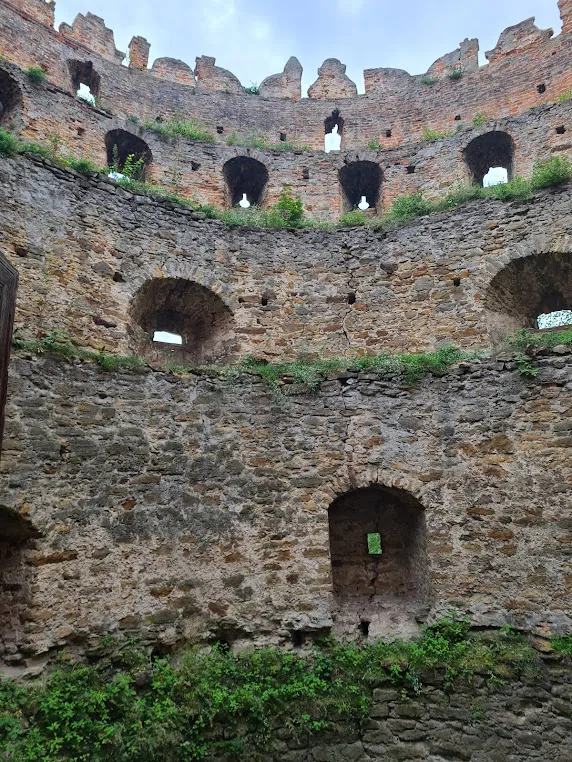
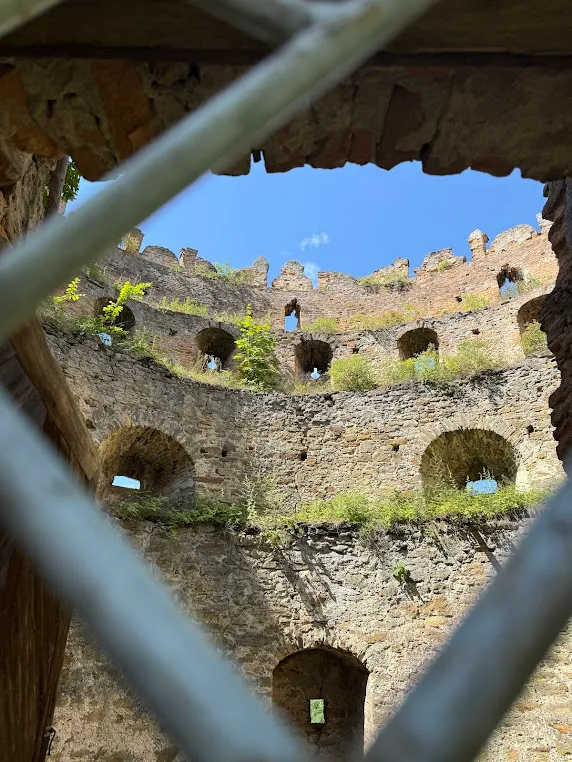
Pniv Castle is an irregular pentagon in plan, shaped by the terrain of the Strahora massif. The walls are built of large hewn blocks of gray mountain stone, with red brick on the inner sides.
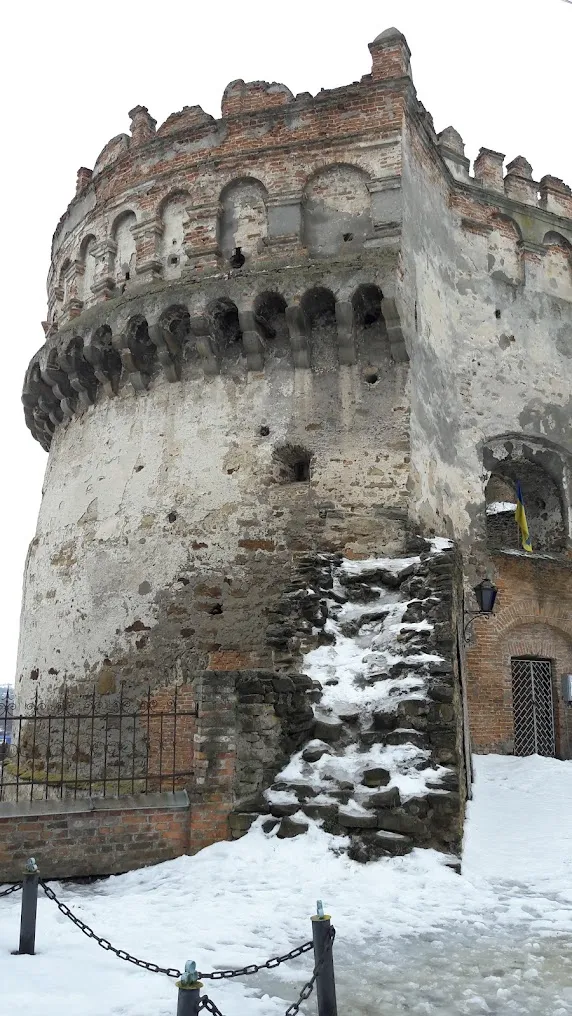
Five towers stand at the corners — all differently shaped:
- the gate tower — the main entrance
- the east tower — round
- the north and south towers — hexagonal
- the west tower — semicircular
This variety of shapes wasn’t a whim, but a practical choice: each tower had the optimal field of view given its position on the slope.
Entry was via a drawbridge over an artificial water-filled moat.
The 17th Century: Capture and Destruction
In the 17th century, the castle was captured and rebuilt several times:
- Cossack detachments during the Khmelnytsky uprising
- Ottoman and Tatar raids during the Polish-Ottoman wars
Each attack brought new damage; each retreat, a rebuilding. The castle remained an important outpost until the late 17th century, when the border line shifted further east.
The Underground Passage to Maniava Hermitage
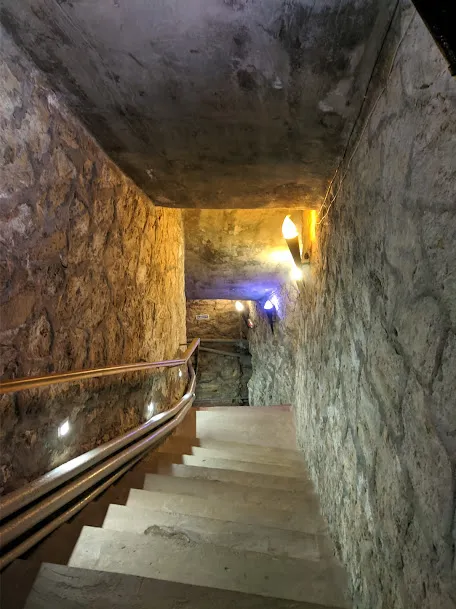
Beneath the castle lies a system of underground passages. One, it’s said, led to a tower in Nadvirna’s town park (a real and documented site).
Another — according to legend — led to the Maniava Hermitage.
Maniava Hermitage lies 19 miles away.
A 19-mile underground passage through the Carpathian foothills isn’t fortification anymore — that’s legend in its purest form. But the abandoned underground chambers of Pniv Castle genuinely exist.
The 19th Century and Decline
Once the border line moved far from Precarpathia, the castle lost its strategic importance. By the early 19th century, it had fallen into final decline. Its fortifications were gradually dismantled for building material.
2007–2016 — partial conservation work. The castle was added to Precarpathia’s tourist routes.
Since 2022 — restoration has been paused due to the full-scale war.
What’s There Today
On Mount Strahora: ruins — sections of wall, tower fragments (the round one best preserved), and the outline of the castle courtyard. Walls up to 6 ft (1.8 m) thick still impress with their mass.
From the hill: a panorama of the foothills and Nadvirna.
The underground chambers exist, but their condition is unstable.
What Not to Expect
This isn’t a restored castle. Restoration is paused, and for now Pniv Castle remains open ruins with no tourist infrastructure whatsoever.
But that’s exactly what makes it interesting for those who value authenticity over comfort.
What to See Nearby and How to Fit It Into a Route
Pniv and Nadvirna are the gateway to the Carpathians from the Ivano-Frankivsk side:
- Bukhtivetskyi Waterfall (~6 miles / ~10 km) — a popular natural stop on the way into the mountains
- Maniava Hermitage (~19 miles / ~30 km) — where the legendary underground passage supposedly led; regardless of the legend, an Orthodox monastery worth visiting
- Yaremche (~16 miles / ~25 km) — a tourist center, Probii Waterfall
- Dovbush’s Rocks (Bubnyshche) (~19 miles / ~30 km)
Practical Information
- Admission: free
- Climb: a trail up Mount Strahora; ~15–20 minutes on foot
- Condition: ruins; no infrastructure
- Footwear: hiking shoes
- Time on site: 30–60 minutes
- From Nadvirna: ~1.9 miles (~3 km) to the base
Conclusion
The Kuropatwas built the castle, opened a customs post, and named a town after their own servants.
Four hundred years later, nothing remains in the underground chambers — but the towers still stand.
And the legend of a passage to the hermitage, 19 miles away, will probably outlive any wall.