The town is called “Ostroh” — from the Old Rus’ word “ostrih”: a sharpened-stake fence, a palisade around a fortification.
In other words, the town is named after a type of defensive structure. Not the other way around.
That fits the castle’s character: here, nothing is quite what you’d expect. A church has firing slits. A tower once served as a residence. An academy stood beside the fortress. And the first complete edition of the Bible in Church Slavonic anywhere in the world came out right here.
General Information
| What? | Description |
|---|---|
| Name | Ostroh Castle |
| Address | 5 Akademichna St., Ostroh, Rivne Oblast |
| Castle hill | 66 ft (20 m) above the Vilia River valley |
| Four structures | the Stone Tower (14th century), the Round Tower (16th century), the Epiphany fortress-church (1521), the gate-belfry (1905) |
| Moat | deep, water-filled; a drawbridge |
| Ostroh Academy | 1576 — the third institution of higher learning in Eastern Europe |
| the Ostroh Bible | 1581 — the first complete edition of the Bible in Church Slavonic anywhere in the world |
| Status | State Historical-Cultural Reserve |
| Museum | the Ostroh Museum of Local Lore (since 1916) |
| Admission | paid |
From “Ostrih” to a Castle: Four Centuries
A wooden fortification stood on this hill even before the town’s first written mention, in the Hypatian Chronicle of 1100. In 1241, the Mongols destroyed the fortification.
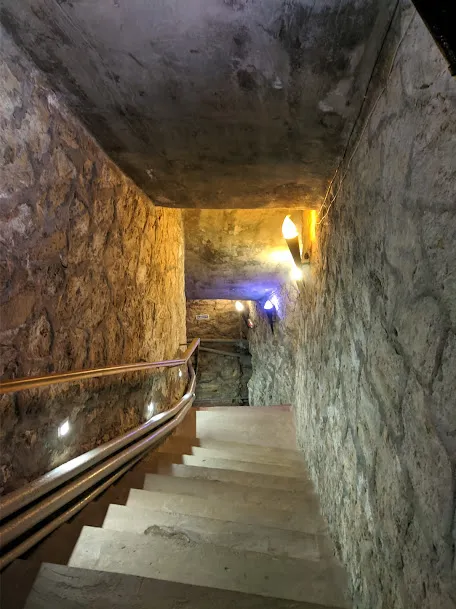
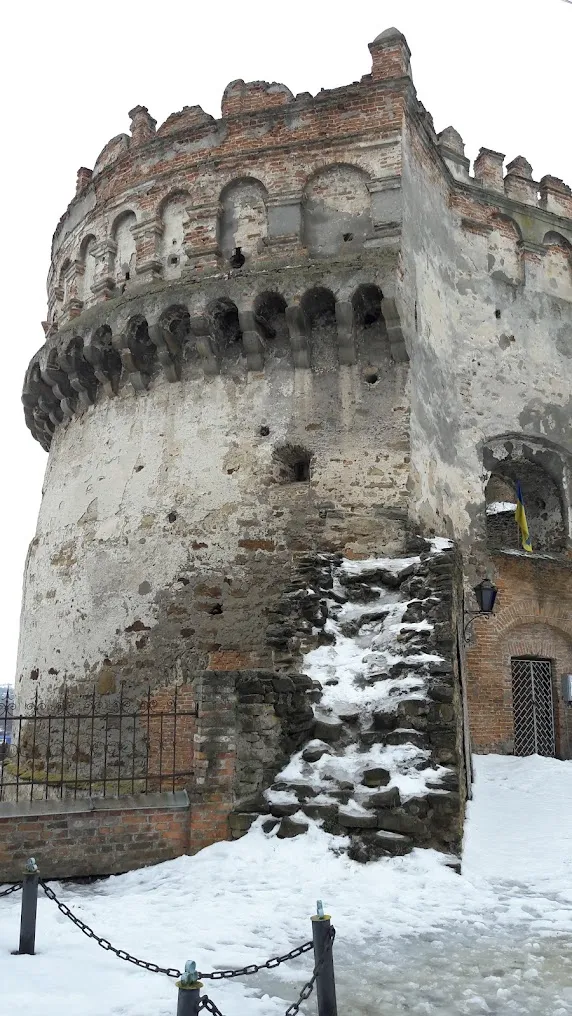
14th century — Prince Danylo Ostrozky builds the first stone structure: the Stone Tower, a keep. It’s the oldest surviving keep in Volhynia, and one of the best preserved in Ukraine. The tower served more than defense — the Ostrozky princes themselves lived there. On the lower level: a well and stores. Around 40 firing points.
~1430 — powerful fortifications with towers, a moat, and a rampart are built around Ostroh.
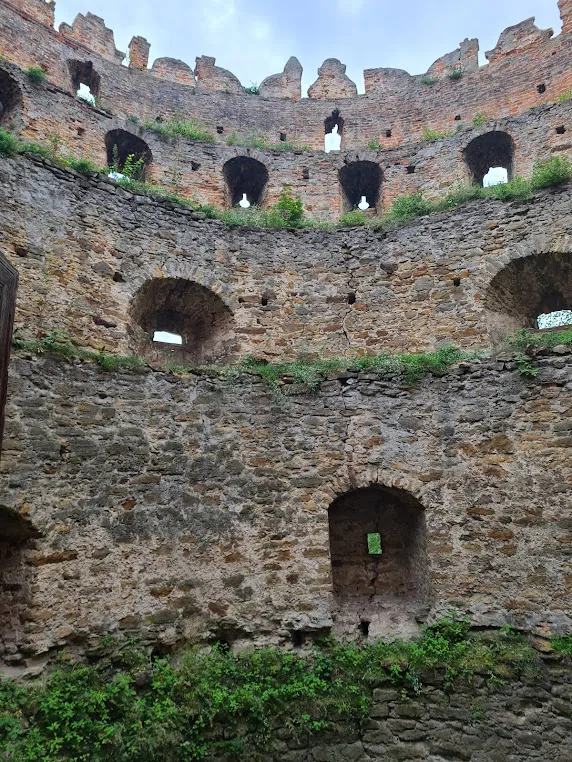
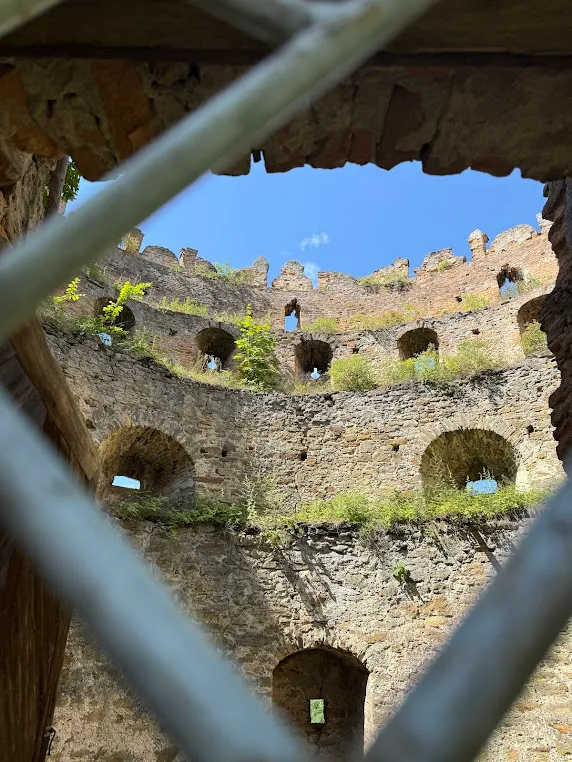
15th–16th centuries — expansion under Konstanty Ivanovych Ostrozky (the castle’s greatest flourishing) and Vasyl-Konstantyn Ostrozky. The Round (New) Tower appears — a Renaissance addition, with basement-level walls nearly 16 ft (5 m) thick.
1521 — restoration of the Epiphany Church; the date is carved into the stone by the windows.
A Church With Firing Slits
The Epiphany Church — the Ostrozky family’s church and burial site — doubles as a defensive structure.
Its north wall is a surviving remnant of the castle’s defensive wall. The stone frames of four firing slits in that wall carry carved inscriptions dated 1521. The church was designed so that its window-slits could be used to fire on an enemy.
The Epiphany Church is Ukraine’s only example of sacred and defensive architecture organically combined in a single structure. After 19th-century restoration, it became a model of the scholarly approach to monument preservation. Several members of the Ostrozky family are buried here, including Vasyl-Konstantyn, founder of the Ostroh Academy.
The Ostroh Academy and the Bible
The castle and the academy were two parts of one plan by Vasyl-Konstantyn Ostrozky.
In 1576, he founded a Slavic-Greek-Latin school — the Ostroh Academy. It was the third institution of higher learning in Eastern Europe (after Prague and Kraków; Vilnius University followed in 1579). Scholars were invited from the Balkans, Greece, and Poland. Petro Konashevych-Sahaidachny studied here.
In 1581, printing was completed at the castle on the “Ostroh Bible” — the first complete edition of the Bible in Church Slavonic anywhere in the world. It was printed at Ostrozky’s expense, at the castle’s own printing house, by Ivan Fedorov. The print run was about 1,500 copies; roughly 300 survive.
When, in 1636, the castle’s owner Anna Alojza Chodkiewicz — Vasyl-Konstantyn’s granddaughter, who had converted to Catholicism — closed the Orthodox Epiphany Church and handed it to the Jesuits, the academy ceased to exist. Until the late 19th century, the church remained Catholic.
The Round Tower: Attics and Roses
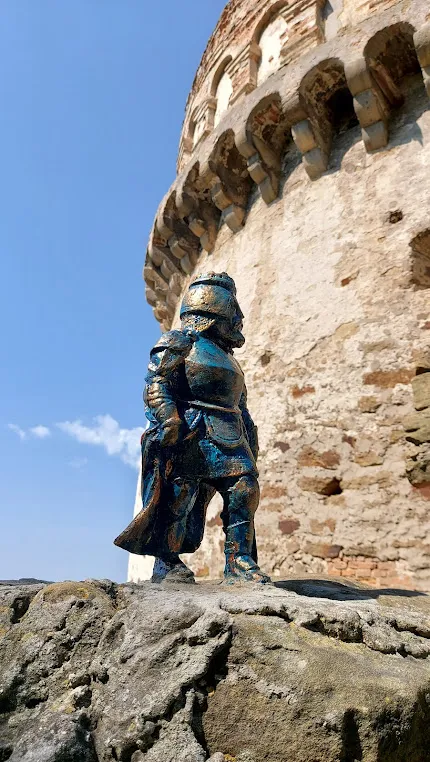
The 16th-century Round (New) Tower is a masterpiece in its own right.
Diagonally from the rosettes: acanthus branches. Carved roses on the main façades. Elaborate attics — decorative “crown”-shaped tops. Each tier is separated by a cornice. Inner diameter: 43 ft (13 m); basement wall thickness: nearly 16 ft (5 m).
This tower exemplifies the “Renaissance phase” of Ukrainian defensive architecture: functional fortification combined with decoration of a high order.
What’s There Today
The castle is a State Historical-Cultural Reserve; the Stone Tower has held a local history museum since 1916.
Inside: weapons, 15th–18th-century icon painting, ceramics, personal belongings of the Ostrozky family, and material on the academy’s history. The prince’s study, with surviving desk and furniture. An icon collection.
The Epiphany Church is active, with regular services. Separate entrance.
What Not to Expect
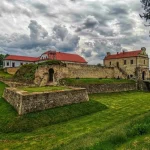
Ostroh Castle isn’t a traditional castle with a continuous perimeter wall. It’s three separate structures on a hill: a tower, another tower, a church. There’s no ring of walls connecting them.
That’s not a flaw — it’s the castle’s character. But if you’re expecting a “classic” castle, you’ll find something rather different and unusual.
What to See Nearby and How to Fit It Into a Route
In Ostroh:
- the modern Ostroh Academy — next to the castle; tours of the old building can be arranged
- the Lutsk Gate Tower — 15th–16th centuries, a book museum inside
- the Tatar Tower — 15th–16th centuries, less well preserved
From Ostroh, a natural route continues: Dubno (~28 miles / ~45 km), Olyka (~22 miles / ~35 km), Tarakaniv Fort (~31 miles / ~50 km).
Practical Information
- Address: 5 Akademichna St., Ostroh
- Admission: paid (museum plus church — separately or combined)
- Hours: Tue–Sun; confirm
- From Rivne: ~28 miles (~45 km), ~40 min
- From Dubno: ~28 miles (~45 km)
- From Lutsk: ~50 miles (~80 km)
Conclusion
The town is named after a fence. A church with firing slits stands beside the oldest keep in Ukraine. The world’s first Church Slavonic Bible came out of this castle.
Fifty years later, the founder’s granddaughter converted to Catholicism, closed the church, and handed the academy to the Jesuits.
The Ostrozky family built it — and, in the end, stopped it themselves.