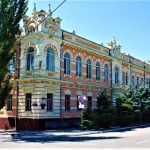
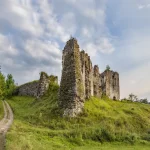
On April 15, 1540, Polish king Sigismund I granted Grand Crown Hetman Jan Amor Tarnowski permission to found a town and build a castle in the Sopilche tract.
Construction began that same year.
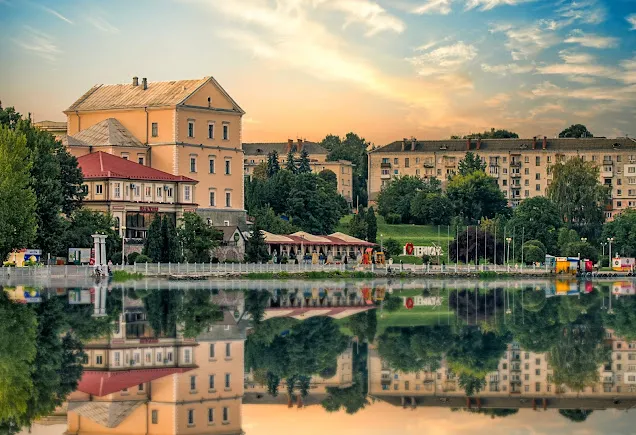
Along with the castle, a dam was built across the river — creating the Ternopil pond. One construction decision gave the town both a fortress and a body of water that still defines its look today.
This is the first entry in Ternopil’s chronicle. The town was born together with the castle.
General Information
| What? | Description |
|---|---|
| Name | Ternopil Castle (the Old Castle) |
| Address | 12 Zamkova St., Ternopil |
| Built | 1540–1548 |
| Commissioned by | Jan Amor Tarnowski (1488–1561), Grand Crown Hetman |
| Material | local sandstone, brick |
| Distinctive feature | 5 levels facing the pond (with underground casemates), 3 facing the town |
| Status | architectural monument of national significance; depicted on Ternopil’s coat of arms (1992) |
| Museum | present; paid admission |
The Castle That Founded a Town
Tarnowski chose a spot near the Seret and Rudka rivers — a corner where a marshy floodplain naturally protected two sides. But that wasn’t enough: a dam was built, damming the Seret. A large pond formed, surrounding the castle on three sides.
On the town side: a rectangular inner bailey with corner watchtowers, a dry moat with ramparts, and an oak palisade. The main entrance was a two-story gate tower with a drawbridge. On the pond side, the building had five levels (including underground sandstone casemates).
The castle was built of local sandstone — the same stone used at Terebovlia and Zbarazh. The main building was completed by Jan Krzysztof Tarnowski, the founder’s son.
In 1566, the town was exempted from part of its taxes due to the heavy costs of construction.
Later, Tomasz Zamoyski invested in further construction — he received the town as a dowry through his wife Katarzyna, daughter of Vasyl-Konstantyn Ostrozky. The Ostrozky family appears here too.
The First Entry — and the First Attack
The castle was built during years of constant threat. In 1544 — while still under construction — the Tatars attempted an attack. It was repelled thanks to a militia led by Bernard Pretwicz, Jan Herburt, and Aleksander and Prokop Sieniawski.
After that — systematically: destruction in 1575, 1589, 1649, and 1672. Rebuilding, reinforcement, new strikes.
In 1675, the Ottoman pasha Ibrahim Shishman laid siege to the town after a failed assault on Terebovlia Castle. His enraged forces destroyed Ternopil’s castle utterly, blew up its towers, and drained the pond.
Draining a reservoir as a military tactic was an unusual move for this region.
Korytowski and the End of the Fortress
After restoration in the late 17th century, the castle continued for some time. But in the 19th century, Ternopil’s new owner, Count Franciszek Korytowski, decided he had no use for a defensive castle.
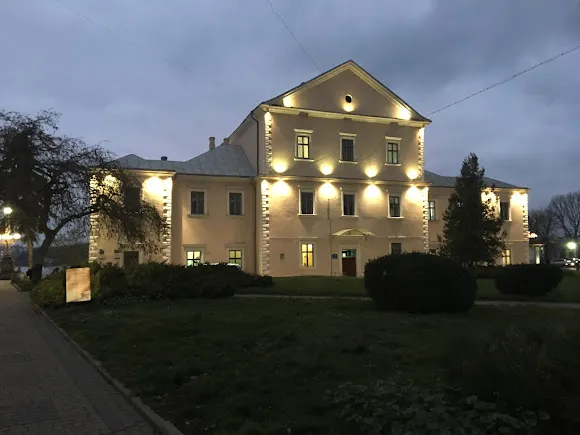
He removed every fortification element: ramparts, towers, moat. He converted the fortress into an ordinary lordly palace, surrounded by a stone wall with a gate, its pylons bearing the owner’s coats of arms. Above the coats of arms: lion masks.
After this, only the two lower floors on the pond side remained of the original 1540–1548 castle.
World War II and Another Blow
In 1944, Ternopil became one of the hardest-fought bridgeheads of the Soviet-Nazi war. The castle was one of the last points of Nazi defense. After the Red Army took the city — further destruction.
The town was rebuilt over several decades. So was the castle.
What’s There Today
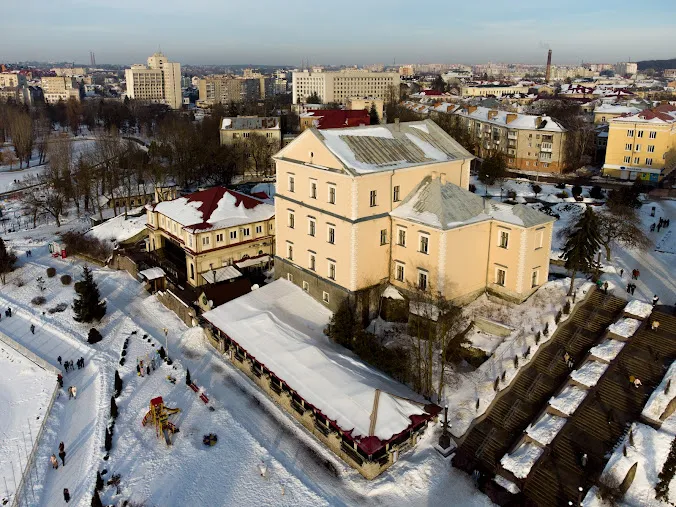
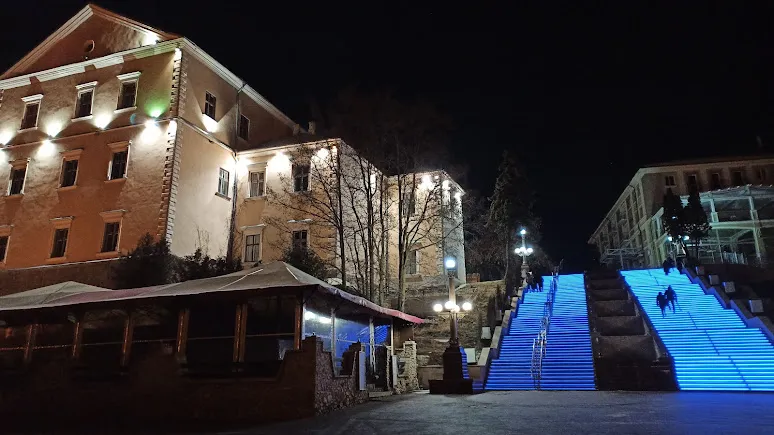
The visible part of the castle today is a mostly 19th-century palace, with 16th–17th-century elements surviving in the lower floors on the pond side. It’s no longer a fortress — it’s a restored residence with a museum.
Inside: the regional museum of local history, with exhibits on archaeology, medieval weapons, and the natural history of the Ternopil region. Exhibition halls for temporary displays.
The castle appears on Ternopil’s coat of arms (approved in 1992) — a symbol of the town’s founding.
What Not to Expect
Don’t expect a medieval castle with towers and bastions. Korytowski did his work in the 19th century — almost nothing of the original fortifications remains.
But the castle has another advantage: it stands in the town center, on the Ternopil pond embankment. It’s the most “urban” castle location in Ukraine — easily combined with a walk along the embankment, a café, and the town itself.
How to Fit It Into a Route
Ternopil Castle is a starting or ending point for routes through the Ternopil region:
- Zbarazh (~16 miles / ~25 km) — the castle and Khmelnytsky’s siege
- Terebovlia (~20 miles / ~32 km) — a castle with 16-ft walls
- Kremenets (~37 miles / ~60 km) — Mount Bona and a bottomless well
Practical Information
- Address: 12 Zamkova St., Ternopil
- Admission: paid
- Hours: Tue–Sun (confirm)
- From the town center: a ~10-minute walk from Maidan Voli
- Parking: available nearby
Conclusion
Tarnowski received permission for a castle in 1540 — and a town was born alongside it.
Korytowski, in the 19th century, removed every tower and turned the fortress into a palace.
The castle appears on Ternopil’s coat of arms. But what we see today is largely the work of a count who had no love for fortifications.