Most castles were built on hills or cliffs — wherever nature offered an advantage.
Mikołaj Sieniawski, in 1534, chose a marsh.
Thousands of oak piles were driven into the marshy river valley on an island in the Zolota Lypa, before the walls could even begin. The castle rose not above an enemy, but in the middle of a bog — a bog that was, in itself, the best possible defense.
General Information
| What? | Description |
|---|---|
| Name | Berezhany Castle |
| Address | Berezhany, Ternopil district, Ternopil Oblast |
| Setting | an island on the Zolota Lypa River, a marshy valley |
| Built | 1534–1554 (main structure); expanded in 1570 and the early 17th century |
| Commissioned by | Mikołaj Sieniawski (1489–1569) |
| Architect | unknown (Italian by style) |
| Shape | a pentagon, 4 towers of different shapes |
| Holy Trinity Church | 1554 — the Sieniawski family burial site |
| Status | architectural monument of national significance; under restoration |
| Admission | paid |
Oak Piles and a “Palazzo” in the Bog
The site was marshy — building here without preparation was impossible. So thousands of oak piles were first driven into the ground, and only on that stabilized foundation were the cellars and walls laid.
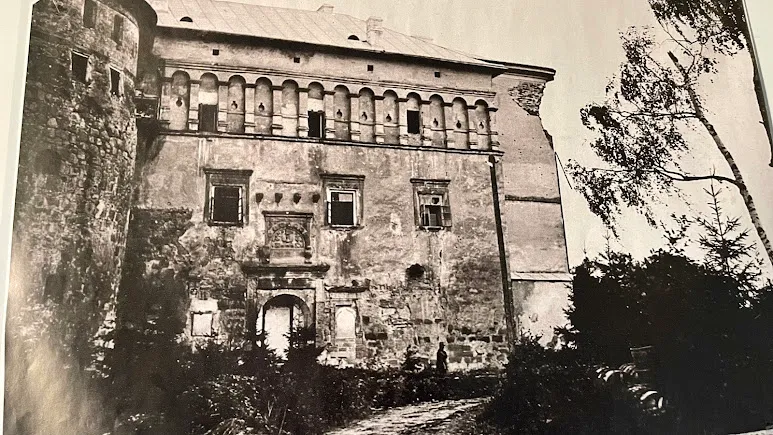
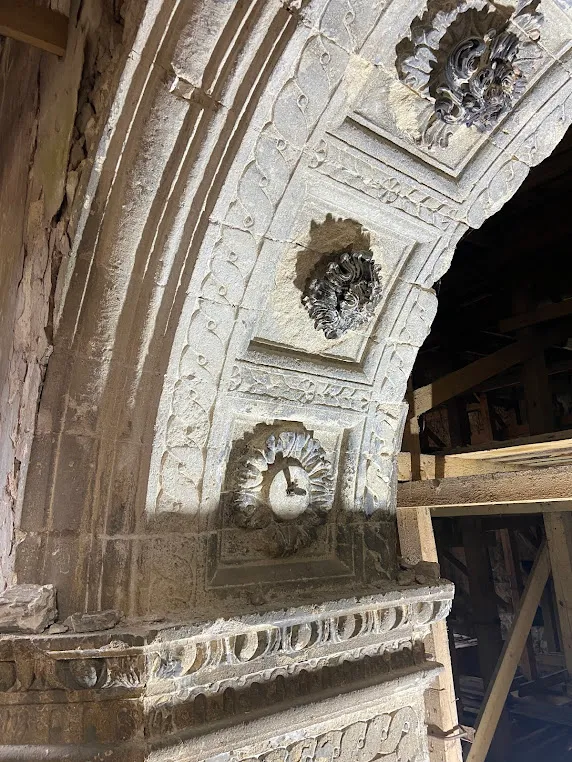
The castle rose on an island formed by two arms of the Zolota Lypa. On three sides: water and marsh. The only solid approach, from the south, was guarded by a chain bridge and a white-stone gate with carved decoration.
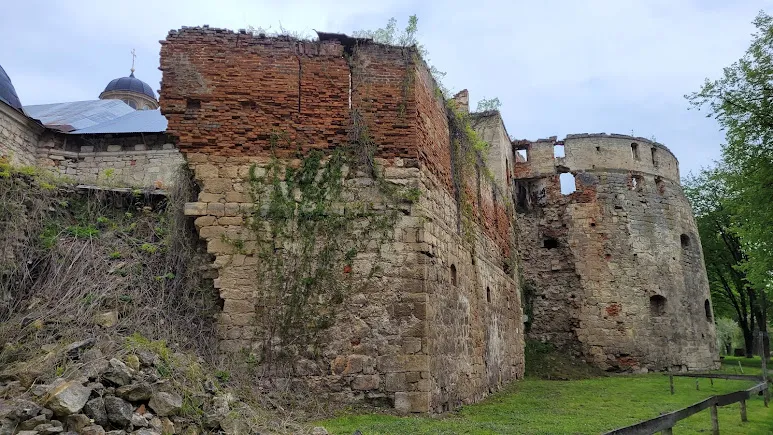
Inside the castle courtyard: arcaded galleries reminiscent of an Italian palazzo. The architect is unknown, but the structure and decoration clearly point to a master from the Apennine peninsula. The southwest walls reached 20 ft (6 m) in thickness.
Two- and three-story residential buildings lined the walls along the entire perimeter. Berezhany Castle was built first and foremost as a place to live — and only secondarily as a fortress.
14 Grand Halls, Each With a Name
The palace section of the castle held 14 grand halls, each with its own name — after the color of its decor, or in honor of specific events. A picture gallery held portraits of Polish kings and members of the Sieniawski family. Two built-in toilets — a rarity for the 16th century.
The castle didn’t look like a fortress from inside. It looked like a defended residence.
Mazepa and Peter I — at the Same Time
In 1698, the Sieniawskis hosted Polish king Augustus II in Berezhany.
In May 1707, Hetman Ivan Mazepa and Tsar Peter I of Muscovy were both at the castle simultaneously. What they discussed isn’t recorded in the chronicles. But a year later, Mazepa switched allegiance to Charles XII.
What the Castle Withstood, and What It Didn’t
Tatar attacks — repelled. Cossacks in 1648 and 1667 — repelled. Ibrahim Shishman in 1675 — having already taken Zolochiv and Buchach castles beforehand — never took Berezhany.
But in 1651, Cossack detachments under Maksym Kryvonis did take the castle by storm.
In 1655, the Swedish army forced the garrison to surrender: winter had frozen the river and marsh solid, and the Swedes approached right up to the walls.
Water saved the castle — but only when it wasn’t frozen.
The NKVD: Twice
On September 1, 1939, Red Army units captured the castle. Burials in the chapel were looted. Gunfire destroyed the “Mother of God” mosaic on the main altar. Gravestones were smashed. The chamber interiors were ransacked.
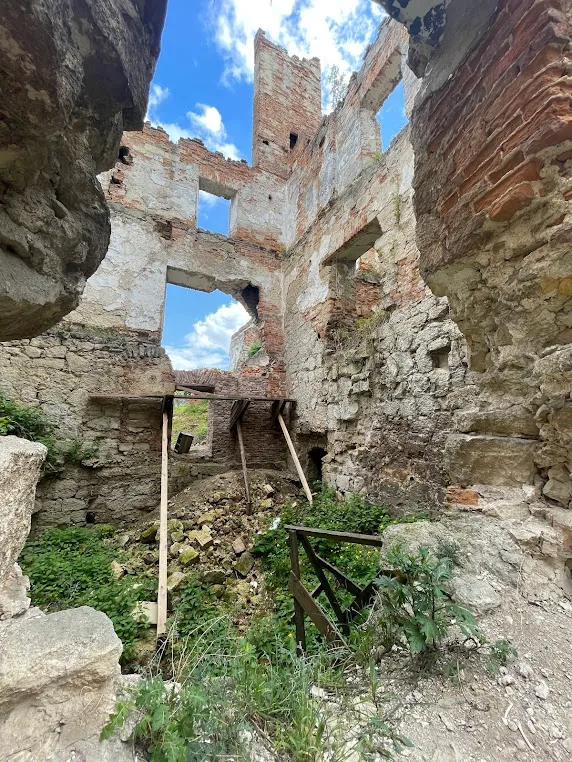
On July 1, 1941, as Soviet forces retreated, ammunition and gunpowder stores in the tower were blown up. A significant part of the castle was destroyed in the explosion.
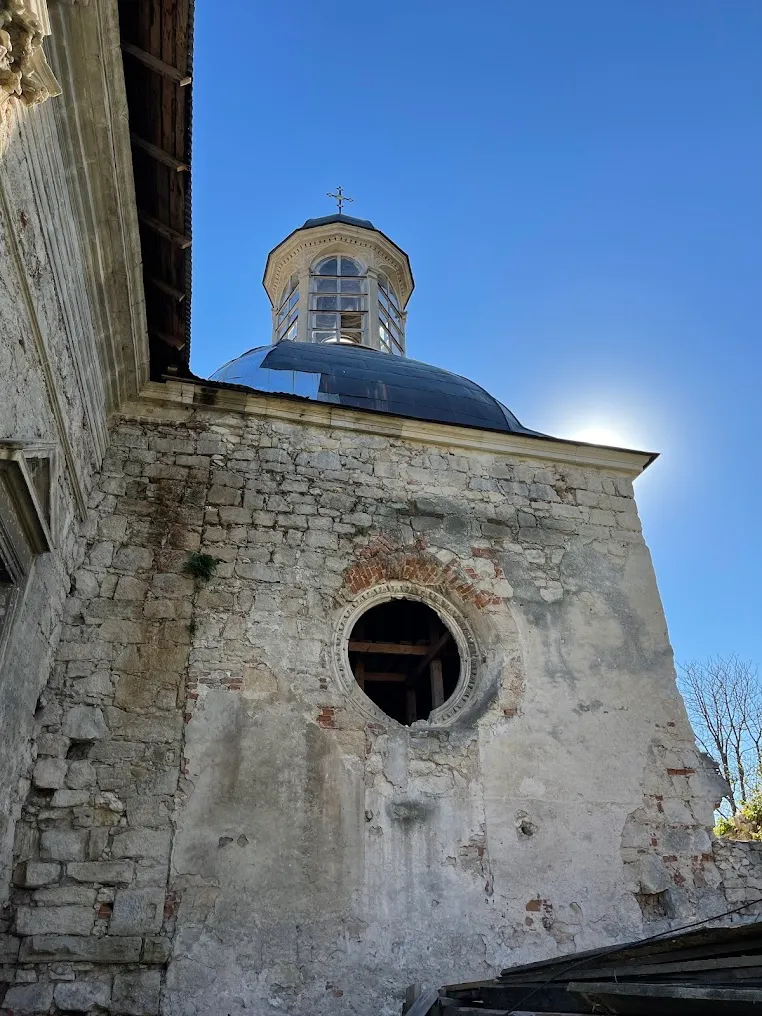
In 1946, NKVD units finished the job. The castle chapel was left without a roof or rafters.
What the Swedes, Ottomans, and Cossacks couldn’t do in two centuries — the NKVD managed twice in seven years.
The Holy Trinity Church: the Most Important Survivor
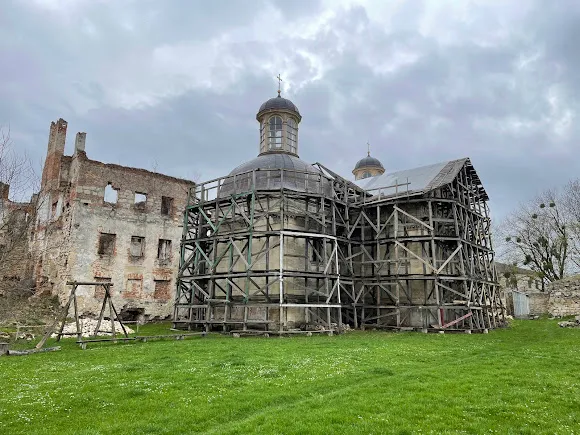
The Holy Trinity Church (1554) — the Sieniawski family burial chapel — is the complex’s chief architectural treasure.
In the burial chapels: tombstones by sculptors Jan Pfister and Heinrich Horst. The sarcophagus of Adam Hieronim Sieniawski and his three sons is one of the most refined Renaissance funerary complexes in Galicia.
The church is under restoration. The last major work before this was in 1877–1878 — meaning nearly 150 years between restorations.
What Not to Expect
The castle halls are destroyed — no interiors survive. But the Holy Trinity Church is open and partly restored. It’s the main reason to make the trip.
What to See Nearby and How to Fit It Into a Route
Berezhany is in Ternopil district, ~44 miles (~70 km) from Ternopil and ~62 miles (~100 km) from Lviv.
- Zbarazh (~34 miles / ~55 km) — the castle and the 1649 siege
- Pidhirtsi (~31 miles / ~50 km) — Galicia’s most beautiful Renaissance castle
- Zolochiv (~28 miles / ~45 km) — the Golden Horseshoe of the Lviv Region
Practical Information
- Admission: paid
- Church: open for separate visits
- Restoration: ongoing; part of the site is closed
- From Ternopil: ~44 miles (~70 km) via the R12 highway
- From Lviv: ~62 miles (~100 km) via the E50 highway through Peremyshliany
- Time needed: 1–1.5 hours (castle plus church)
Conclusion
The castle was built on oak piles in a marsh — and it withstood everything: Tatars, Cossacks, Swedes, Ottomans.
It didn’t withstand the NKVD.
But the church still stands. And inside it, sarcophagi nearly five centuries old.