On July 3, 1766, a storm swept over Khust.
The first bolt of lightning set the roof ablaze. The garrison feared the fire would reach the powder tower.
The second bolt frightened everyone further.
The third struck the powder magazine.
A castle that had withstood Tatars, Mongols, Ottomans, and Kuruc rebels for 676 years was destroyed by a storm in a matter of hours.
General Information
| What? | Description |
|---|---|
| Name | Khust Castle |
| Location | a hill of volcanic origin, Khust, Khust district, Zakarpattia Oblast |
| Built | 1090–1191 (a stone bearing the date 1191 was found during excavations) |
| Purpose | defending the salt road from Solotvyno and Hungary’s eastern borders |
| Destroyed | July 3, 1766 (three lightning strikes, a gunpowder explosion) |
| Khust’s coat of arms | 19th–early 20th century — the castle ruins on a green hill |
| Admission | free |
The Salt Road and the Reason It Existed
Khust Castle wasn’t built for scenic beauty or dynastic ambition. In 1090, Hungarian kings began building a fortress here with one specific purpose: controlling the salt road from the Solotvyno mines to the Danube basin.
Salt was a strategic resource in the Middle Ages. Whoever controlled its transit controlled the economy of an entire region.
Construction took a hundred years. A stone bearing the date 1191 — the year of completion — was found in the castle. It rose on a volcanic hill overlooking the entire Tysa valley.
In 1303, Khust became the center of Maramureș County; the fortress commandant carried out administrative and judicial functions for the whole region.
What It Withstood — and What Defeated It
In 1242, the Mongols under Khan Batu destroyed the castle. It was rebuilt.
In 1594 and 1659, Tatar raids. They never took it.
In 1660, Ottoman janissaries approached the fortress and decided not to storm it. Instead, they sent a delegation that included the traveler Evliya Çelebi. He wrote: “Khust Castle stands atop Mount Hasan, its walls high and thick. In its power, it resembles the fortress of Iskandar [Alexander], for the height of its towers reaches the sky.”
Ottoman janissaries compared the castle to the fortress of Alexander the Great — and left.
Between 1677 and 1687, Khust Castle became a center of the Kuruc movement under Imre Thököly against Austrian rule. After the betrayal of the Maramureș ispán, Austrian forces occupied the fortress.
In 1709, a general Transylvanian assembly of Ferenc II Rákóczi’s supporters was held at the castle.
In 1717, the garrison’s last combat sortie: an attack on a Tatar detachment, freeing thousands of captives.
After that — 49 years of quiet.
July 3, 1766: Three Lightning Strikes
On July 3, 1766, an unprecedented storm raged over Khust. After the first lightning strike, the fortification’s roof caught fire; the second frightened the garrison; the third struck the powder magazine.
Gunpowder was stored in two places: in the cellars of the Ferdinand I tower and in the Bubnova Tower in the northwest corner. The explosion “shook the earth with terrifying force.” Stone debris blocked the only exit. People died both from the blast and in the fire.
The county authorities began repairs. But seven years later, in 1773, the future Austrian emperor Joseph II inspected the ruins and ordered the garrison transferred to Mukachevo.
In 1798, another storm destroyed the last tower.
In 1799, authorities allowed locals to dismantle the castle for stone. Khust’s Catholic church and government buildings were built from its walls. What had withstood armies became building material.
A Coat of Arms Made of Ruins
The town memorialized the 1766 catastrophe in an unusual way.
On Khust’s 19th–early 20th-century coat of arms: against a red field, on a green hill, stand the ruins of a silver castle with three towers and three firing slits.
The town made its own tragedy its coat of arms.
The Dracula Legend — and Why Not to Take It Seriously
Online, Khust Castle is often called “Ukraine’s Dracula castle,” through an alleged connection to Vlad the Impaler (Vlad Țepeș).
Vlad the Impaler did have ties to Transylvania, which once included part of present-day Zakarpattia. But there’s no documentary evidence he was ever in Khust. This is a tourism marketing narrative that emerged no earlier than the 2020s.
The castle’s real history is far more interesting than any vampire legend.
What’s There Today
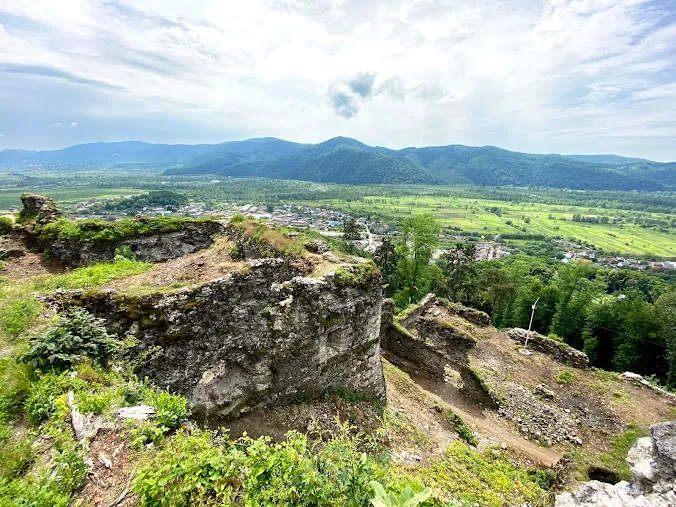
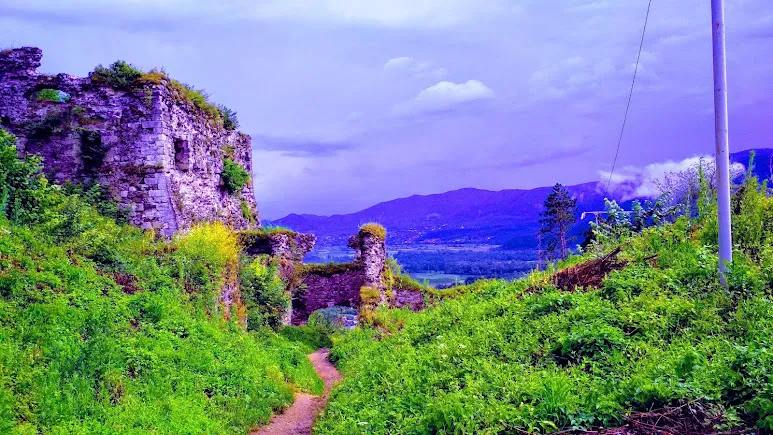
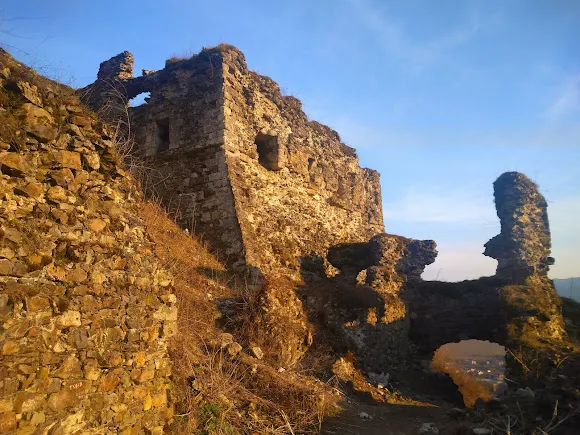
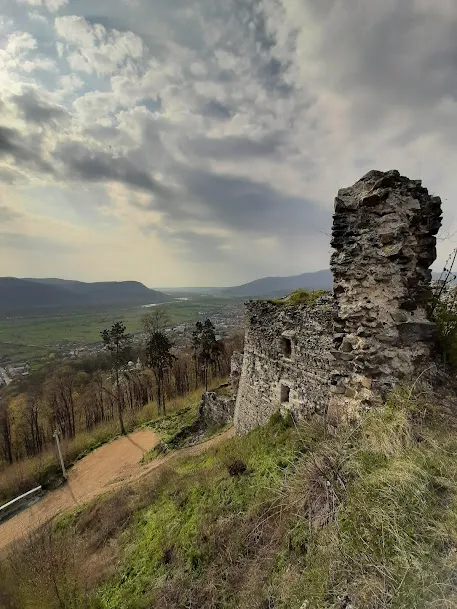
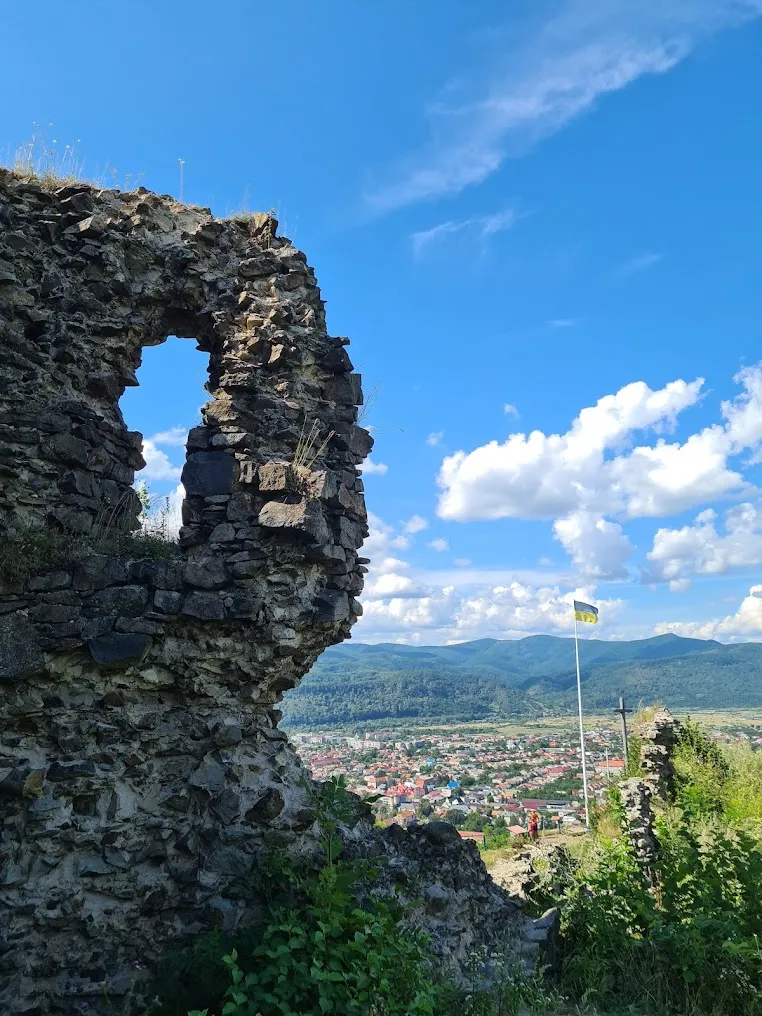
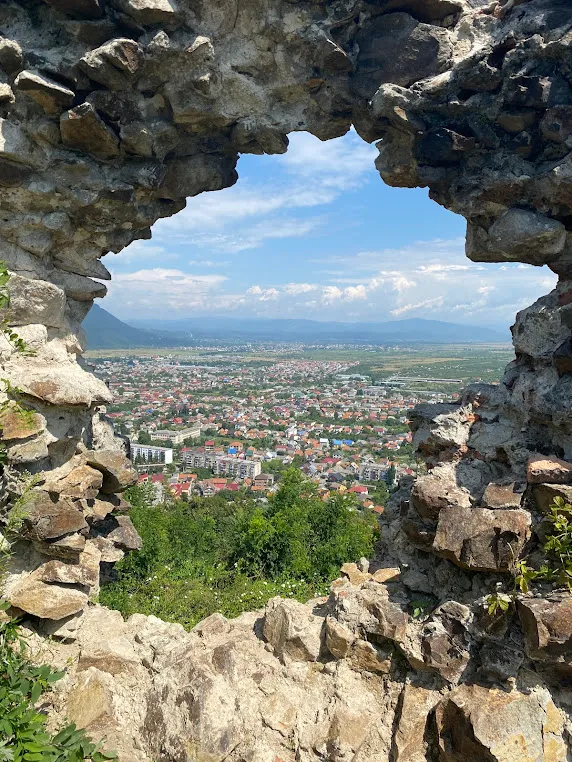
What remains: fragments of walls and towers atop the volcanic hill. Some walls reach several meters in height. From the summit: a panorama of the Tysa valley and the confluence of the Tysa and Ryka rivers.
Tropical-looking plants grow on the hill, thanks to the volcanic massif’s distinctive microclimate.
In 2025, the Zakarpattia Regional Museum carried out archaeological excavations, uncovering artifacts, medieval weapons, and coins.
What Not to Expect
Khust Castle is nearly a complete ruin: isolated wall fragments, and little else. No halls, no roofed spaces. This is a place for the panorama and for grasping the scale — not a “Dracula’s castle,” which is a marketing myth without documentary basis.
What to See Nearby and How to Fit It Into a Route
Khust is a convenient stop on a route through Zakarpattia:
- Palanok Castle, Mukachevo (~28 miles / ~45 km) — well preserved, with a museum, a contrast to Khust
- Solotvyno (~19 miles / ~30 km) — salt lakes and mines, the very resource the castle was built to defend
- Vynohradiv (~19 miles / ~30 km) — another medieval castle in ruins (Kankiv)
Practical Information
- Admission: free
- Climb: a trail up the castle hill; ~20–30 minutes on foot
- Footwear: sturdy closed shoes or hiking boots
- Time on site: 30–60 minutes
- From central Khust: ~10 minutes on foot
Conclusion
A Turkish traveler compared Khust Castle to the fortress of Alexander the Great, and didn’t dare storm it.
Lightning decided otherwise.
Khust’s coat of arms shows ruins on a green hill. The town remembers.