You’re driving through Podillia. Fields, hills, scattered trees.
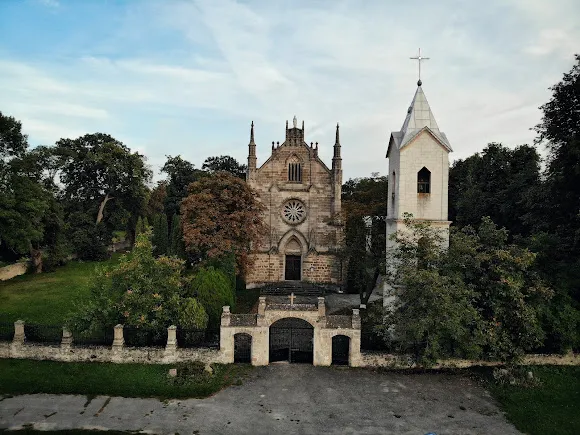
Then, suddenly, two slender towers with spires rise above the roofs of Pidlisnyi Mukariv. Sharp, medieval-looking — entirely out of place in this landscape.
This is St. Joseph the Betrothed Church. Built not of brick but of hewn stone. Over 13 straight years. Funded by the parishioners themselves.
General Information
| What? | Description |
|---|---|
| Name | St. Joseph the Betrothed Church |
| Address | 19 Muzeina St., Pidlisnyi Mukariv village, Dunaivtsi district, Khmelnytskyi Oblast |
| Type | Roman Catholic church |
| Built | 1859–1872 |
| Consecrated | 1886 (Bishop of Lutsk-Zhytomyr K. Lubowidzki) |
| Style | late neo-Gothic |
| Material | hewn stone (sandstone) |
| Initiated by | Father Vasyl Shakh |
| Status | active church, architectural monument |
From 1613 to 1872: Two Chapters of One Place
The first church in Pidlisnyi Mukariv was built by Andrii Hursky, deputy judge of Podillia, in 1613. It was a wooden building, granted privileges and furnishings by King Sigismund III of the Polish-Lithuanian Commonwealth that same August. In the late 17th century, the wooden church was damaged by Ottoman raids.
Two and a half centuries later, in 1859, at the initiative of Father Vasyl Shakh, the parishioners decided to build a new church — this time of stone. The community funded it entirely on its own. Construction took 13 years and was completed in 1872. The church was consecrated later, in 1886, by the Bishop of Lutsk-Zhytomyr, K. Lubowidzki.
Architecture: “A Textbook Example of Gothic Form”
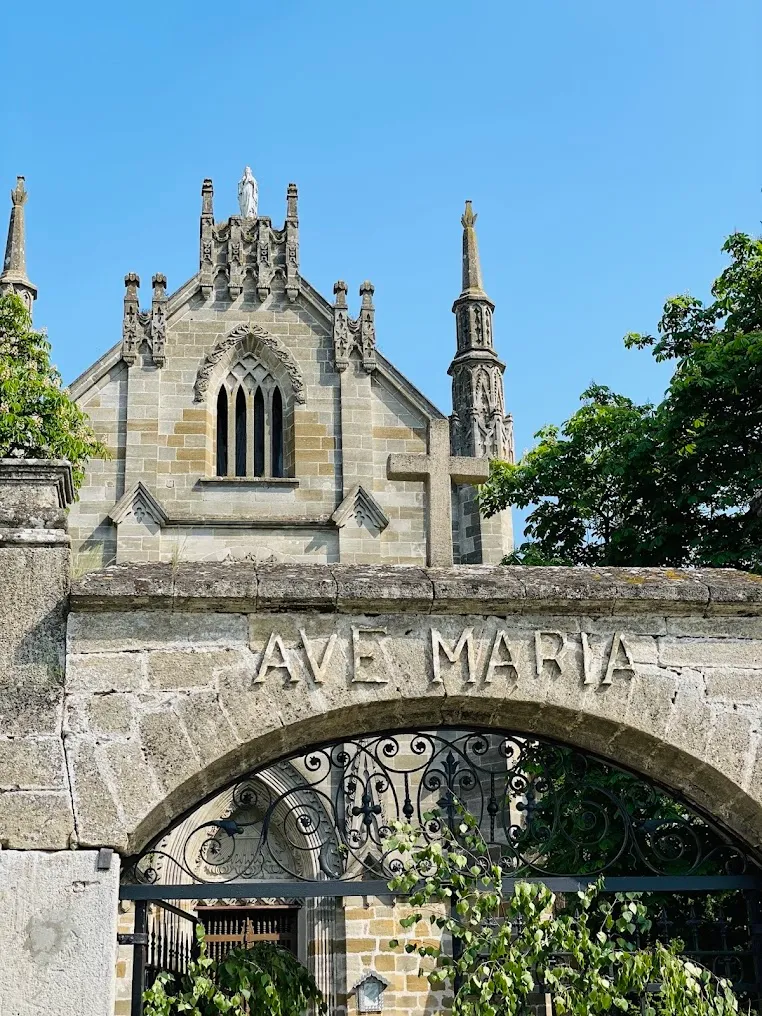
The church in Pidlisnyi Mukariv is one of the most refined examples of late neo-Gothic architecture in Podillia. That’s not an exaggeration: travelers and researchers compare it to the church in Ozeriany and consider it well suited for studying Gothic forms.
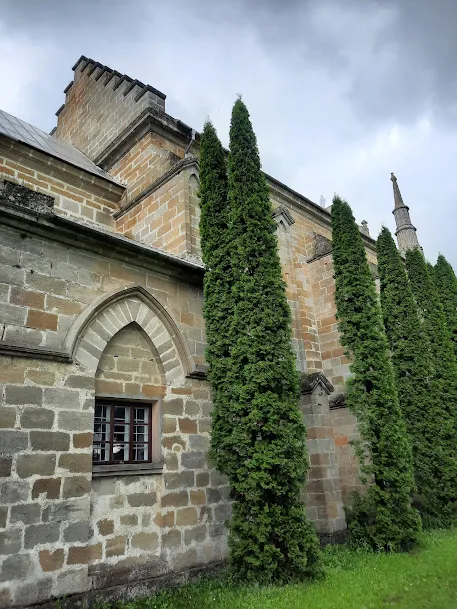
Its main distinction from most neo-Gothic village churches in the region: it’s built not of brick, but of hewn stone. The gray sandstone gives the façade greater mass and a different character — more restrained, more archaic.
The façade brings together all the typical elements of Gothic style, harmoniously combined:
- a rose window on the main façade;
- finials with crockets — decorative vertical spire ornaments;
- gablets — sharp-angled decorative canopies over the windows and portals;
- two slender towers with spires;
- pointed-arch windows all around the perimeter.
On the north façade, the year of construction is carved directly into the stone — a primary document set right into the material.
Inside: an Organ from Czechia and Lviv Artists
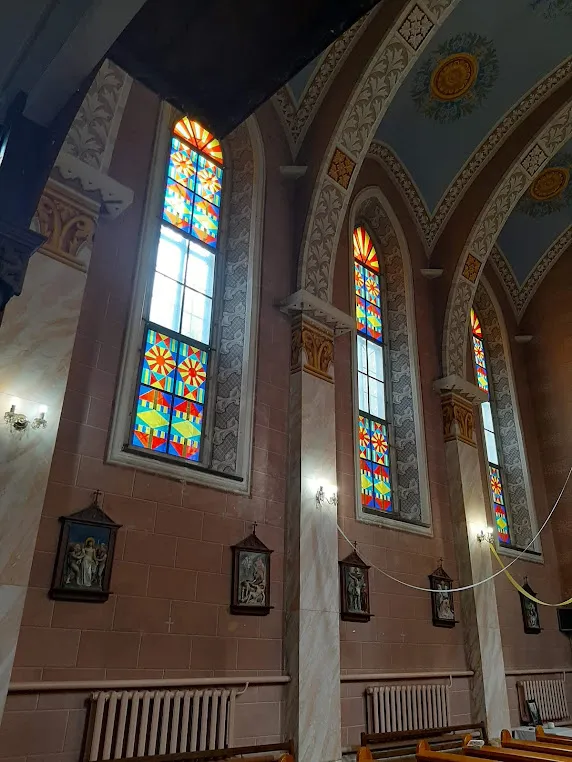
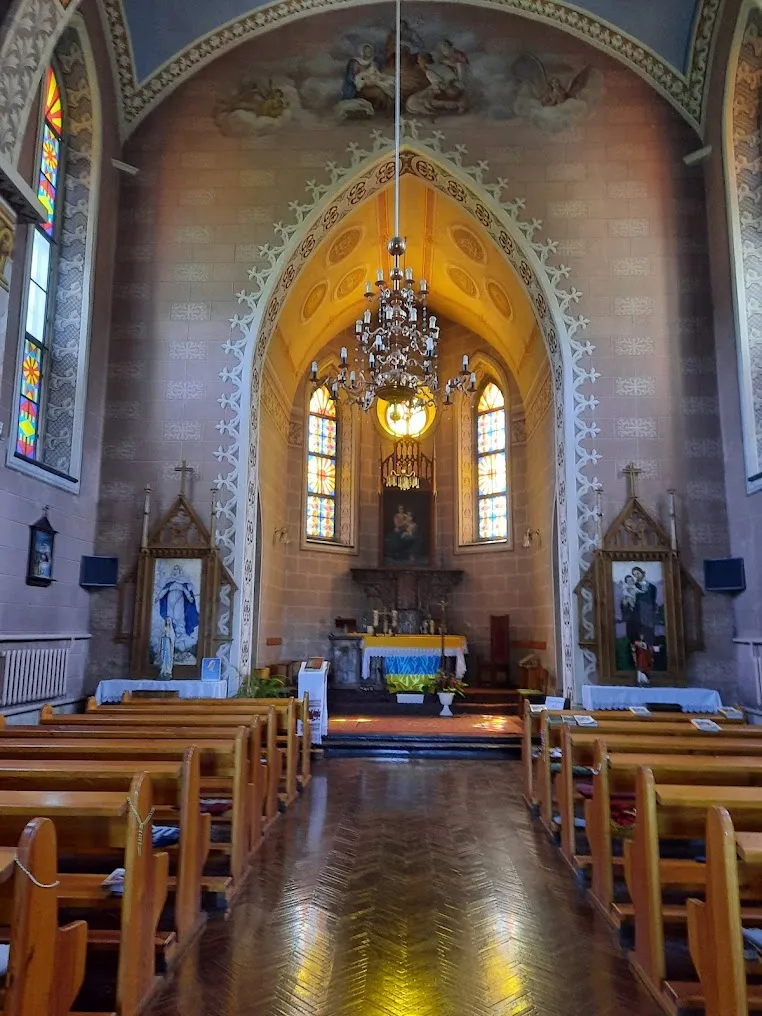
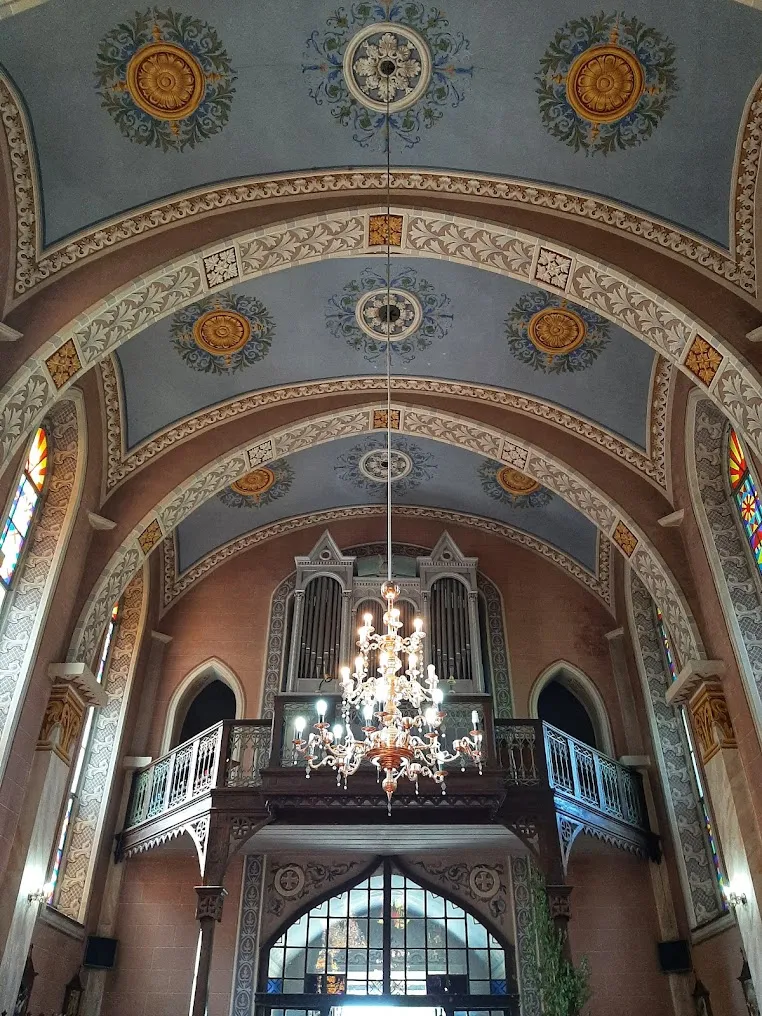
The interior is unexpectedly intact. After the church was returned to the community in 1989, a substantial restoration followed.
The organ remained in the church throughout the Soviet period — but in terrible condition: half its pipes lost or damaged, its bellows unusable. Reconstruction was carried out by the Czech firm “Rieger-Kloss,” with the participation of Vitalii Pivnov, organist of the Lviv Organ Hall, at the initiative of parish priest Yuzef Chop. The organ now plays again.
The wall and vault paintings, done between 1989 and 1992, were the work of artists from Lviv under the direction of Roman Dovhanyk. The altar, confessionals, and Stations of the Cross frames were made by Stefan Adamsky and colleagues from Lviv.
The result: a church that looks lived-in and cared for, despite decades of neglect.
The Soviet Years: Three Closures, Three Reopenings
Soviet authorities closed the church in 1933 — a standard fate for religious buildings of that era.
What followed was less standard. Under Nazi occupation in 1941, the church reopened. In 1959, it closed a second time. First it was used as a warehouse, then as a village museum (which likely explains the name of the street — Muzeina, “Museum Street”).
In 1989, the church was returned to the community, and restoration began.
What to See Nearby
Maliivtsi (~4 miles / ~7 km from Pidlisnyi Mukariv) is one of the most scenic corners of Podillia, with castle ruins and the Studenytsia canyon. Most visitors to Mukariv combine their trip with Maliivtsi — a good approach.
The wider context is the Khmelnytskyi region between Kamianets-Podilskyi and Starokostiantyniv: churches, castles, and the canyons of the Zbruch and Smotrych rivers. The church fits into the “Dniester Panoramas of Ukraine” or “Small Waterfalls of Podillia” routes — both pass through this district.
Practical Information
- Status: an active church
- Address: 19 Muzeina St., Pidlisnyi Mukariv village, Dunaivtsi district
- Admission: free during daytime (except during services)
- Organ: played by prior arrangement — special performances for visitors have precedent
- Time needed: 30–60 minutes (exterior and interior)
How to Get There
Pidlisnyi Mukariv is in Dunaivtsi district, about 4 miles (7 km) from Maliivtsi.
- From Kamianets-Podilskyi: ~28 miles (~45 km), via the N03 highway (Chernivtsi–Khmelnytskyi), turning at Mitsivtsi (between Dunaivtsi and Yarmolyntsi), then through Maliivtsi.
- From Dunaivtsi: ~12 miles (~20 km).
- The road to Maliivtsi has been resurfaced; from Maliivtsi to Mukariv it’s a village road, but passable.
- The church stands at the edge of the village, clearly visible from the road.
Little-Known Details
- The first church here was built in 1613 — when most of the region’s “ancient” castles were already standing or only just being built.
- The church is built of hewn stone rather than brick — a rarity for rural neo-Gothic architecture in Podillia, giving it a more archaic feel.
- Construction took 13 years — long even for buildings of this kind.
- The organ survived every closure and remained in the church, ultimately restored by a Czech firm.
- The name of Muzeina Street, where the church stands, took hold during the Soviet era, when a village museum occupied the building.
- Researchers rank the church alongside Ozeriany as one of the finest examples of neo-Gothic architecture in Podillia.
Conclusion
Pidlisnyi Mukariv isn’t a tourist town. There’s no infrastructure, no crowds. There’s only a church of hewn stone, with two towers, and an organ that plays again.
If you’re already heading to Maliivtsi, stop here for an hour. If you’re not — maybe it’s time you did.