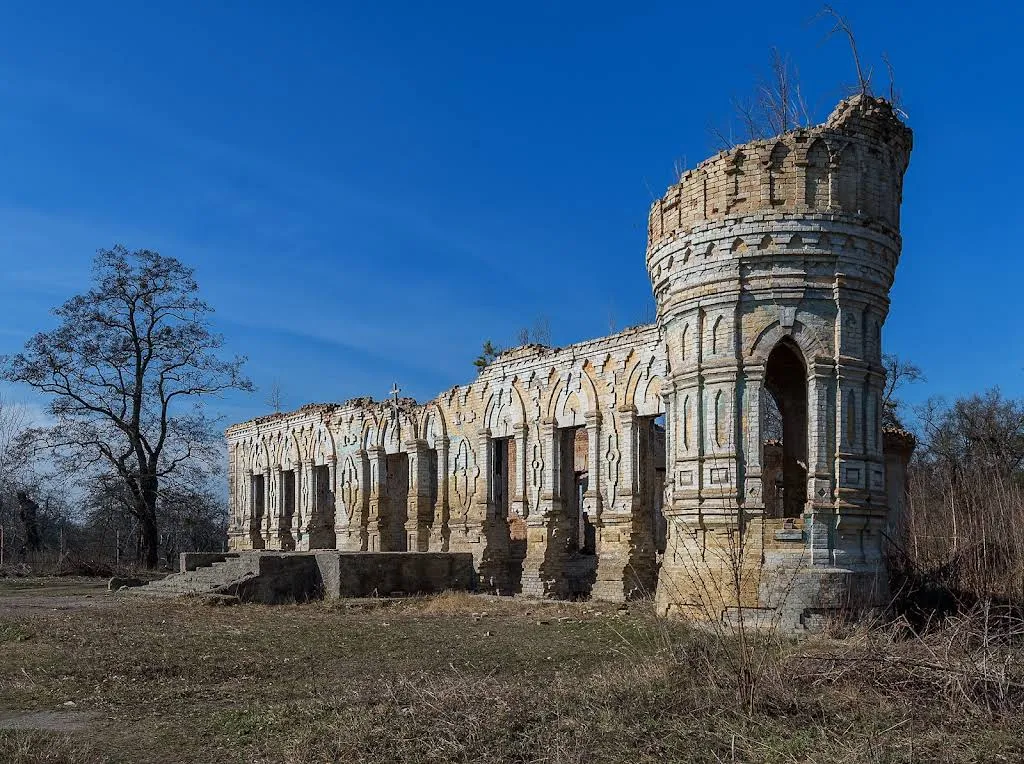
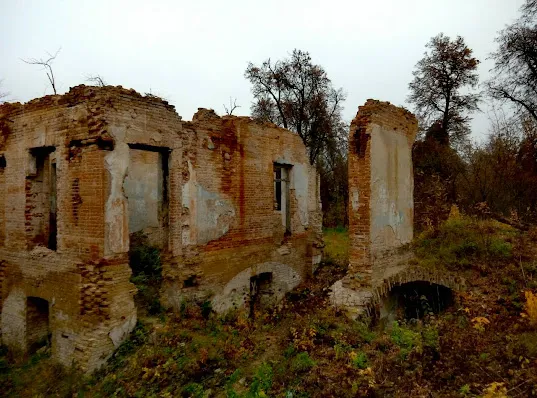
24 miles from Kyiv’s metro, on the edge of Nemishaieve urban-type settlement and Myrotske village, stand ruins that resemble the Parthenon.
Columns, open sky instead of a ceiling, plants growing through the masonry. The von der Osten-Sacken Palace — four owners, several fires, and no restoration at all.
General Information
| What? | Description |
|---|---|
| Name | The von der Osten-Sacken Palace (the Osten-Sacken Estate) |
| Address | Parkova St., Nemishaieve urban-type settlement, Borodianka district, Kyiv Oblast |
| Coordinates | 50.5764°N, 30.1087°E |
| Distance from Kyiv | ~24 miles (~38 km) |
| Land granted | 1805 (given to Karl Sacken) |
| Palace built | first half of the 19th century |
| Sold by the Osten-Sackens | 1873 |
| Fire | 2000 (November) |
| Transferred to the community | May 2018 |
| Status | architectural monument, not entered in the register; ruins |
Karl Sacken and the Mystery of His Death
The estate’s story begins not with construction, but with a gift.
In 1805, the Mykulychi estate — together with Myrotske, Mykulychi, Pylypovychi, Babyntsi, and Poroskoten — was granted to Count Karl Sacken. He served as an actual privy councillor, and earlier as tutor to Grand Duke Konstantin Pavlovich; part of his service was spent in Livonia and Courland. In 1797 he retired and moved to Estland.
He was rarely at the estate.
According to a legend passed down among locals: one evening, when the count did visit the estate, he suddenly went mad and died soon after. What he saw in the dark corners of the grounds is unknown. There’s no documentary confirmation of this account, but it lives on today.
After Karl’s death, the estate passed to Chamberlain Ivan Khristoforovich von der Osten-Sacken (d. 1853), and then to his son, Major General Karl Ivanovich von der Osten-Sacken.
The Palace and Park
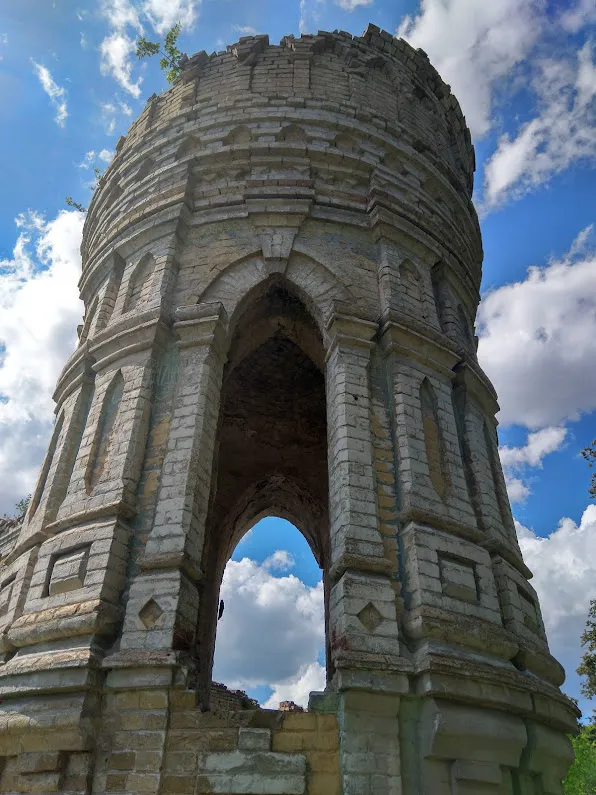
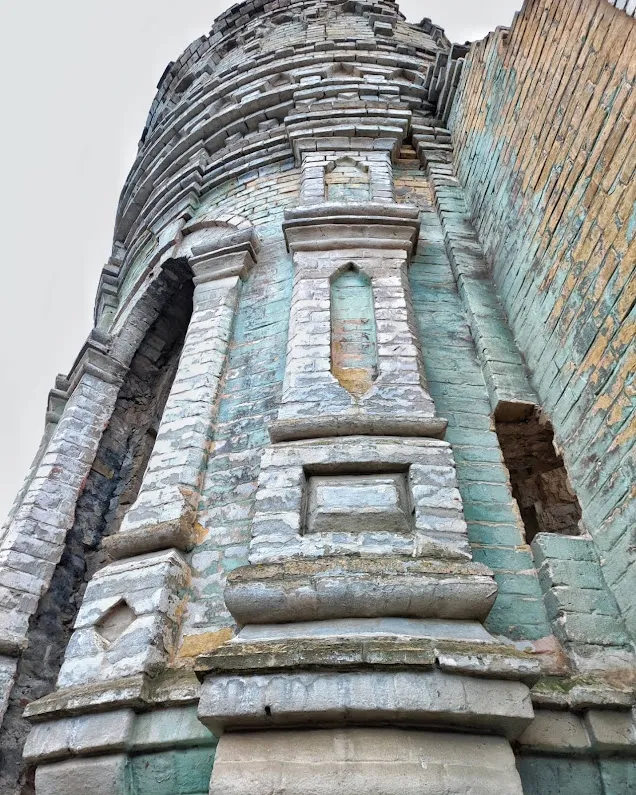
In the first half of the 19th century, the owners built a single-story brick palace with a corner tower and laid out a large surrounding park.
By the early 20th century, the estate included:
- the palace
- two wooden houses in the park
- a gazebo
- fruit trees
- a pond on the Orlianka River, with a wooden footbridge
- greenhouses on the opposite bank
The neighboring plot eventually became the foundation of the railway settlement of Nemishaieve (1902).
Four Owners in 40 Years
The Osten-Sackens held the estate until 1873, when Karl Ivanovich sold it to Yevdokia Astakhova, wife of a Kyiv merchant.
In the 1890s, the estate passed to Count Vorontsov-Dashkov — a man of business, but without luck in agriculture: he built a spirits distillery on the grounds, which turned out to be unprofitable. That’s why, in 1904, the count decided to sell the estate at auction, in parcels.
The new owner was named Andrii Kulyk. According to local tradition, he was a former shepherd, “a businesslike, non-smoking man” who made his fortune buying up goods from drunken chumaks (traveling traders). By another version, he found a barrel of Polish gold, hidden by someone fleeing Ukraine — and bought the estate with it.
Kulyk shut down Vorontsov-Dashkov’s unprofitable horse-breeding operation, brought order to the farm, and kept horses, cows, poultry — and even peacocks.
From Club to Ruins
After the 1917 revolution, the estate was nationalized. The palace and park went to Nemishaieve settlement. When a biochemical plant was built nearby, the palace became the plant’s workers’ club. Early 20th-century furniture remained in the building right up until the late 1990s.
In November 2000, a fire broke out in the palace, at night. The flames destroyed the antique furniture — everything that had survived from the Vorontsov-Dashkov era. The building itself was badly damaged.
After the fire, the estate was never restored. Locals dismantled part of the brick for building materials.
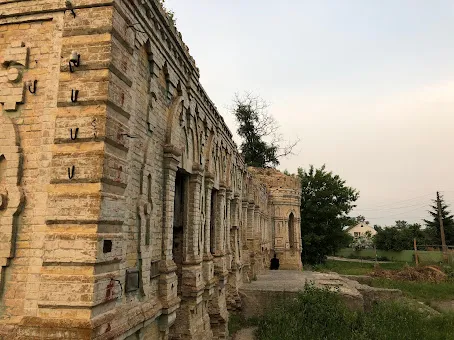
In May 2018, the ruins were handed over to the community of Nemishaieve settlement. There was talk of building a monastery on the site — but it came to nothing more than a cross mounted on the wall. No restoration work has ever begun.
What Stands Today
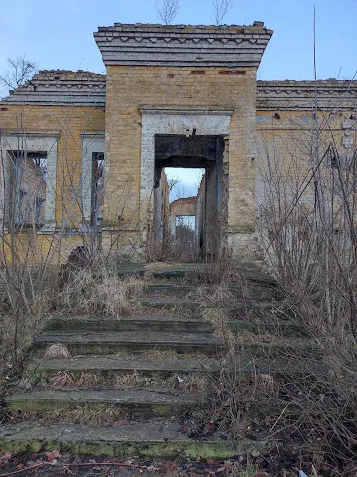
The ruins resemble the ancient Parthenon — open sky instead of a roof, columns, and wall fragments. The façade wall and the remains of the tower have survived better than the rest.
Around it is a park with fruit trees and the Rokach River running through. There are a few ponds.
You can walk into the ruins freely. But take care — the structures are unstable.
What to See Nearby
- The Nemishaieve Reservoir — right nearby
- Nemishaieve railway station — suburban trains to Kyiv several times a day
- Irpin and Bucha (~9–12 miles / ~15–20 km) — if planning a broader route
Practical Information
- Admission: free, unfenced
- Condition: structurally unsafe; exterior viewing is safe
- Time needed: 1–1.5 hours (ruins, park, and ponds)
How to Get There
- Bus/minibus: from Sviatoshyn metro station (route 1921) to the “Myrotske” stop
- Suburban train: Kyiv (Sviatoshyn or Kyiv-Pasazhyrskyi) → Nemishaieve station; then a ~10-minute walk
- By car: the Borodianka or Nemishaieve highway (~24 miles / ~38 km from Kyiv); GPS “Parkova St., Nemishaieve”
Little-Known Details
- Karl Sacken rarely visited the estate he was granted — he lived mostly in Estland.
- The Osten-Sackens sold the estate in 1873 — it changed hands twice more before the revolution.
- Andrii Kulyk, the last private owner, reportedly found a barrel of Polish gold and used it to buy the estate — the first documented “former shepherd” to own a noble palace.
- Under Kulyk, the estate kept peacocks — an unusual detail for a working farm.
- The monastery planned for 2018 never materialized. Only a cross on the wall remains.
- The ruins are commonly compared to the Parthenon — open sky, columns, no roof.
Conclusion
The von der Osten-Sacken estate isn’t a story of grandeur or tragedy. It’s an unbroken chain: a count who went mad; a shepherd who found gold; an unprofitable distillery; a fire that destroyed the furniture; a cross where a monastery should have stood.
24 miles from Kyiv. A suburban train from Sviatoshyn. A park with fruit trees. Ruins that look like the Parthenon.
Worth a visit, at least once.