Fourteen miles from Lviv, in the valley of the Zubra River, stands a building that doesn’t fit any expected image of a village church.
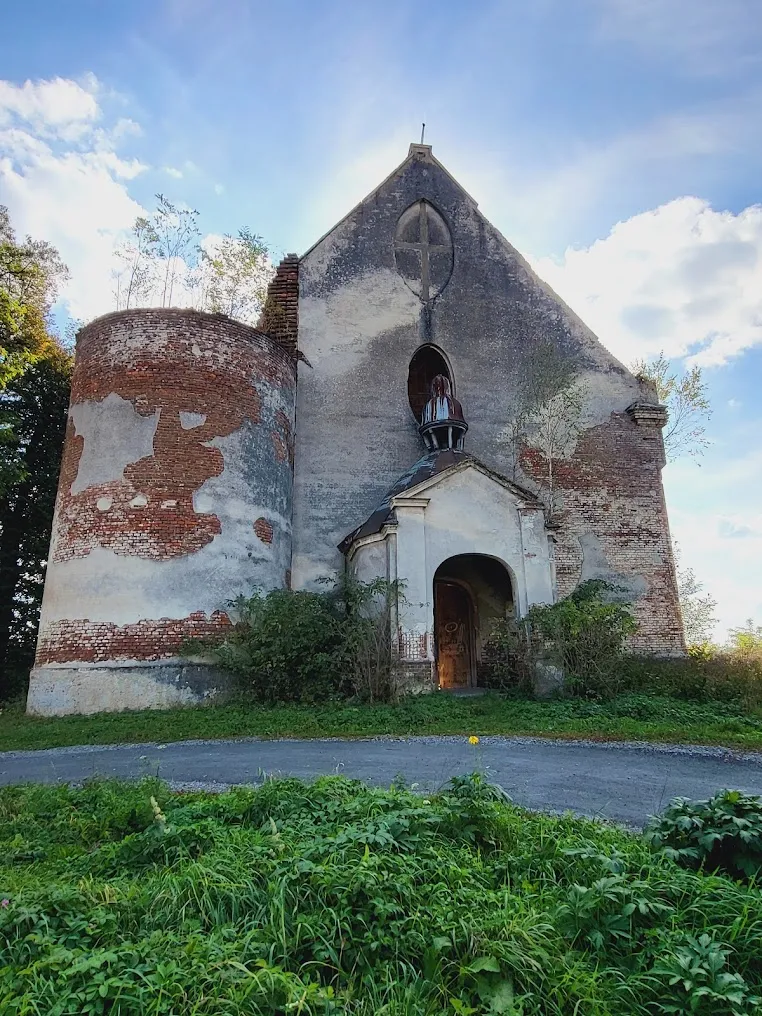
It’s not a baroque chapel. Not provincial neo-Gothic. It’s a church built in the art deco style — from 1924 to 1929, with an asymmetrical plan, a stark façade, and bullet marks on its walls.
The area around Vovkiv is called the “Lviv Carpathians,” for its picturesque hills, and “Kalynovyi Rai” (“Guelder-Rose Paradise”), for something that’s no longer there. The church, too, is about something no longer there. But it still stands.
General Information
| What? | Description |
|---|---|
| Name | St. Mary Magdalene Church |
| Location | Vovkiv village, Solonka rural community, Lviv district, Lviv Oblast |
| Distance from Lviv | 14 miles (22 km), via Lypnyky |
| Built | 1924–1929 |
| Consecrated | October 27, 1929 |
| Style | art deco (modernism) |
| Architect | Bronisław Wiktor (Lviv) |
| Status | architectural monument of local significance No. 1946-m; inactive, partly ruined |
Four Chapters of One Place: from the 16th Century to 1929
A parish has existed in Vovkiv since 1563. The first church, dedicated to St. Mary Magdalene, was built in the mid-16th century. But the current building is already the fourth or fifth on this same site.
16th century — the first wooden church, dedicated to Mary Magdalene, founded alongside the parish in 1563.
1620–1621 — an Ottoman-Tatar raid destroys the church.
1673 — the next church is destroyed.
1677 — a new wooden church is built, this time dedicated to St. Stanislaus, consecrated in 1712.
1912 — the community commissions a design for a stone church from Lviv architect Jan Nowyt. World War I halts construction.
1924 — on the recommendation of a conservator, the old wooden church is dismantled. On May 24, 1924, Dean of Shchyrets, Father-Prelate Kazimierz Dziurzyński, consecrates the cornerstone of the new stone church.
This time, it went through. Under the leadership of parish priest Father Jozafat Hieszczyński and to a design by Bronisław Wiktor, funded largely by parishioners’ donations, the church rose quickly. On October 27, 1929, the same Dziurzyński consecrated the completed church. On December 1, 1929, the first service was held. An organ was installed in 1930.
Art Deco in a Field: Why This Church Is Unique
Most village churches in Galicia from the 19th and early 20th centuries are neo-Gothic or eclectic, with classicist elements. Bronisław Wiktor chose art deco instead, making the church in Vovkiv the most striking example of that style in the sacred architecture of the Lviv region.
The building is asymmetrical in plan — a rarity for village churches. Its body forms a nave with two rows of side chapels; a sacristy is attached to the west, against the walls of the nave and the altar section. The altar faces south — not east, as in most Orthodox and Catholic churches.
Outside: severe geometry, minimal decorative excess, an emphasis on the plasticity of volumes. Inside — before Soviet-era destruction — there was organ music, altars, pews, and a processional icon. All of this was successfully moved to other churches before the closure, saving these treasures from destruction.
Bronisław Wiktor used this same style in other projects: churches in Stara Sil (1922–1928), Vyzhniany (1929–1931), and Radokhyntsi (1931). Vovkiv is the most complete and characteristic of them.
Film and a Bullet: Two Unexpected Details
First. The first Ukrainian detective film, “A Crime with Many Unknowns,” based on a work by Ivan Franko, was filmed within these walls. Sources don’t specify exactly when or under what circumstances, but the fact itself is documented.
Second. In July 1944, Vovkiv changed hands several times between warring sides. Traces of that fighting — shell holes and bullet marks in the church walls — were still visible as of 2015, and are likely visible today.
This isn’t decoration or legend. It’s physical memory of specific events.
Soviet Fate: Mineral Fertilizer
In April 1946, the parishioners left Vovkiv, resettled to Poland as part of the postwar population transfer. The church was first converted into an Orthodox church, then, in 1948, into a collective farm warehouse for mineral fertilizer.
Where the organ once played, chemicals were stored.
After independence, the building remained neglected for some time. A restoration to return it to its original appearance was never carried out.
Condition Today
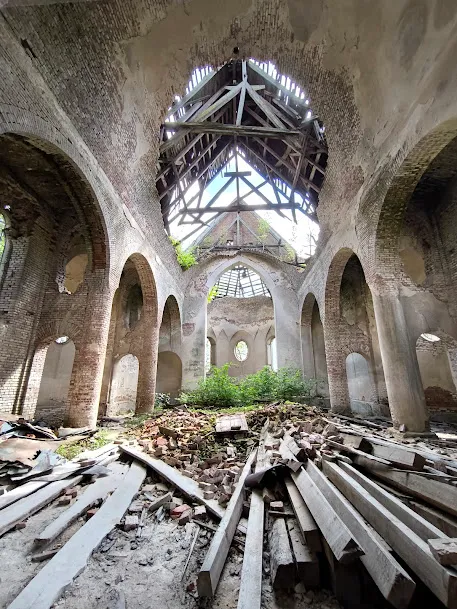
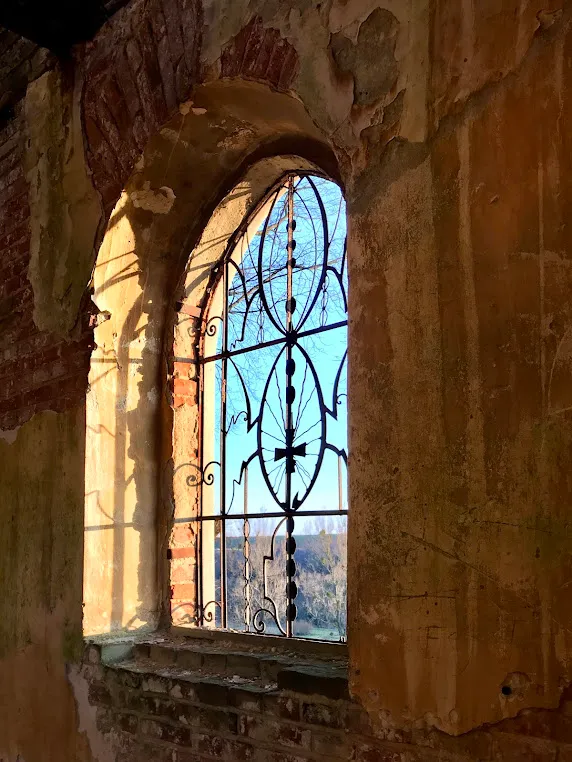
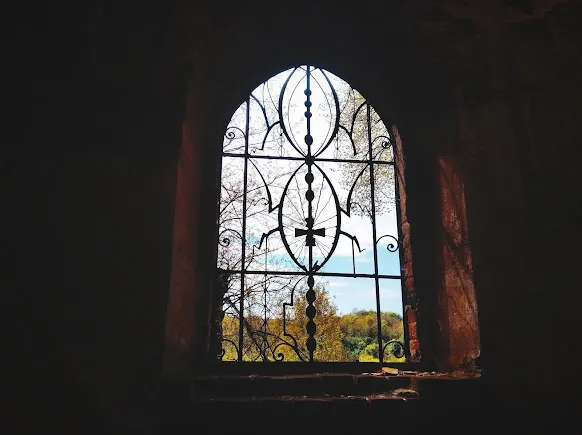
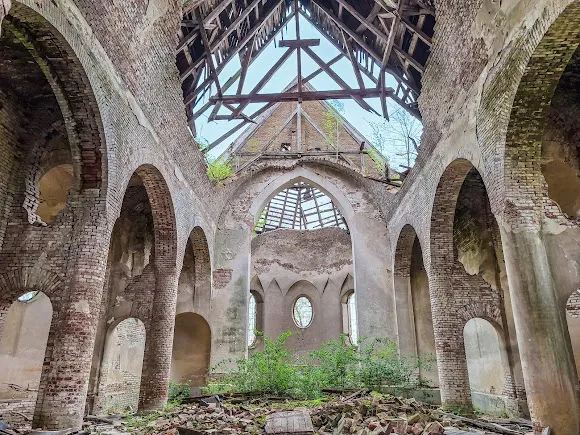
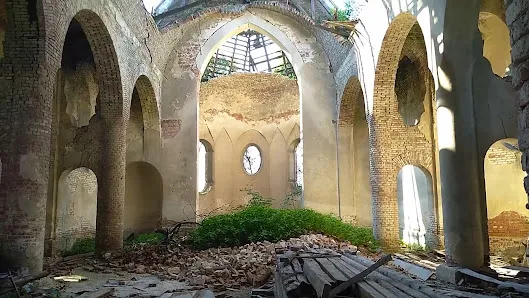
The church is partly ruined. Its roof structure is damaged, plaster is crumbling, and parts of the walls bear graffiti. Almost none of the interior architectural elements survive — everything of value was removed before closure. What remains are the walls, the volume, the spare geometry of the façade, and the bullet marks.
But it still stands. For more than 95 years now.
What to See Nearby and How to Fit It Into a Route
Vovkiv is 14 miles (22 km) from Lviv — close by.
Right in the village stands another landmark: the wooden Church of the Presentation of the Virgin Mary, with its bell tower (1702–1706) — also an architectural monument of local significance. Two different centuries, two different styles, two different materials — wood and brick — literally across the road from each other.
In the broader context, Vovkiv lies within the Pustomyty direction from Lviv, alongside Svirzh, Pidhirtsi, and the road to Stryi — a natural single-day route linking several locations.
Practical Information
- Status: inactive, partly ruined
- Admission: free (no fence)
- Getting inside: possible through open gaps, but take care — the roof structure is damaged
- Time needed: 20–40 minutes (exterior, plus the wooden church nearby)
- Mobile signal: available
How to Get There
- From Lviv: 14 miles (22 km) via Lypnyky — the Lviv–Stryi highway, turning toward Solonka and then Vovkiv.
- Coordinates: 49°44′14″N, 23°52′02″E
- The road is paved. Parking is available in front of the church.
Little-Known Details
- Art deco in rural sacred architecture in Galicia is rare. Vovkiv is the most complete surviving example of this style among Bronisław Wiktor’s works.
- A design for a new stone church was already commissioned in 1912 — but World War I halted construction. Twelve years passed between the plan and its realization.
- The wooden church in Vovkiv (1702–1706) is 220 years older than the stone church. Both monuments stand in the same village.
- Vovkiv is first mentioned in writing in 1398 — by some accounts, even as early as 1369. Locals say the village is older than Lviv.
- “Kalynovyi Rai” (“Guelder-Rose Paradise”) is the area’s old folk name. The guelder-rose bushes are gone, but the name has stuck.
- Ukrainian cinema’s first detective film was shot right here — in a hall now abandoned, marked by geometric vaults and bullet holes.
Conclusion
The church in Vovkiv is about several kinds of loss happening at once. A community that left. An organ that fell silent. Fertilizer in place of worship. And 1929 art deco standing under the open sky, 14 miles from Lviv.
It hasn’t been restored, and likely won’t be anytime soon.
But it’s worth the stop — while it’s still standing.