Standing beside Dzhurynsky Waterfall, you’ll barely hear the person next to you. The water drops 52 ft (16 m) across a 66-ft (20 m) width — and the roar is loud enough that people nearby gesture instead of talking.
But there’s one thing almost every tourist description leaves out: nobody actually knows for certain how this waterfall came to be.
General Information
| What? | Description |
|---|---|
| Name | Dzhurynsky (Chervonohorod, Nyrkiv) Waterfall |
| Location | the Chervone tract, between Nyrkiv and Ustechko villages, Chortkiv district, Ternopil Oblast |
| Coordinates | 48°48′18″N, 25°35′15″E |
| Height | 52 ft (16 m) |
| Width | 66 ft (20 m) |
| Cascades | 3 |
| River | the Dzhuryn (a tributary of the Zbruch, which flows into the Dniester) |
| Status | hydrological monument of nature of local significance; part of the “Dniester Canyon” National Nature Park |
| Admission | free |
Three Versions of One Waterfall
The most popular story goes like this: in 1672, during the siege of Chervonohorod Castle, Ottoman forces cut through a rocky ridge between two arms of the Dzhuryn River, to deprive the fortress of its water defenses. The river took a new, shorter path — and the resulting elevation drop created the waterfall.
It’s a good story. But it doesn’t hold up against the maps.
The von Mieg maps of 1779–1782 — the most accurate geographic record of that era — show that by the late 18th century, the river here already ran full, with a water mill standing beside it. Had the Ottomans diverted the channel for the siege, it would have remained diverted afterward too.
A second theory: the channel was altered during construction of the Poniński family’s palace in the 18th century, to create a lavish surrounding park. But that raises a question about the surviving 19th-century bridge nearby — it wouldn’t have made sense to build if a substantial river hadn’t already existed there.
A third theory: it’s simply natural, and always has been.
The official position: artificial or mixed origin, but the exact moment and cause remain unknown. The site was declared a natural monument on October 23, 1972.
What Happens to the Water Here
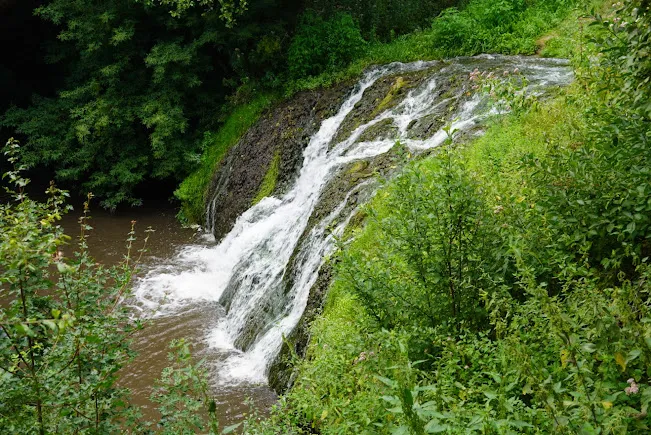
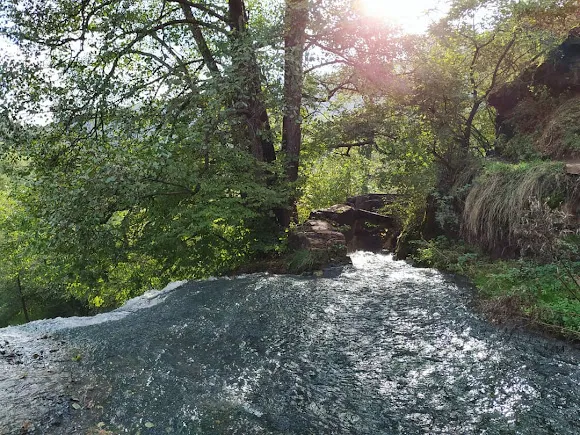
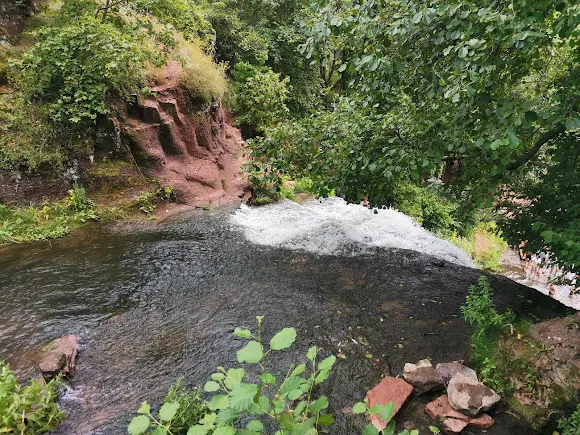
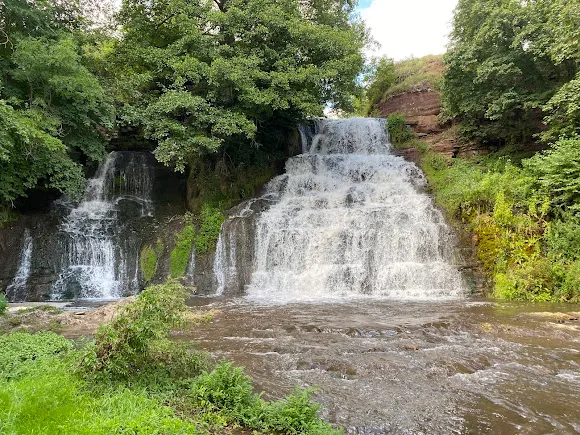
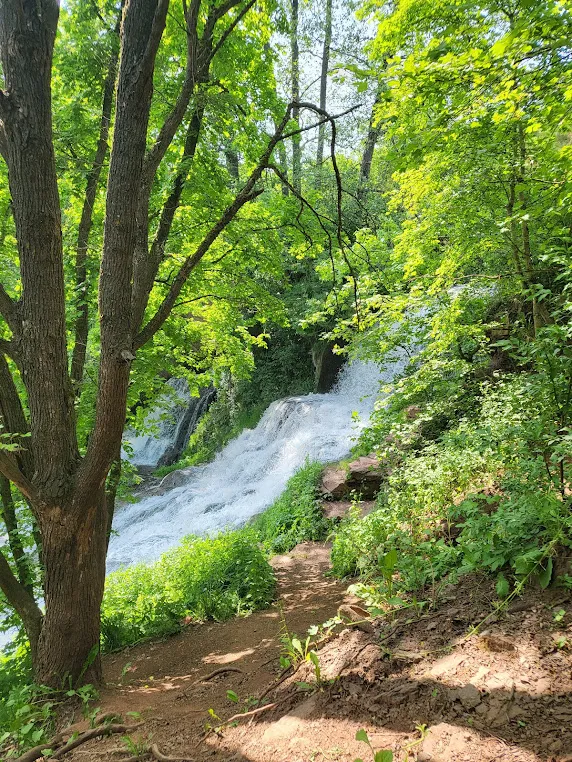
The waterfall consists of three cascades. The upper one is the most photogenic, but also the most dangerous: slippery rocks and a strong current.
The lower cascades form deep pools, popular for summer swimming. The water in these pools stays cold even in August: around 59°F (+15°C). After the cold plunge, you feel it accordingly.
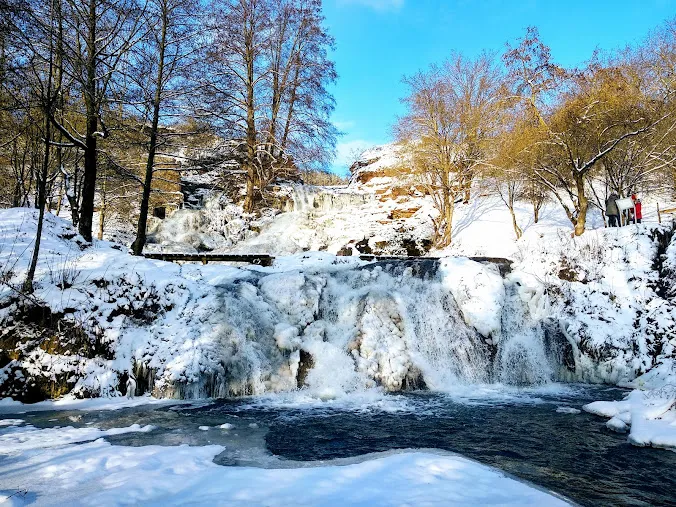
In winter, the waterfall freezes into columns of ice — a completely different look from summer. It’s a less-visited but no less striking version of the site.
The surrounding rocks carry a reddish tint — the source of the area’s old name, Chervonohorod (“Red Town”): the ground here really is a different color.
What Not to Expect
On weekends from May through September, the site draws large crowds — sometimes very large, especially in hot weather and closer to midday. If you want solitude or clean photos without strangers in the frame, come on a weekday morning, or in April before the tourist season picks up.
One more thing: the waterfall looks more compact than it sounds. Online photos are taken from the right angles at the right time of year, creating the impression of something far larger. Expect Niagara, and you’ll see Podillia instead. But the roar, and the feel of the water, are the real thing.
What’s Nearby — and Why It’s Worth Staying Longer
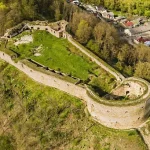
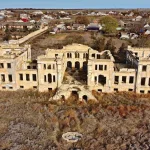
A 10-minute walk to the east are the ruins of Chervonohorod Castle and the remains of the Poniński family’s 1870 Gothic-style palace (architect Julian Zachariewicz). Until 1939, Princess Lubomirska lived here; then came the Bolsheviks, then emptiness. Now only the walls stand, gradually overgrown with trees.
A 30-minute walk downstream is the “Hermit’s Cave”: a small grotto in a travertine cliff where, in the 19th century, a monk lived and carved stone. Part of the statue of St. Onuphrius he carved survives. Above the entrance are three statues of the Mother of God and the “Maiden’s Tears” waterfall.
Practical Information
- Admission: free
- Parking: informal, near the approach to the tract; a 10–15 minute walk from there
- Footwear: hiking or closed-toe shoes — the area near the water is slippery
- Swimming: in the pools of the lower cascades; water around 59°F (+15°C)
- Time needed: 40 minutes for the waterfall alone; 3–4 hours with the castle and cave
- Best time: a weekday morning, April–May or September
How to Get There
- From Chortkiv: ~16 miles (~25 km) via Zalishchyky or a direct road; ~30 minutes
- From Ternopil: ~68 miles (~110 km); the Ternopil–Buchach–Yazlovets–Nyrkiv road
- Public transport: a Ternopil–Ustechko or Chernivtsi–Sverkivtsi bus; or reach Zalishchyky and continue by taxi
Conclusion
Dzhurynsky Waterfall is a rare case of a place louder than its reputation — not in scale, but in sound. You stand there and realize that this small Podillia river drops 52 ft here for reasons nobody fully understands.
Somehow, that fits Podillia as a whole.