The first impression here is strange.
These don’t look like rocks.
It’s as if someone carefully cut the stone into identical blocks and stacked them into a wall. Too even. Too symmetrical. Too “man-made.”
But no.
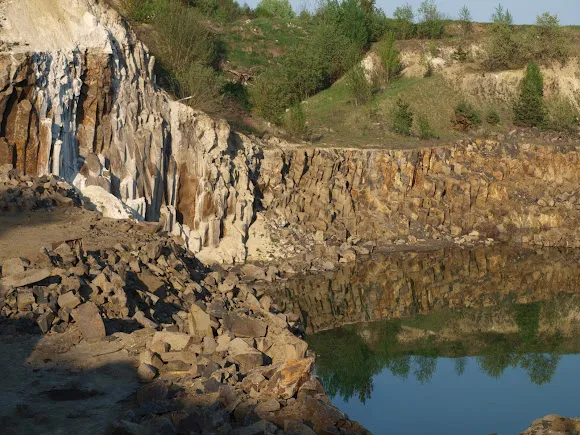
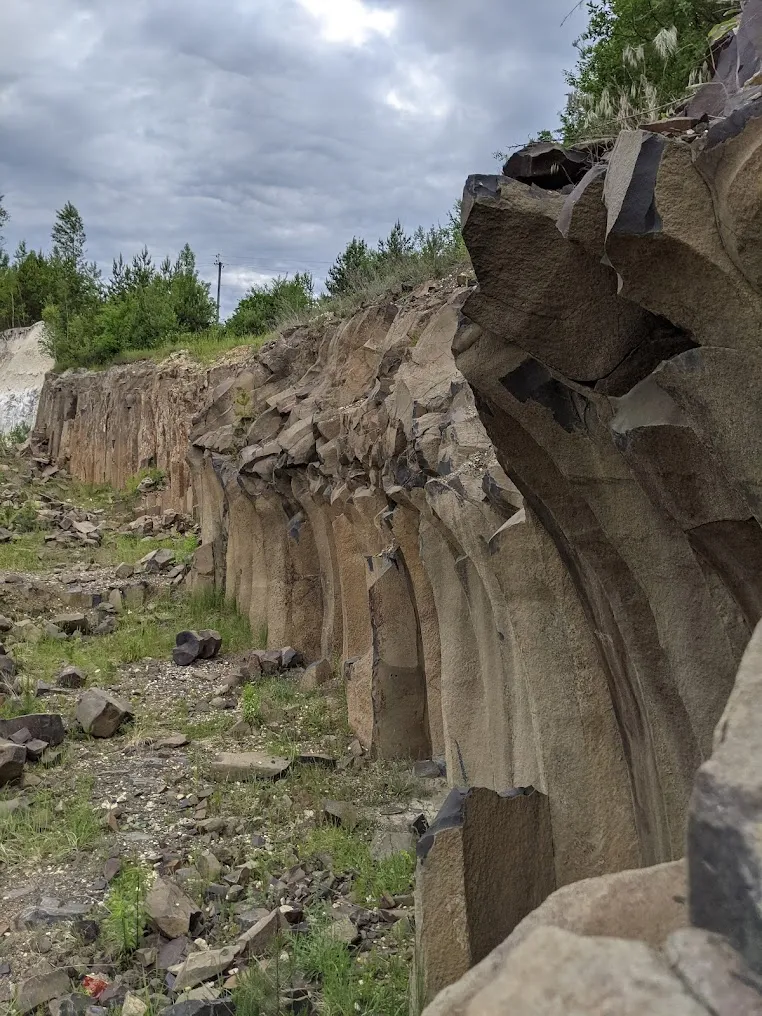
This is pure geology. Basalt that cooled slowly — and over millions of years of orderly crystallization produced something any architect would have had to design on purpose.
General Information
| What? | Description |
|---|---|
| Name | Basalt Columns (geological reserve) |
| Official name | “Basalt Columns” Geological Monument of Nature |
| Location | Bazaltove village (formerly Yanova Dolyna), Holovyne rural community, Rivne district, Rivne Oblast |
| Coordinates | 50.922748°N, 26.234317°E |
| Age of the basalt | ~700 million years |
| Column height | 10–98 ft (3–30 m) |
| Column thickness | 2–4 ft (0.6–1.2 m), mostly around 3 ft (0.8–1.0 m) |
| Shape | from four-sided to eight-sided, most commonly hexagonal |
| Length of the monument | ~590–755 ft (180–230 m); the protected area extends over 0.9 miles (1.5 km) |
| Protected area | about 2 acres (0.8 ha); a reserve since 1972 |
| Status | one of the 7 natural wonders of Ukraine; a geological monument of nature |
Why the columns are so regular: geology in a minute
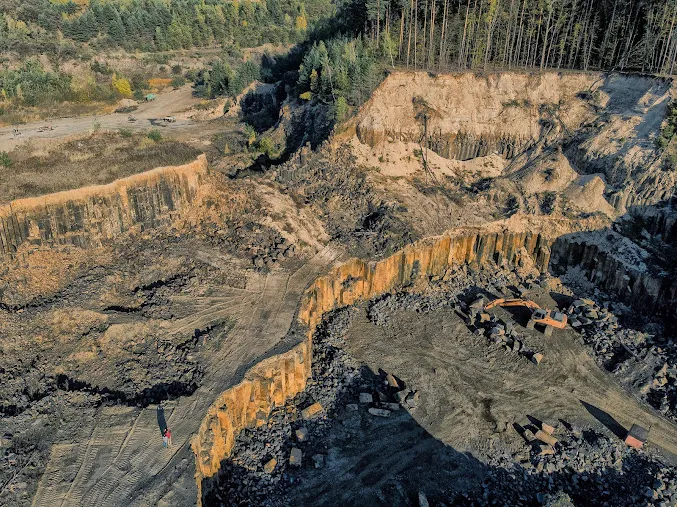
Millions (more precisely, hundreds of millions) of years ago, there was a volcano here. Lava flowed out, cooled, and crystallized. As it cooled slowly, the basalt mass contracted evenly and cracked along straight lines, forming regular polygonal columns.
Why hexagons? Because a six-sided shape is the most efficient geometric structure for even contraction — it minimizes crack area for a given volume. Nature “chooses” it on its own.
The same kind of structures exist in Iceland (Reynisfjara), Ireland (Giant’s Causeway), Scotland, and Japan. But in Ukraine, only here — because exposed basalt deposits exist in just one place in the entire country: the Rivne region.
What went to Paris and Vienna
Basalt has been quarried here since 1861, first for paving stones and now for industrial uses as well.
Basalt from the Rivne region was laid as paving stones in Paris, Brussels, Vienna, Warsaw, and Berlin. That’s not a legend — it’s a documented fact.
Today, basalt from here goes into heat-shielding coatings for spacecraft, fabric for firefighting suits and space suits, and is used in turbojet engines.
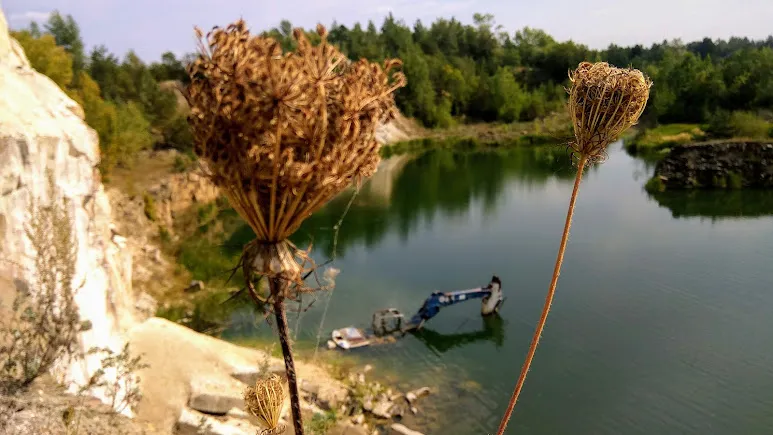
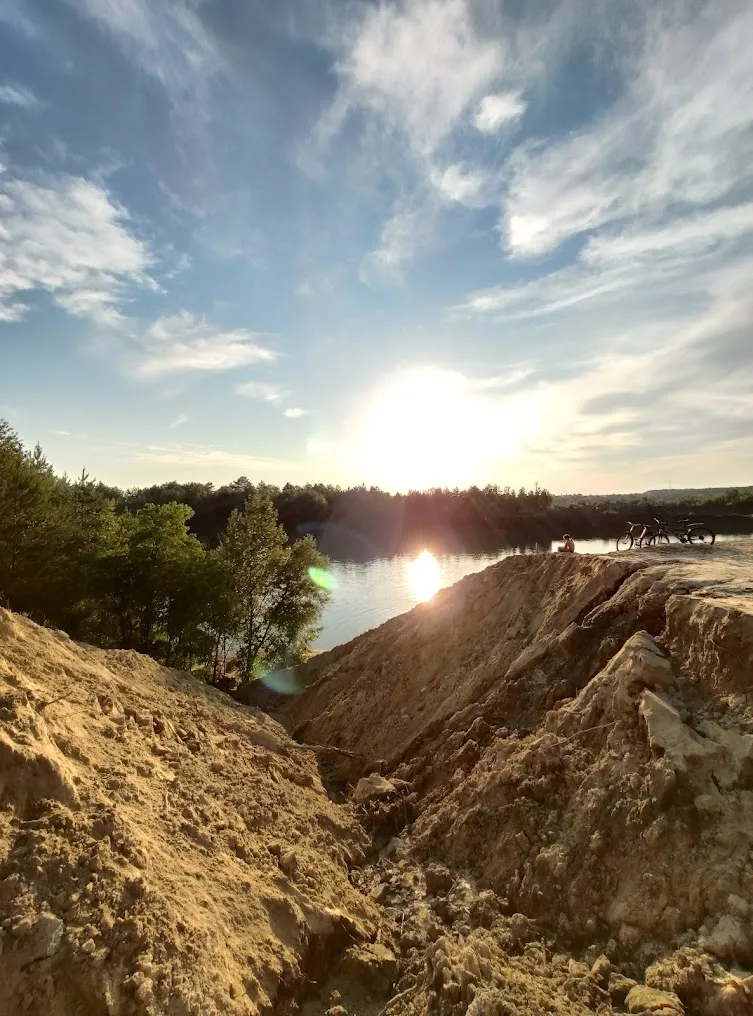
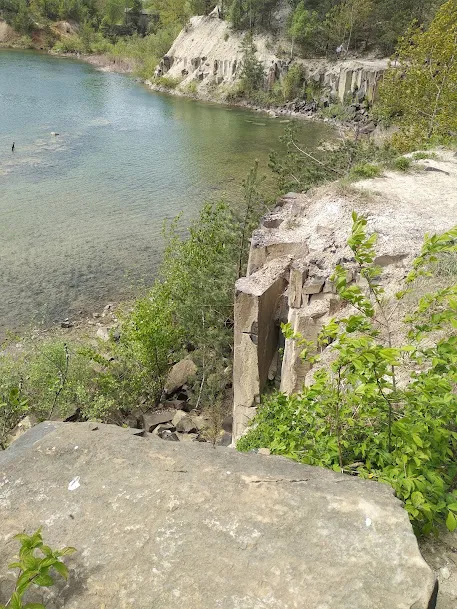
The deposit has five quarries. The basalt columns are best seen in quarries No. 3 and No. 5. Some of the quarries are flooded and have turned into lakes with clear water.
The Island of Love and gemstones
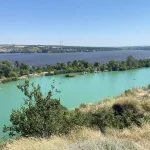
Bazaltove Lake (a flooded quarry) is a tourist draw in its own right. The water is emerald-clear, almost turquoise. In the middle sits a small heart-shaped island that locals have named the “Island of Love.” You can swim or take a boat out to it.
Gemstones turn up in the cracks between the columns: adularia, chlorite, chalcedony, pyrite, azurite, and native copper. That’s not a myth — it’s been confirmed by a lead geologist from the Rivne Geological Survey Expedition.
And if you find the mouth of the extinct volcano (locals can point it out), you can see the columns fanning out from a central point — the spot where it all began.
Film and music
Scenes from the Ukrainian film “Poводyr” (“The Guide”) (2014) were filmed here, along with a music video by Ruslana.
Practical Information
- Admission: free
- Coordinates: 50.922748, 26.234317
- Five quarries: stop at No. 3 or No. 5 for the tallest columns; Bazaltove Lake is the most striking flooded quarry
- Swimming: there’s a beach at Bazaltove Lake
- Diving: growing in popularity thanks to the underwater terrain
- Fishing: crucian carp, tench, perch; in the nearby Horyn River — bream, catfish, crayfish
- Time needed: 1.5–2 hours (columns plus lake)
How to Get There
- From Rivne: ~56 miles (~90 km) north via Kostopil
- Train or bus Rivne–Kostopil, then a minibus or taxi to Bazaltove
- By car: set your GPS to 50.922748, 26.234317
What to See Nearby
- Tunnel of Love (Klevan) — ~43 miles (70 km), in the opposite direction from Rivne, but the two combine into a classic Rivne-region route
- Dubno and Ostroh (~43–50 miles / 70–80 km) — castles and the “Ostroh Academy”
- Tarakaniv Fort (~50 miles / 80 km) — can be folded into a trip to Dubno
Little-Known Details
- It’s Rivne district, not “Kostopil district” as older sources say. After the 2020 administrative reform, Kostopil district was merged into Rivne district.
- The village’s former name was “Yanova Dolyna.” The quarry is still officially called “Ivano-Dolynskyi.”
- In the 1930s, entire workers’ settlements were built here to Polish-era designs — schools, stadiums, cinemas, clinics. Some of it survives.
- Quarrying began in 1861 — basalt has been mined here for more than 160 years.
- You can find and see the mouth of the extinct volcano, where the columns fan out from a central point.
- Basalt is the leading mineral resource of the Rivne region, after amber.
Conclusion
The Basalt Columns look as if someone designed them on purpose.
But they were made by lava that cooled hundreds of millions of years ago. That stone was later shipped to Paris to pave its squares. Now it goes into space suits.
And in the middle of it all — a heart-shaped island in an emerald lake.
The Rivne region knows how to surprise.