Imagine: pine forest, country roads, green hills all around. And suddenly — sand. Dunes. Wind that erases traces in a few minutes.
The Kytsivka Desert is one of the most unexpected natural locations in Ukraine. It is officially called “Hilly Sands” and is a semi-desert, but it looks more convincing than any explanation.
General information
| What? | Description |
|---|---|
| Name | Kytsivka Desert (officially “Hilly Sands”) |
| Other names | Kharkiv Desert, Kharkiv Sahara |
| Location | south of the village of Kytsivka, Chuhuiv district, Kharkiv region. |
| Object type | sandy hilly massif, semi-desert |
| Dimensions | length ~5 km, width ~2.3 km, area ~9 km² |
| Dune height | up to 8 m; height difference ~50 m |
| Coordinates | 49.851338, 36.822477 |
How the desert appeared
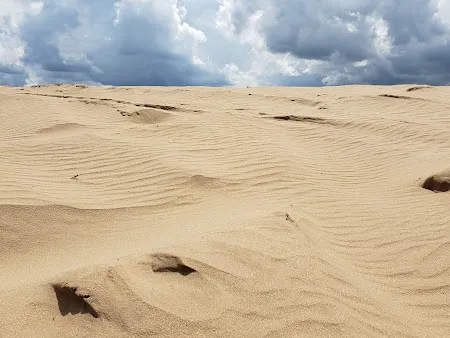
The sand deposits here are of natural origin and are about 100 thousand years old. They were formed in the ancient riverbed of the Siverskyi Donets: the river deposited alluvial sand in the floodplain, and this sand still lies here in mounds that move under the influence of the wind.
In the 20th century, man intervened in this landscape radically. From the 1960s to the 1990s, a Soviet tank training ground operated here. Tanks moved over the dunes, completely destroying any vegetation that tried to gain a foothold on the sand. After the training ground was liquidated, the landscape remained open.
That is why the desert looks the way it does: not covered in forest, not overgrown with bushes – alive, mobile, a little different every year.
Natural features
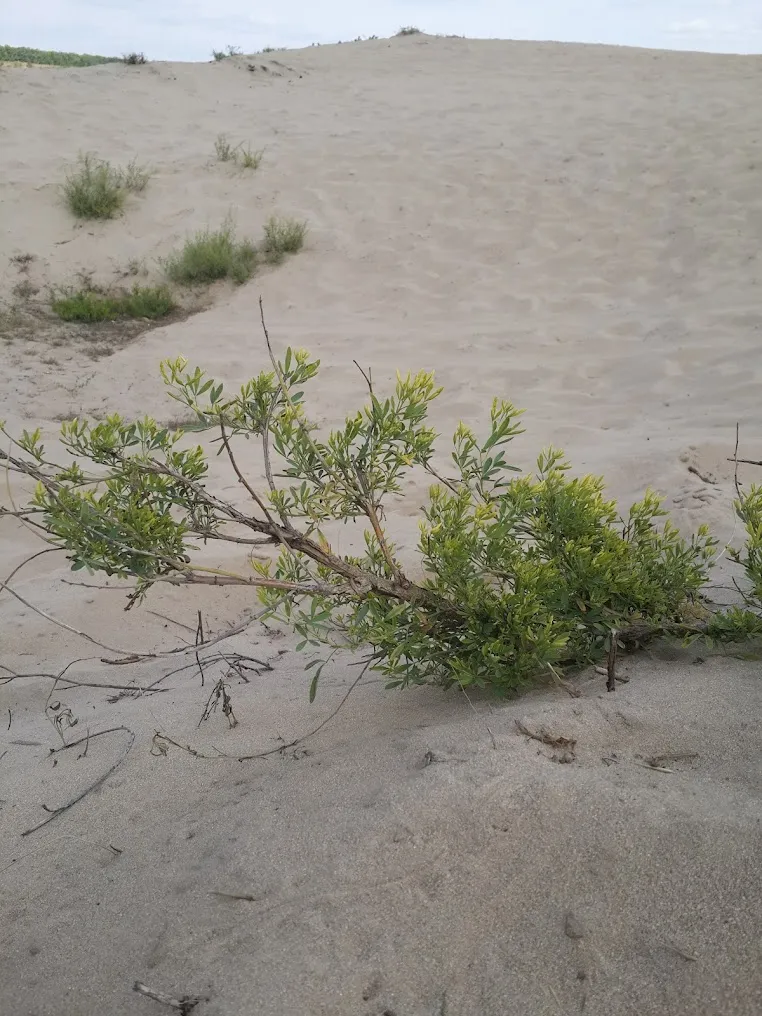
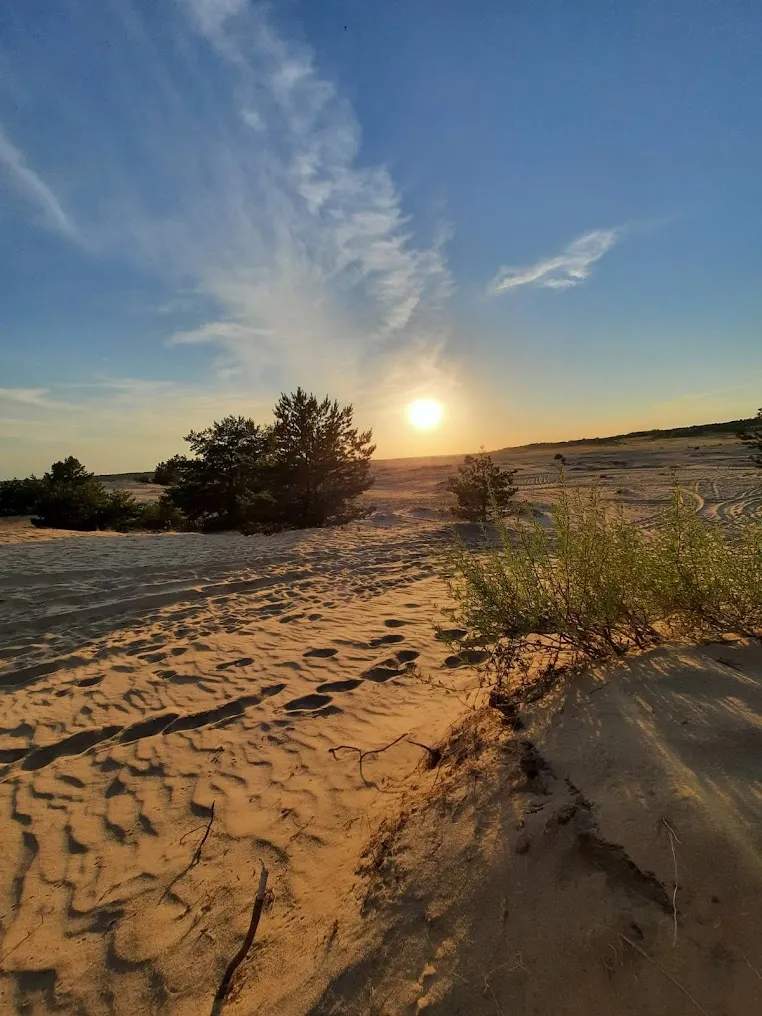
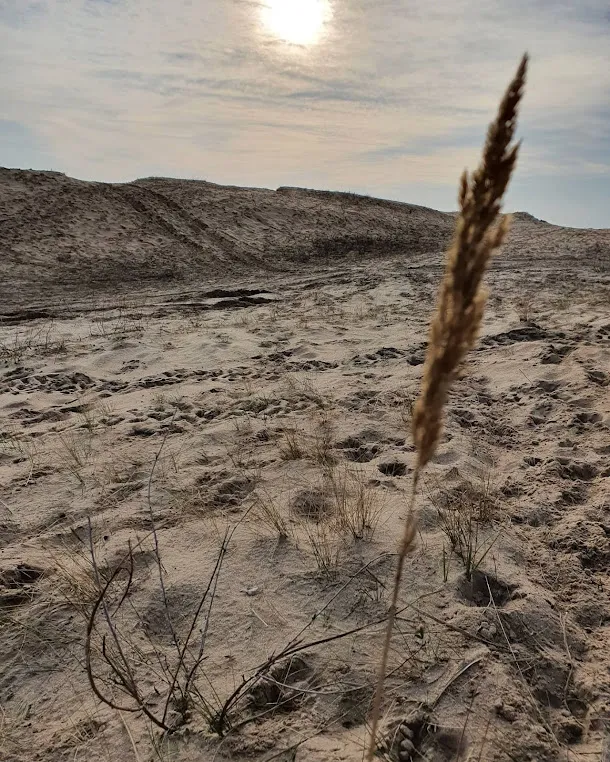
Waving sandy hills, single pine trees growing straight out of the sand, almost complete lack of shade – the contrast with the surrounding pine forest is physically felt. You step out of the forest shade – and find yourself in a different climate.
On hot days, the sand heats up so much that it is difficult to walk on it barefoot. On the ridges of the dunes, the wind is constant.
In addition to the landscape, the Kytsivka Desert is a documented habitat for several rare species of insects that are almost not found anywhere else in Ukraine. The semi-desert conditions – heat, sand, minimal moisture – are ideal for them. This is the official basis for protecting the place, even despite the lack of formal reserve status.
Sense of place
Locals don’t tell legends.
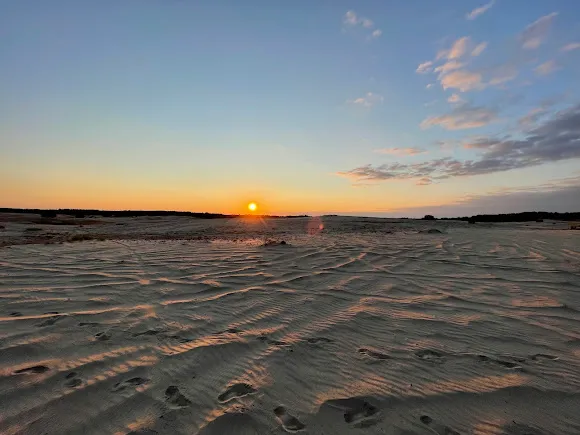
But they do speak accurately about the feeling: the sound is different here – footsteps are absorbed by the sand, landmarks disappear quickly. The space seems larger than it really is.
Before sunset, the dunes cast long shadows – and the desert looks unreal, like a fragment of another continent inserted into the map by mistake.
What to see nearby
Kitsivka Desert goes well with the Pechenihy Reservoir – it is located nearby and provides an opportunity to end the day on the water after a walk on the sand.
The Kytsivka Desert is one of the most obvious “anomalies” of the left-bank forest-steppe.
Practical information
- Entrance: free, 24 hours
- Infrastructure: completely absent – bring water, food, sunscreen
- Exploration time: 1–2 hours
⚠️ Security — two separate risks
- Unexploded ordnance. The former tank range has not yet been completely demined. Artillery shells and cartridge cases from the Soviet era are found among the sand. Do not move or touch unfamiliar objects in the sand. These are not cautions for the sake of ticking off the box – this is a real risk, recorded in several sources.
- Frontline region. Kharkiv region is a zone of active fighting and shelling. Chuhuiv district was partially occupied in 2022. Before traveling, be sure to check the current security situation through official channels of the Kharkiv Regional Military Administration. The situation is changing.
When to go
The best time is April-May or September-October. In the summer, the sand is hot at noon, there is no shade. In a strong wind, the sand hits your face – take sunglasses. After rain, the sand sticks together and partially loses its expressiveness; but the risk of “sand traps” on the approach is minimal.
How to get there
Location — ~50 km from Kharkiv, Chuhuiv district, south of the village of Kytsivka.
By car: along the highway towards Pechenihy. After the village of Kytsivka — turn onto a dirt road without signs. Navigator coordinates: 49.851338, 36.822477. A passenger car will pass in dry weather; after rain — higher ground clearance is desirable.
Public transport: bus “Kharkiv – Pechenihy” from bus station No. 6, stop “Snizhynka” in Kytsivka — then 2 km on foot through the forest.
Parking — near the forest, without entering the dunes themselves.
Little-known details
- The official name in the geographical registers is “Hilly Sands”. “Kytsivka Desert” and “Kharkiv Desert” are folk names, but they are the ones that have become established in tourist usage.
- This is one of two deserts in Ukraine: the second is Oleshky Sands in the Kherson region, which is much larger in scale (~219,000 ha versus ~900 ha).
- The age of the sand deposits is about 100 thousand years: the desert existed long before any human influence.
- The rare insects that live here have not been studied enough – some species do not even have Ukrainian folk names.
- Even after the landfill was liquidated in the 1990s, the desert did not “grow back”: without constant soil compaction by machinery, the sand remains mobile and restores itself independently.
Conclusion
The Kytsivka Desert is not impressive in scale.
It is impressive in the very fact of its existence — a landscape that has no place here according to all climatic logic. It is as if someone mixed up the coordinates and placed a piece of Central Asia in the middle of the Kharkiv forest-steppe.
The location is suitable for photographers, connoisseurs of unusual landscapes and everyone who is ready to exchange infrastructure for silence and space.
Just check the safety map first — and don’t touch anything in the sand.