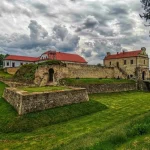
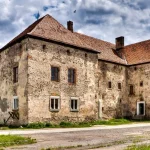
Amid the country roads of the Kyiv region, in Tkhorivka, stands an almost forgotten estate that once belonged to the noble Strashynsky family. Locals still call it the “manor house.”
There were once lavish evenings here, a park, a balcony overlooking a lake, and a tower with a clock. Today there’s a concrete fence, overgrown lanes, silence, and local stories that tie this place to one of the darkest chapters of the serfdom era.
General Information
| What? | Description |
|---|---|
| Name | Strashynsky Estate |
| Location | Tkhorivka village, Skvyra urban community, Bila Tserkva district, Kyiv Oblast |
| Type of site | noble estate, manor complex |
| Architect | Henryk Marconi (1792–1863) |
| Period built | 19th century |
| Status | architectural monument of local significance |
| Coordinates | 49.692°N, 29.766°E |
Who Built It, and When
In the 19th century, Tkhorivka was owned by the noble Strashynsky family. A member of the family made the village his residence and hired Henryk Marconi to design it — a Polish architect of Italian descent, one of the most sought-after masters working on the Right Bank of Ukraine in the first half of the 19th century (his designs produced dozens of buildings across Poland, Belarus, and Ukraine).
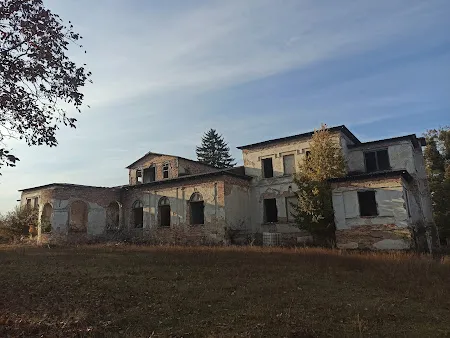
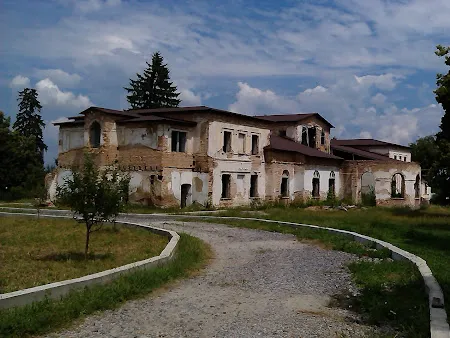
Marconi’s design produced a manor house, a church, a clock tower, and a landscaped park. The complex spans several acres (a few hectares), stretching from the house down to the lake.
This was a typical 19th-century magnate’s residence: both a working estate and a cultural one, open to guests and closed to serfs.
A Dark Chapter: Strashynsky and “500 Women”
The estate is tied to one of the most thoroughly documented, scandalous episodes of the serfdom era in the Kyiv region.
One of its owners, Viktor Strashynsky, went down in history as a man who systematically raped women from the surrounding villages, including his own serfs. By contemporaries’ estimates, the number of victims exceeded 500. This is recorded in accounts from the period, though no archival documents of any legal prosecution of Strashynsky have survived — or none have yet been brought into scholarly circulation: curbing a landowner’s abuses under serfdom depended on his own goodwill, not on the law.
Locals nicknamed him “Bluebeard,” after the fairy-tale character. The nickname survives in local memory to this day.
This isn’t mysticism or legend in the usual sense — it’s social memory of a specific person and specific violence. That’s exactly why the estate still provokes a double feeling today: architectural beauty alongside the weight of what happened here.
What Survives, and Its Current Condition
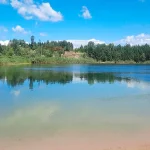
The park is gradually turning into forest, but it’s still pleasant. Below the manor, a lake survives that was originally part of the estate’s design.
The manor house itself is private property: in the early 2000s it was bought by the former director of the Tkhorivka distillery, who repaired the roof, carried out partial renovations, and enclosed the whole property with a 6.5-ft (2 m) concrete fence. Official access is restricted, and photographing the house from beyond the fence is nearly impossible.
You can reach the grounds by going around the lake, where the fence ends. According to local residents, a guard may open the gate if asked in advance — but there’s no guarantee.
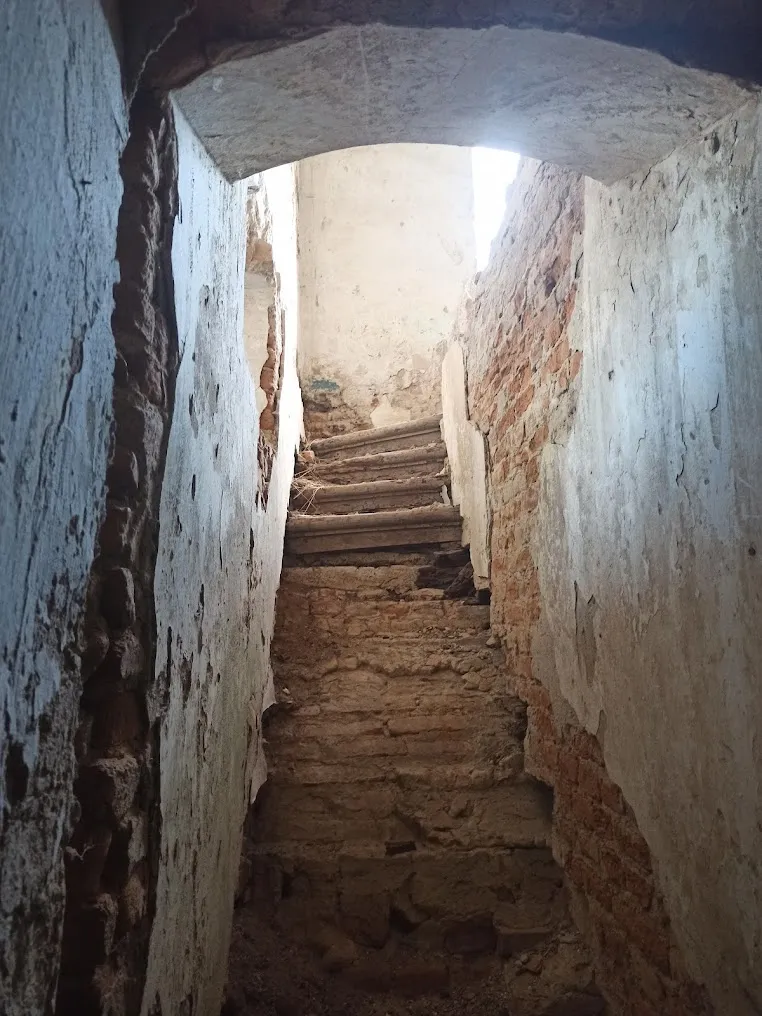
Restoration, officially ongoing since the 2000s, has effectively stalled. As of 2009 there had been no significant changes, and the situation hasn’t changed since.
What to See Nearby and How to Fit It Into a Route
Tkhorivka fits well into a “Palaces and Manors of the Kyiv Region” or “Historic Suburbs of Kyiv” route — both involve touring Right Bank estates.
Nearby are Skvyra, with its own set of landmarks; Bila Tserkva (~43 miles / 70 km from Tkhorivka) with its “Oleksandriya” arboretum; and several other derelict estates in the region.
How to Get There
Tkhorivka is located in the Skvyra community of Bila Tserkva district.
- From Kyiv: the E95 highway (Kyiv–Odesa) or the P32 road are the practical routes to follow.
- Coordinates: 49.692°N, 29.766°E
- The last stretch runs along regional and rural roads; a regular car can manage it in dry weather.
- Park on the shoulder near the fence.
Practical Information
- Admission: formally private property; de facto, partial access is possible via the lake
- Facilities: none — bring water and food
- Photography: difficult because of the fence; the best angles are from the lake side
- Time needed: 1–1.5 hours (exterior, park, and lake)
- Best time to visit: spring or early autumn, in the morning
Little-Known Details
- The estate complex included not just the manor house and park but also a church and a clock tower — a detail typical of large 19th-century estates that underscores the scale of the original design.
- The project’s architect, Henryk Marconi (1792–1863), built for the wealthiest patrons in Poland and the Right Bank of Ukraine. He designed the Pac Palace in Dowspuda, along with a number of churches and estates. Tkhorivka is one of his projects on Ukrainian territory.
- The nickname “Bluebeard” refers to a specific person — Viktor Strashynsky — and is a folk reaction to specific crimes of the serfdom era, not a fairy-tale image.
- The descendants of the Strashynsky family and the current private owner are reportedly still in a legal dispute over ownership, according to some accounts.
Conclusion
The Strashynsky Estate in Tkhorivka is neither a “treasury of grandeur” nor simply a ruin. It’s a place where architectural beauty and moral darkness exist side by side, without cancelling each other out.
A park that has grown into forest, a lake that reflects the sky, and walls that once enclosed what isn’t usually spoken of aloud — that’s what this estate really is.
For those traveling through the Kyiv region in search of genuine places with memory, not just attractions.