Kamianske is a city of metal. A steel plant. Smokestacks. Industrial districts.
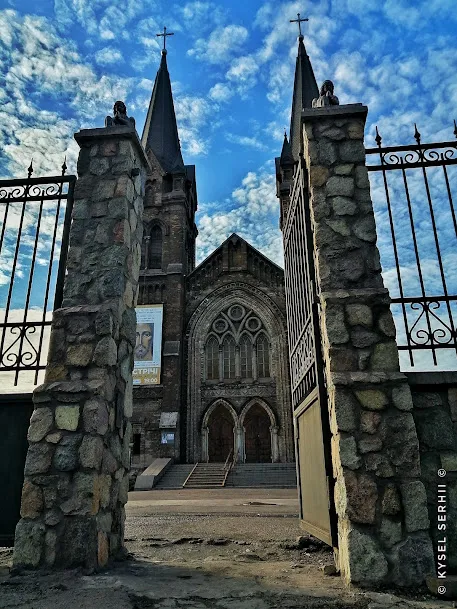
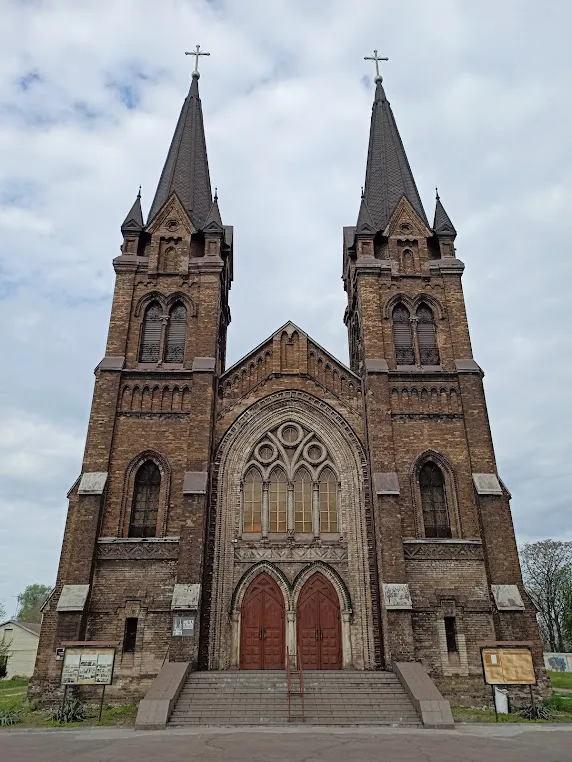
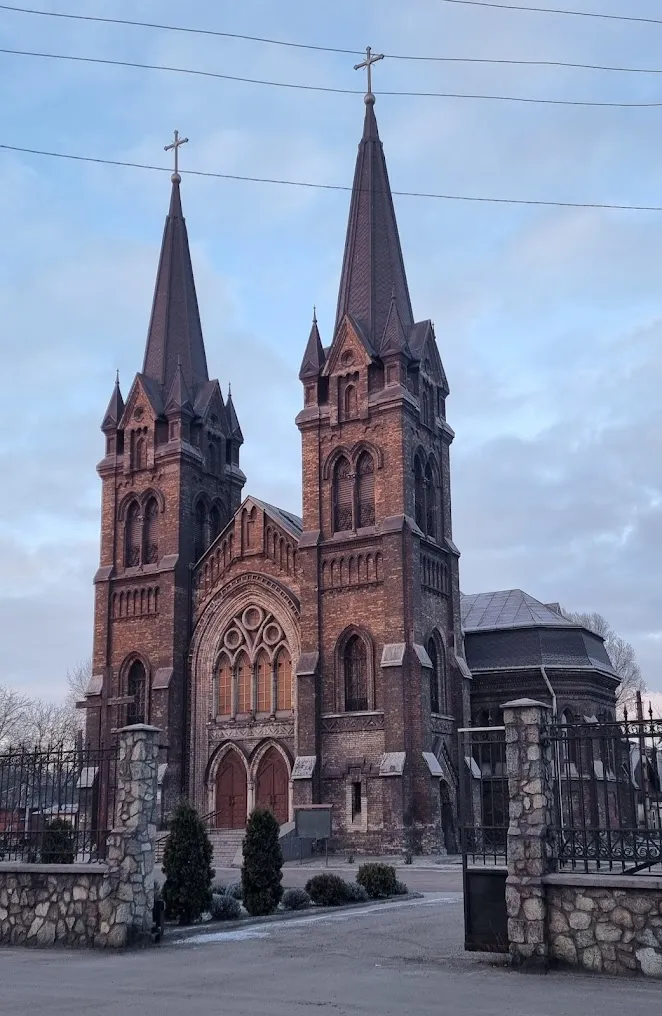
And then, suddenly: two 108-ft towers with spires. Yellow brick. Stained glass.
St. Nicholas Church has stood here for more than 125 years. And it looks as if it were just built.
General Information
| What? | Description |
|---|---|
| Name | St. Nicholas Church (the Kamianske Parish Church in the Name of St. Nicholas) |
| Address | 3 Kovalenka St., Kamianske, Dnipropetrovsk Oblast |
| Built | 1895–1897 |
| Architect | Marian Chormański (a Kharkiv-based architect, 36 years old at the time of the design) |
| Commissioned by | Ignacy Ignatovich Jasiukowicz, managing director of the Dnieper Metallurgical Plant |
| Style | Neo-Gothic |
| Height | 108 ft (33 m) |
| Capacity | 500 people |
| Status | architectural monument; an active Catholic church |
Why This Church Exists — and What an Attack in Japan Has to Do With It
In 1891, Tsarevich Nicholas (the future Nicholas II) was traveling through Japan. On April 29, in the city of Otsu, a local fanatic attacked him and inflicted knife wounds. The heir survived, but Russia was shaken.
Ignacy Ignatovich Jasiukowicz, director of the Dnieper Plant, immediately proposed building two churches in Kamianske — an Orthodox one and a Catholic one — linking the name of St. Nicholas (venerated by both Orthodox and Catholic Christians) with the name of the rescued tsarevich. That’s why both of the city’s main churches share the same name.
To get approval, Jasiukowicz had to petition, through the Minister of Internal Affairs, directly to Alexander III — building a Catholic church in Russia required the tsar’s personal approval.
At a meeting of Catholic workers and staff, it was decided to deduct 1% of wages into a special fund held by the plant’s treasury. The resulting fund reached 120,000 rubles — contributions from plant workers plus a contribution from the Metallurgical Society. That text is inscribed on the marble plaque that still hangs on the church wall today.
After four years of bureaucratic delays, construction began in 1895.
The Architect and the Design
Jasiukowicz brought in 36-year-old Kharkiv architect Marian Chormański and invited him to try his hand at the Neo-Gothic style. Chormański accepted the challenge and proposed building a basilica-type church modeled on medieval Gothic cathedrals.
Yellow brick was specially brought in from Kyiv — the exact color the architectural design called for. Construction took two years and was completed in September 1897.
The Architecture: What the Eye Sees
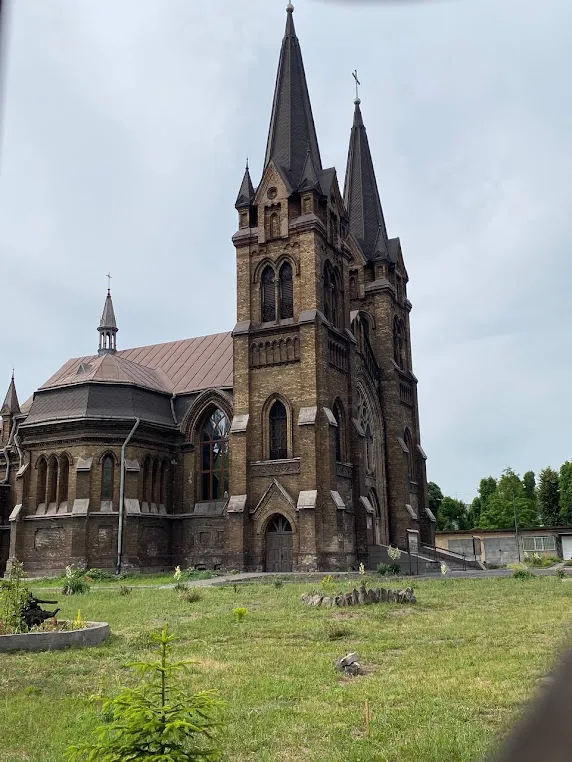
The façade is asymmetrical and striking. On either side of the central entrance stand two spired towers, crowned with crosses. They rise 108 ft (33 m) — the highest point in that part of the city. Seen from above, the building takes the shape of a Latin cross.
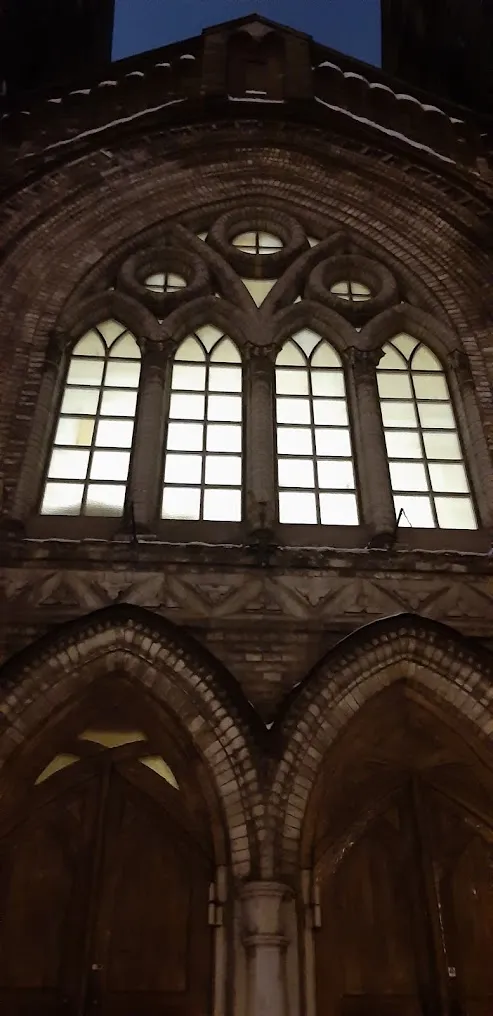
The entrance portal is decorated with wood carving and wrought ironwork. The windows are framed with stained glass. On the façade opposite the entrance is a faceted apse. Stairs with wrought-iron railings lead up to the bell tower.
Its capacity is 500 people, though on major holidays far more attended, with some standing outside.
Before the Revolution: a Parish of Six Thousand
The first Holy Mass was celebrated on May 14, 1898. The formal consecration took place on September 25, 1905, led by Bishop Joseph Aloysius Kessler of Tiraspol.
By 1917, the parish numbered more than 6,800 people: Poles, Russians, Belarusians, Baltic residents, and Czechs — all Catholics of industrial Kamianske. The church operated a library and an orphanage for children. Weddings were held there every Sunday.
The Soviet Era: From a Draft Office to a Car Wash
At four in the morning on December 12, 1929, the church’s property was seized and the building closed. This followed a decree dated December 1, 1929, under which the Orthodox cathedral, the Catholic church, the synagogue, and the Lutheran church were all closed simultaneously.
Over the following decades, the building housed, in succession: a Polish club, a planetarium, a “Knowledge” lecture hall, a military conscription office, a stable (under Nazi occupation), a car wash, a naval training school run by the Soviet paramilitary organization DOSAAF, art fund workshops, a furniture warehouse, and cooperative offices.
The church’s last rector, Father Jakub Rosenbach, was imprisoned and executed in a Siberian labor camp in 1938.
In 1990, an initiative group formed within the Dniprodzerzhynsk city council to save the church. The first Holy Mass on the steps of the still-closed, nearly ruined church was celebrated on November 30, 1991. The Catholic community was officially registered on March 4, 1992.
Today: an Active Church and an Architectural Landmark
St. Nicholas Church is an active Roman Catholic church. Services are held in Ukrainian and Polish, and organ and chamber music concerts take place there.
It remains the largest Catholic church in Eastern Ukraine and, by various rankings, one of the ten most beautiful religious buildings in the country.
What to See Nearby
Kamianske is a city with several interesting layers:
- The Orthodox St. Nicholas Cathedral (1894, architect Lev Brodnytsky) — a namesake “twin,” commissioned by the same patron, but stylistically quite different; its architecture survives fully; it served as a local history museum in Soviet times and has been active again since 1988
- The People’s Auditorium (1900, also Jasiukowicz’s initiative) — now the Lesia Ukrainka Theater
- The Dnieper riverside and the industrial scenery of the plants
All three — the church, the cathedral, and the theater — are connected by one person: Ignacy Jasiukowicz. He essentially built a cultural center for an industrial city from scratch.
Kamianske fits into the “Industrial Landscapes of Ukraine” route as a city where Neo-Gothic architecture stands beside blast furnaces.
Practical Information
- Status: an active church — please be respectful during services
- Address: 3 Kovalenka St., Kamianske
- Admission: free, outside of service times
- Concerts: check the parish website for the schedule
- Time needed: 30–60 minutes (exterior plus interior)
- Photography: the best angle is frontal, from 165–230 ft (50–70 m), to fit both towers in frame
How to Get There
- Kamianske is ~22 miles (~35 km) from Dnipro via route R52
- From Dnipro by car: ~40 minutes
- Public transport: regular trains and buses run between Dnipro and Kamianske
Little-Known Details
- The church and Kamianske’s Orthodox cathedral were built for the same reason: the 1891 attack on Tsarevich Nicholas in Japan. Both are named for St. Nicholas.
- The marble plaque describing the construction still hangs on the church wall — a primary-source document visible to every visitor.
- The building’s last Soviet-era tenant was a car wash — a fitting, if telling, endpoint for how the heritage was treated.
- Father Jakub Rosenbach, the last rector before the church’s closure, was executed in Siberia in 1938. A memorial plaque in his honor was unveiled on the church wall in 2017.
- Before the revolution, the church ran an orphanage — one of the few social institutions for the vulnerable in this brick industrial city.
Conclusion
St. Nicholas Church in Kamianske isn’t an “unexpected” find in an industrial city. It was a deliberate choice by a plant director who understood that for a city to be a city, and not just an industrial site, it needed architecture that looked upward.
Jasiukowicz built two churches and a theater. The church outlasted them all — the draft office, the car wash, and the passage of time that erases the memory of the people behind the buildings.