Some places look natural. Some look historic. And some leave you unable to tell where one ends and the other begins.
Dovbush’s Rocks near Bubnyshche belong to that last category.
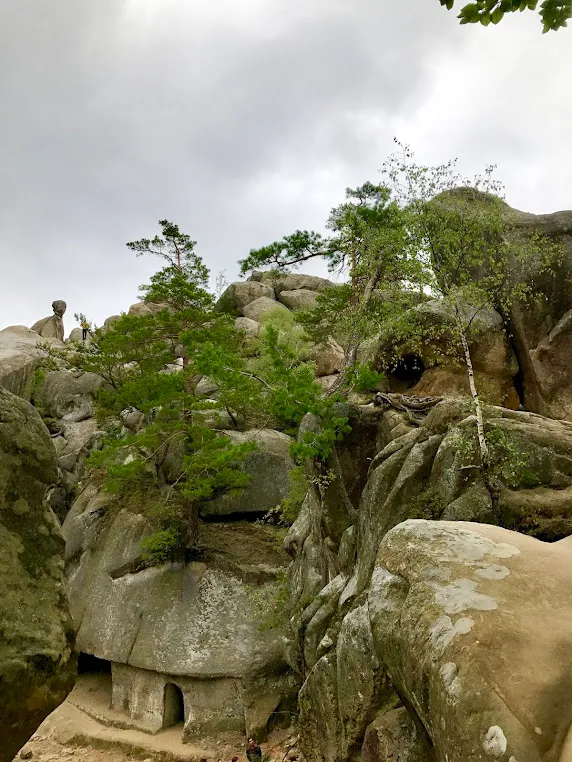
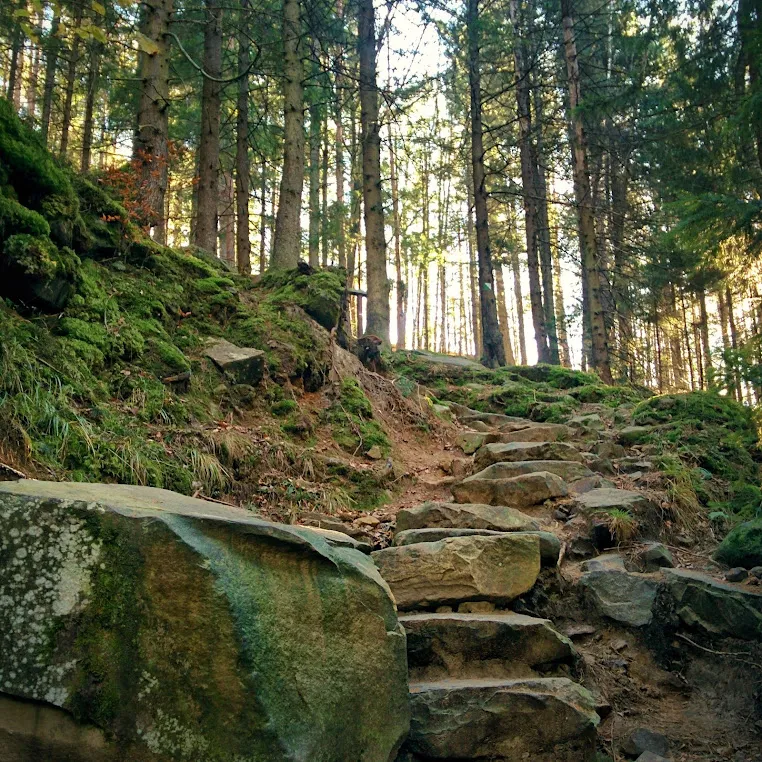
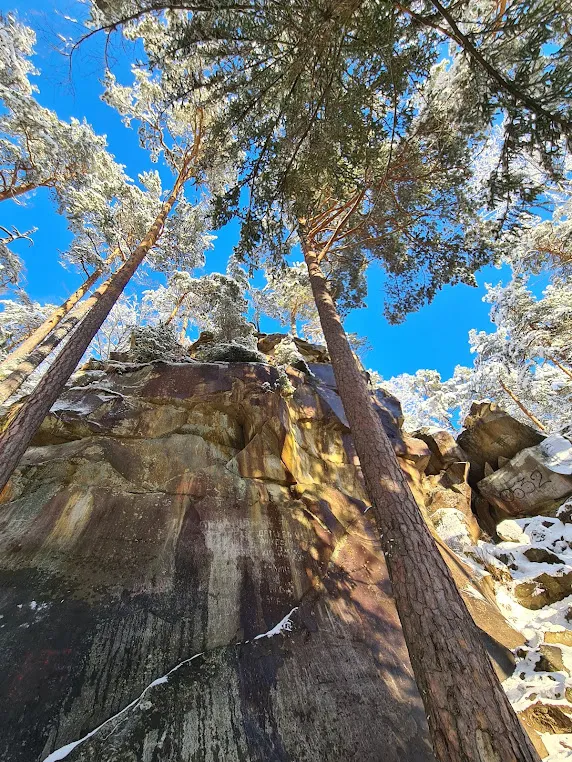
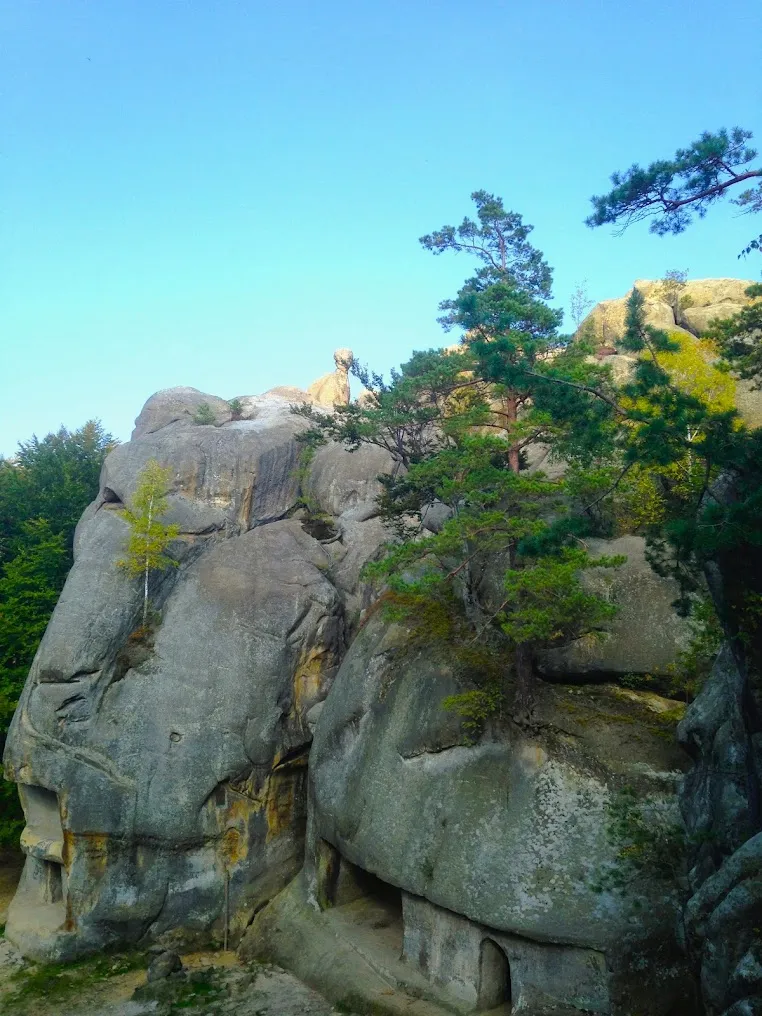
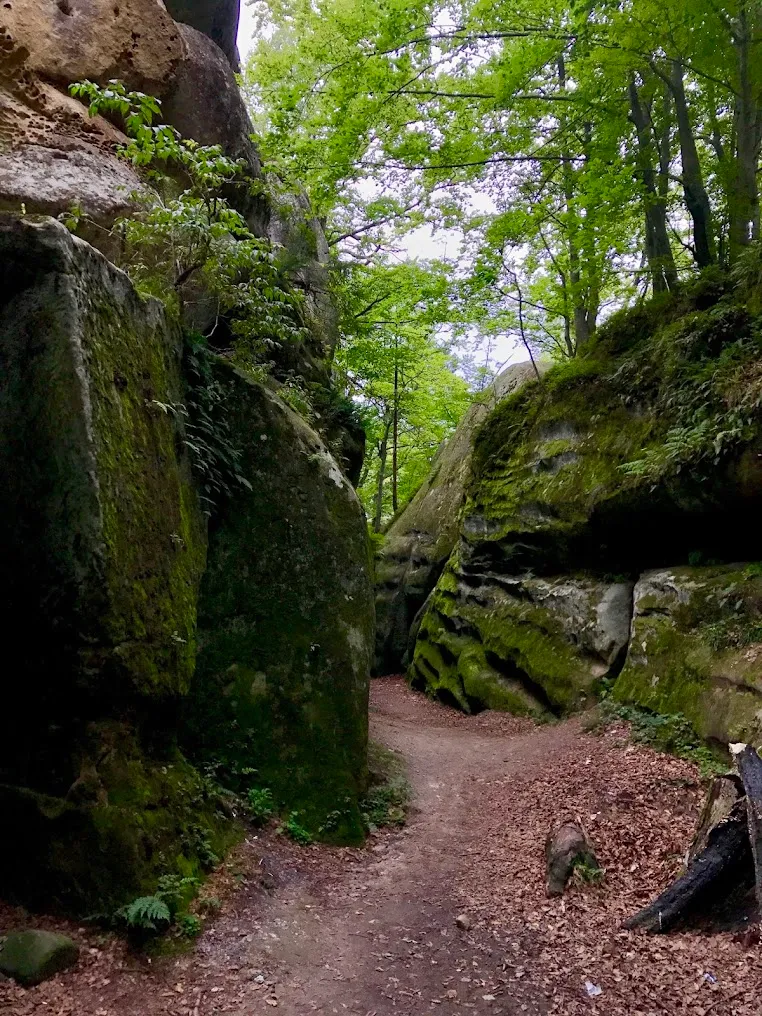
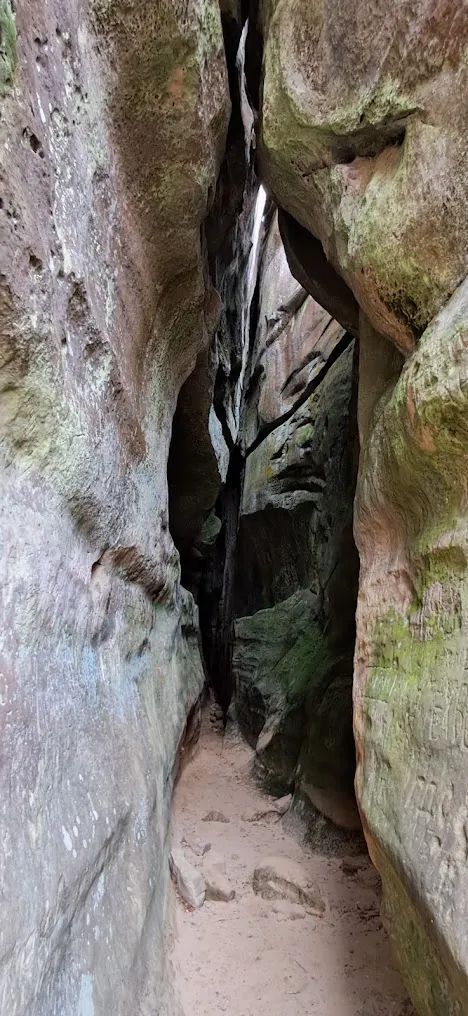
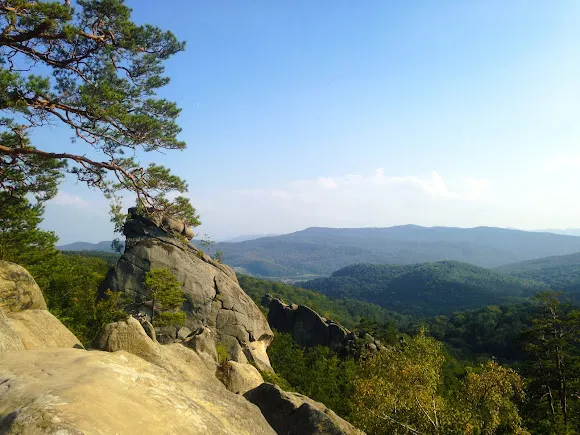
From a distance, it’s just forest. Come closer, and stone towers, passages, niches, and stairs suddenly rise out of the trees.
As if someone built a fortress here. But out of stone that was already there.
General Information
| What? | Description |
|---|---|
| Name | Dovbush’s Rocks (the “Dovbush’s Rocks” rock-and-cave complex) |
| Location | the Bubnyshche tract, near Bubnyshche village, Kalush district, Ivano-Frankivsk Oblast / on the border with Lviv Oblast (Trukhaniv village) |
| Coordinates | 49°02′40″N, 23°40′52″E |
| Elevation | 2,192 ft (668 m) above sea level |
| Rock height | up to 262 ft (80 m) |
| Area | 247 acres (100 ha) |
| Massif | ~0.6 miles (~1 km) long, ~660 ft (~200 m) wide |
| Rock type | Yamna-formation sandstone of the lower Paleogene (66–56 million years old) |
| Status | natural monument of national significance (since the 1930s) |
| Admission | paid, ~50 UAH per person; vehicle entry charged separately |
Geology: an Ancient Seafloor, 70 Million Years On
These rocks began at the bottom of an ancient sea.
During the Paleogene period (~66–56 million years ago), warm shallow waters lapped where the modern Carpathians now stand. Sandy silt settled in layers, compacted, and turned to sandstone. Then came mountain-building, uplift, and erosion. Over millions of years, wind and water carved the same towers, pillars, niches, and corridors out of the sandstone layers.
The Carpathians themselves formed 25 million years ago — they’re “young” mountains. But the sandstone beneath them is far older.
The rock complex divides loosely into two massifs: a main one (an almost continuous monolith) and a group of separate rocks. The Carpathian site of Tustan and Bubnyshche are geologically related: both belong to the same type of Yamna-formation sandstone, similar in appearance but entirely different in character.
What This Actually Is: Nature and the Human Hand
Geology created the form. People added meaning.
First, wind and water “carved” pillars, towers, cracks, and narrow corridors. Later, in the 10th–18th centuries, people:
- carved out niches and caves in the rocks
- cut stairs
- created viewing platforms
- left petroglyphs (a lion carved into one of the rocks)
Mykhailo Hrushevsky identified Dovbush’s Rocks as a defensive rock-and-cave complex. Ivan Franko wrote a work titled “Bubnyshche.” On a 1935 Polish military map, the rocks are already marked as the “Bubnyshche Rock Reserve.”
Ancient tribes, monks, Cossacks, and opryshky outlaws all found a natural fortress here.
Dovbush and the Legends
The name is tied to Oleksa Dovbush, an 18th-century Carpathian outlaw.
According to legend, the outlaws hid gold taken from innkeepers and merchants in a cave within the Odynets rock. A rotating stone seals the entrance — but only Dovbush himself knew the magic word to open it.
Dzvinka herself — Dovbush’s beloved and betrayer — is said, by legend, to have turned into a rock. He died of his wounds. His companions quartered his body and scattered it across the Carpathians — which is why “Dovbush’s Rocks” exist not just here, but in Yaremche and elsewhere too.
Whether any of it is true, the archives stay silent. But standing between 262-ft sandstone walls, it’s easy to believe.
The Route and the “Purgatory” Passage
The stone labyrinth, 660 ft (200 m) wide, stretches 0.6 miles (1 km) from east to west through beech-and-spruce forest.
The route is marked and developed. Key points include:
- “Chystylysche” (“Purgatory”) — a narrow passage between rocks where a person barely squeezes through
- Odynets Rock — the main legendary “treasury”
- The lion carved into the rock — a petroglyph tied to a specific historical figure (guides will tell you more)
- Carved stairs and niches
- Viewing platforms with views over the Carpathians
The route is relatively easy, but includes climbs and descents, and turns slippery after rain.
An Important Note: Bubnyshche ≠ Yaremche
Two different tourist sites share similar names:
- Dovbush’s Rocks in Bubnyshche (Kalush district, this article) — a large 247-acre rock-and-cave complex
- Dovbush’s Trail in Yaremche (Nadvirna district) — a shorter walking trail in town
These are different places with different characters. It’s best to enter specific coordinates into your GPS.
What to See Nearby
- Tustan in Urych (~25 miles / ~40 km) — a similar rock massif, but with a well-researched medieval fortress
- Hoshiv Monastery (UGCC, Dolyna) — along the road from Ivano-Frankivsk
- Bolekhiv (~9 miles / ~15 km) — a small town with Austrian and Polish architecture
Practical Information
- Admission: confirm the current price
- Vehicle entry: charged separately
- Parking: near the entrance to the complex (~1.9 miles / ~3 km from Bubnyshche village)
- Time for the route: 2–3 hours
- Footwear: hiking shoes essential
How to Get There
By car: Lviv → Stryi → Morshyn → Bolekhiv → Bubnyshche → Dovbush’s Rocks (~81 miles / ~130 km from Lviv, ~106 miles / ~170 km from Ivano-Frankivsk). In Bolekhiv there’s a sign pointing right. After leaving Bubnyshche, another sign points right. From the bridge over the Sukil, a dirt road runs ~2.2 miles (~3.5 km) to the rocks (passable for most cars).
From the Lviv region: via Nyzhnie Synovydne → Trukhaniv → a 1.2–2.2-mile (2–3.5 km) walk.
Public transport: a bus to Bolekhiv, then a bus to the turnoff for the rocks (get off there), then a ~2.5-mile (~4 km) walk.
Little-Known Details
- A 1935 Polish military map already marks the rocks as the “Bubnyshche Rock Reserve.”
- The rocks reach 262 ft (80 m) in height — not “131–164 ft” as most popular descriptions claim.
- The rocks sit on the border of two oblasts: Ivano-Frankivsk (Bubnyshche) and Lviv (Trukhaniv).
- Mykhailo Hrushevsky described Dovbush’s Rocks as a defensive rock-and-cave complex.
- In November 2015, the fantasy film “Storozhova Zastava” (“The Guard Post”) was filmed here.
- The lion petroglyph on one of the rocks is tied to a specific historical figure — a guide can tell you more.
Conclusion
Dovbush’s Rocks aren’t about “taking a look.” They’re about walking, touching the stone, peering into the passages, getting a little lost among the shapes.
And suddenly catching yourself thinking: everything here looks natural and man-made at once.
As if the mountains and history had agreed to work together. And agreed long ago — 70 million years ago.