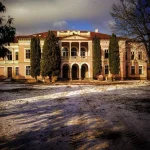
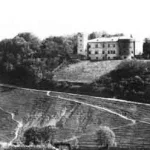
On the banks of the Desna River, 10 kilometers from Korop, stands a building that you immediately want to call a castle.
Battlements, towers, spires — and not a single column. This is not a classicist estate with a park, of which there are many on the Left Bank. This is something else: a whimsical, “bizarre” structure, as contemporaries themselves described it. A residence where the owner wanted the architecture to remind of his victories — and where he never actually stayed for long.
Загальна інформація
| Що? | Опис |
|---|---|
| Назва | Палац Рум’янцева-Задунайського |
| Локація | с. Вишеньки, Коропська селищна громада, Новгород-Сіверський р-н, Чернігівська обл. |
| Відстань від Коропа | ~10 км |
| Роки будівництва | 1782–1787 |
| Стиль | неоготика, романтичний класицизм, елементи «сходознавства» |
| Архітектор | невідомий (можливо — Баженов, Кваренгі або Мосцепанов) |
| Замовник | граф Петро Олександрович Рум’янцев-Задунайський |
| Статус | пам’ятка архітектури національного значення |
The Man Who Built This Palace
To understand Vyshenky, you need to understand the man who ordered it.
Pyotr Aleksandrovich Rumyantsev-Zadunaiskyi (1725–1796) was one of the most prominent military leaders of the 18th century. In the Seven Years’ War, he distinguished himself brilliantly at Gross-Jägersdorf and Kunersdorf, and forced the surrender of Kolberg. But his main glory came during the Russian-Turkish War of 1768–1774.
In the summer of 1770, at Larga, he defeated an 80,000-strong Turkish-Tatar corps with a 25,000-strong army. Two weeks later, at Cahul, his 38,000 soldiers defeated the 150,000-strong army of the Grand Vizier. These victories brought him the field marshal’s baton and the title of “Zadunaiskyi” – as a sign of transferring the fighting beyond the Danube.
At the same time, for twenty-five years — from 1764 to 1789 — he held the position of president of the Little Russian Collegium and governor-general of Left-Bank Ukraine. And it was during his reign that the remnants of Ukrainian self-government were finally liquidated: the regimental system was abolished, the Hetmanate was divided into three governorates, serfdom and the Russian system of administration were extended to Ukraine. He destroyed what was left of the Hetmanate.
He had several estates on the Left Bank — Gomel, Kachanivka, Velyka Topal, Vyshenky. He took care of his estates with the same care as he took care of his combat positions. “He had a penchant for architecture, and gave his numerous estates a bizarre and bizarre appearance,” contemporaries recorded.
How the palace came into being: the reason — Catherine II
1782–1787. Rumyantsev-Zadunaiskyi built an entire complex in Vyshenky and neighboring Chereshenky: the main palace, church, services.
The immediate reason for accelerating the construction was Catherine II’s route to the Crimea. In the winter of 1787, she was supposed to pass through Vyshenky — and the count wanted to receive the empress in decent conditions.
The construction was completed just before her arrival. Catherine did stop by — but not in the way the owner expected. She visited Vyshenky, had dinner, and left — her mood was not the same. And two years later, in 1789, she removed Rumyantsev from the administration of Little Russia.
Who designed it — an unanswered question
The author of the project is not known for certain. The construction was supervised by architect D. G. Kotlyarevskyi, a student of the Ukrainian architect Maksym Mostsepanov. Perhaps it was Mostsepanov who developed the project.
But there are other hypotheses. Researchers suggest the participation of Vasily Bazhenov — at that time he was removed from state orders and took on private ones. Bazhenov is characterized by exactly this combination: romanticism, pseudo-Gothic, “chimicality” — it is clearly visible in Tsaritsyn. The third version is Giacomo Quarenghi.
None of them is documented.
Architecture: a castle without a defensive function
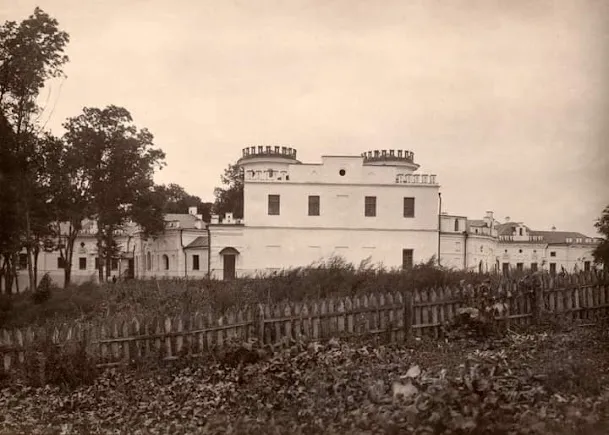
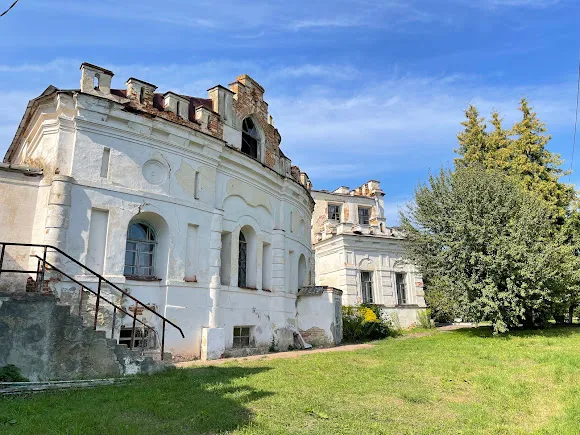
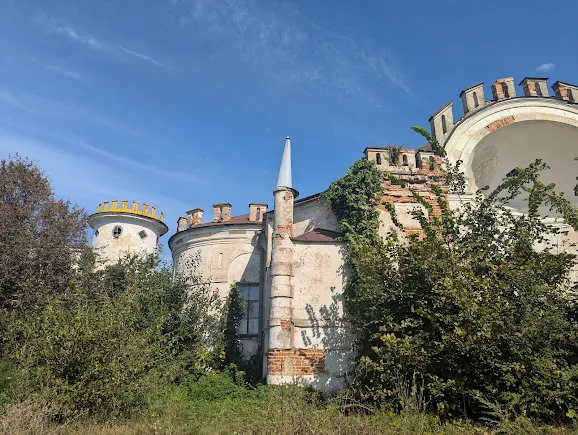
The palace is one-story, in plan it resembles a capital letter “C” (or “E”). The main body is elongated, with side wings. The overall shape is asymmetrical, with several tower-like volumes.
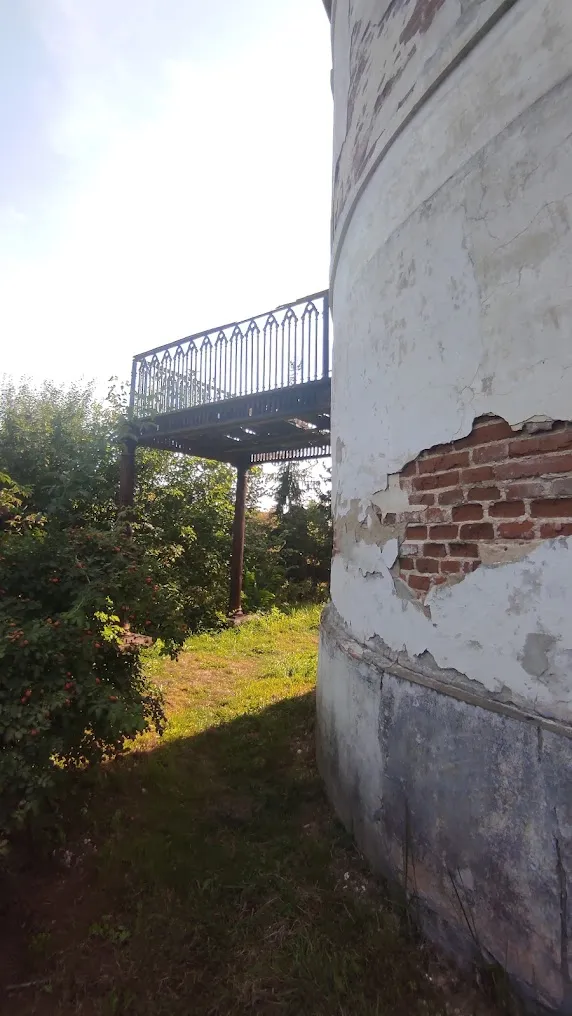
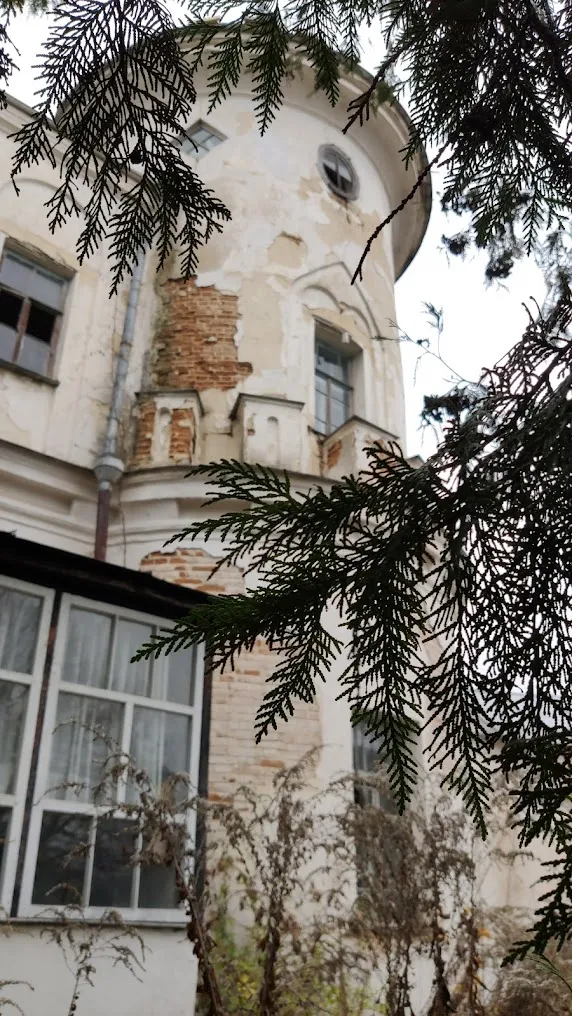
The style is a unique mixture for the Left Bank: battlements and spires in the spirit of a medieval castle, spire-like towers, arched windows – everything that classicism usually avoids. No columns, no porticos with pediments. Instead – romantic “irregularity”.
The decor appeals to two sources: the Gothic Middle Ages and the Middle East. The second layer is special. In some places in the interior, amazing stucco decorations in the spirit of arabesques have been preserved. Some Turkish motifs were supposed to remind of the victories of the owner of the estate over Turkey.
This is a personal triumphal monument. The man who defeated the Turks at Larga and Cahul decided to incorporate this victory directly into the decor of his own home.
Guests: Catherine and Suvorov
Two of the most famous figures of the time visited Vyshenki.
Catherine II – in the winter of 1787, during her trip to the Crimea. She visited, had dinner, and left. Soon after, she resigned from her host.
Alexander Suvorov – also among the guests. The two most prominent military leaders of the time obviously found a common language. Suvorov looked at Rumyantsev with admiration – “The victories at Larga and Cahul, which Suvorov was equal to,” – contemporaries recorded.
Nearby: church and Chereshenki
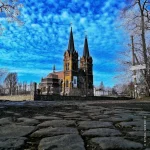
At the same time as the palace, Rumyantsev-Zadunaiskyi built the Holy Assumption Church (1782–1787) — also in the style of classicism with baroque elements, also on the banks of the Desna River, also consecrated in 1787. The church is rectangular in plan, columnless, single-apse, topped by a majestic hemispherical dome. Bell towers are located on either side of the main entrance. Stucco decorates the facades and interior.
The church is in better condition than the palace — and deserves a separate stop.
Traces of the complex have also been preserved in neighboring Chereshenky.
After Rumyantsev: a chronicle of decline and restoration
1796 — Rumyantsev-Zadunaysky died in his estate in Tashan. The cherries passed to his son.
Early 19th century — the palace was sold to the landowner Sudyenko, who began reconstruction. The reconstruction caused partial destruction of the building.
1840 — the new owner, Prince Dolgoruky, restored the palace.
20th century — under Soviet rule, it was successively housed: a nursing home, then a rest home “Dorozhnik”, then a pioneer camp. The last function was preserved — today it is a children’s institution.
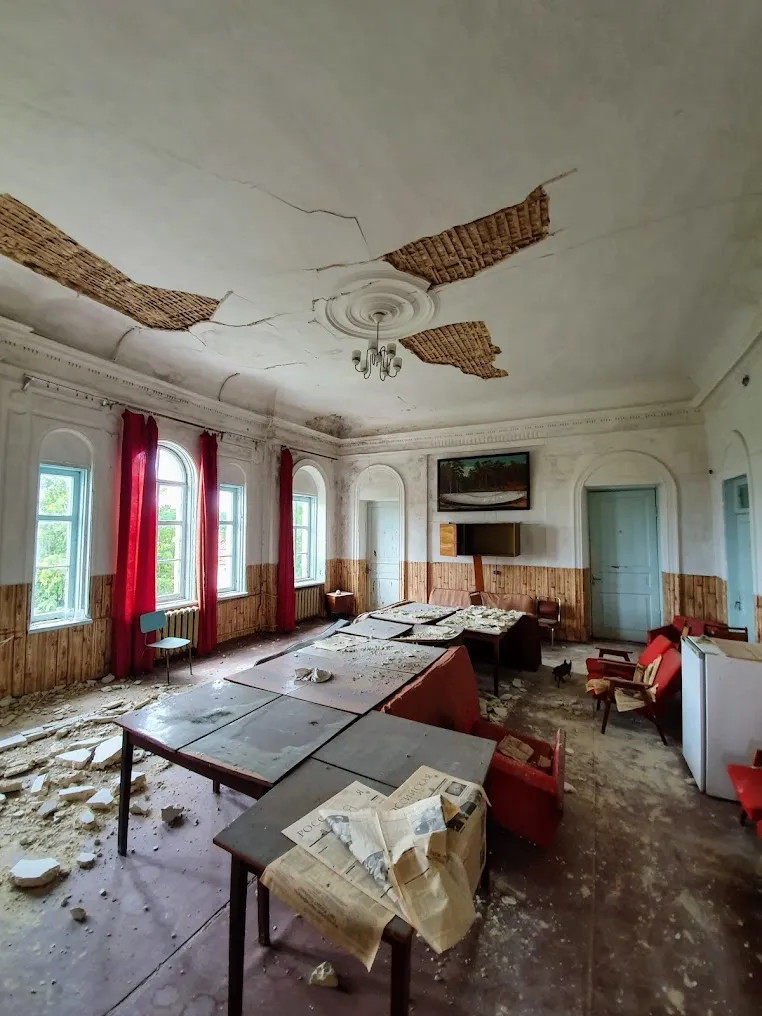
Current condition. The palace is in a state of emergency: cracks in the walls, the decoration is crumbling. Restoration was started several times, but there was no systematic work. In some rooms, the stucco of the arabesque pattern has been partially preserved — the remains of the original interior.
Uniqueness in context
This is the only building from the numerous estates of Rumyantsev-Zadunaiskyi that has preserved at least the structure of the original house. All the others have either been destroyed or rebuilt beyond recognition.
Among all the palace and estate complexes of Left-Bank Ukraine, it is unique in style: romantic classicism with “orientalist” motifs – not even neo-Gothic in its purest form, but something more personal and difficult to classify.
What to see nearby and how to fit it into the route
Vyshenki is located in the Novgorod-Siverskyi district (Koropska community), deep in Chernihiv Polissya, near the Desna River.
Natural route: Chernihiv → Kozelets → Vyshenky → Novgorod-Siverskyi. You can add Baturyn and Kachanivka — and you will get a full-fledged route through the estates and fortresses of the Cossack-Hetman Left-Bank Ukraine.
Practical information
- Status: currently a children’s institution (camp); entry only once a year according to some sources
- External inspection: possible; the building is clearly visible from the road
- The Church of the Assumption is also nearby, in better condition, worth a visit
- Time for inspection: 30–60 minutes (exterior + church)
- Distance from Chernihiv: ~130 km
How to get there
- Vyshenky — ~10 km from the village of Korop, Novgorod-Siverskyi district
- From Chernihiv: ~130 km, highway E101 through Borzna, then turn to Korop
- From Shostka (Sumy region): ~65 km
- The road to Vyshenky is asphalt; the last section is a rural road along the Desna
Little-known details
- Rumyantsev-Zadunaiskyi was one of the largest landowners in the Left Bank: he owned Gomel, Kachanovka, Velyka Topal, Vyshenky, Tashan and other estates. He invested his wealth in their development and decoration.
- After visiting Vyshenky, Catherine II had lunch and immediately left – and two years later removed the owner from the administration of Little Russia. Whether it was a coincidence or not is unknown.
- The three possible authors of the project – Bazhenov, Quarenghi, Mostsepanov – are all geniuses of their time. But documents that would confirm any of them have not yet been found.
- Vyshenky is the only building from all of Rumyantsev-Zadunaysky’s estates that has survived in a recognizable form.
- After Rumyantsev’s death in 1796, Paul I ordered his court to mourn for three days—and called the field marshal “the Russian Turenne.”
- Pushkin called Rumyantsev “the Perun of the Cahul shores”—in an ode that was learned by heart in pre-revolutionary schools.
Conclusion
The Palace in Vyshenky is not just a manor. It is a self-portrait of a man who, in his lifetime, won dozens of battles, destroyed Ukrainian self-government, and built a house with Turkish arabesques in its decor.
A complex portrait. A complex place.
But it stands on the banks of the Desna River. And while it stands, it is worth seeing.