Kamianets wasn’t built around a fortress.
The fortress was carved out of the town itself.
The rock, the Smotrych canyon, the narrow isthmus — everything here looks as if nature built a trap first, and people simply figured out how to use it.
General Information
| What? | Description |
|---|---|
| Name | Kamianets-Podilskyi Fortress (the Old Castle) |
| Address | 1 Zamkova St., Kamianets-Podilskyi, Khmelnytskyi Oblast |
| Type | defensive fortress / military-administrative center |
| Built | 14th–17th centuries (main construction from the second half of the 14th century) |
| Towers | 11 stone towers |
| Status | architectural monument of national significance; one of the 7 Wonders of Ukraine; a museum-reserve (since 1928) |
| Admission | paid |
Why a Fortress Rose Here
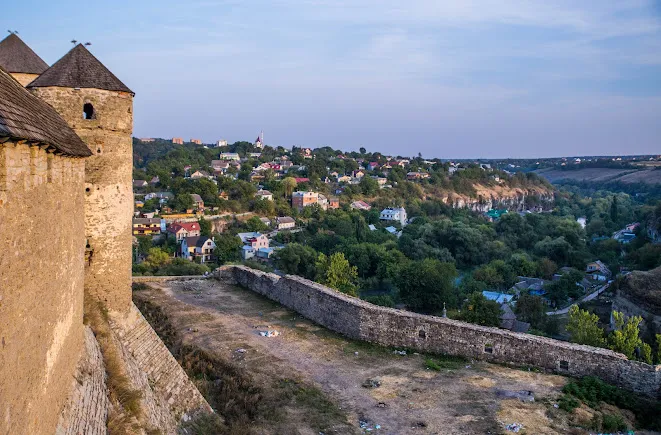
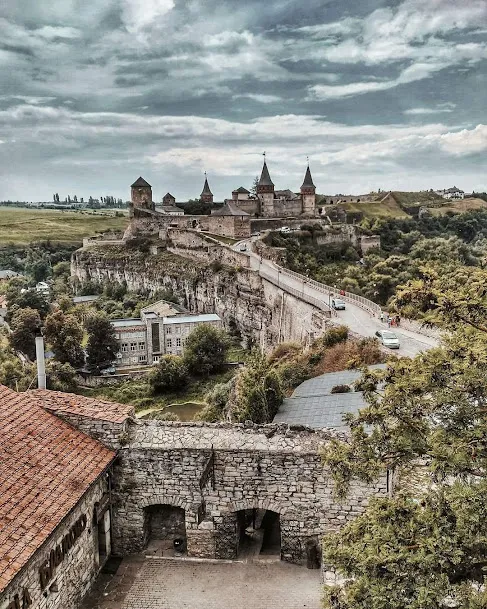
Kamianets stands on an island — not in the literal sense, but geologically: the town is carved into rock by a loop of the Smotrych River. A canyon more than 98 ft (30 m) deep surrounds the old town on nearly every side. A narrow isthmus is the only natural way in.
That terrain meant one thing: hold the isthmus, and a small force could contain a far larger army.
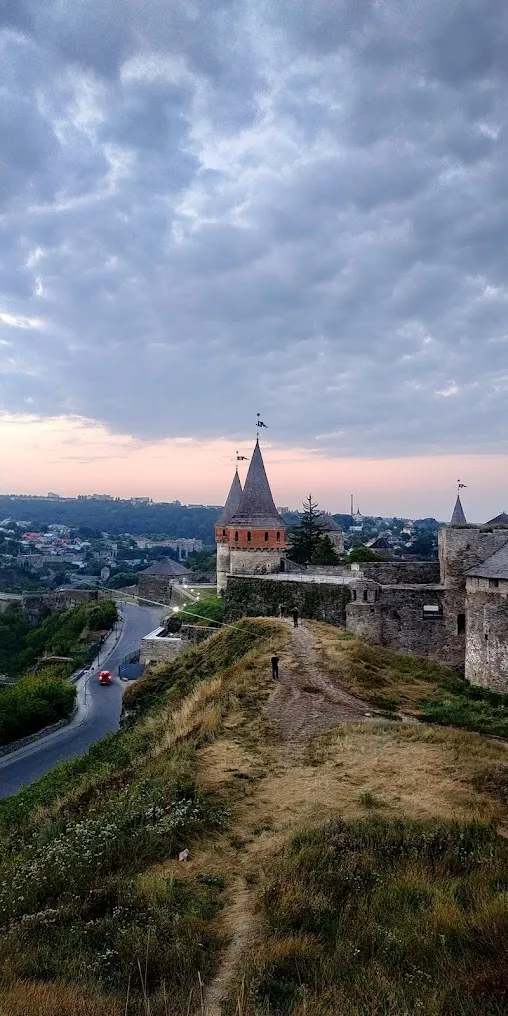
The castle stands exactly on that isthmus. In plan, it’s an irregular quadrilateral, stretched from southeast to northwest, toward the edge of the cliff. The natural canyon and the walls merge into a single defensive system.
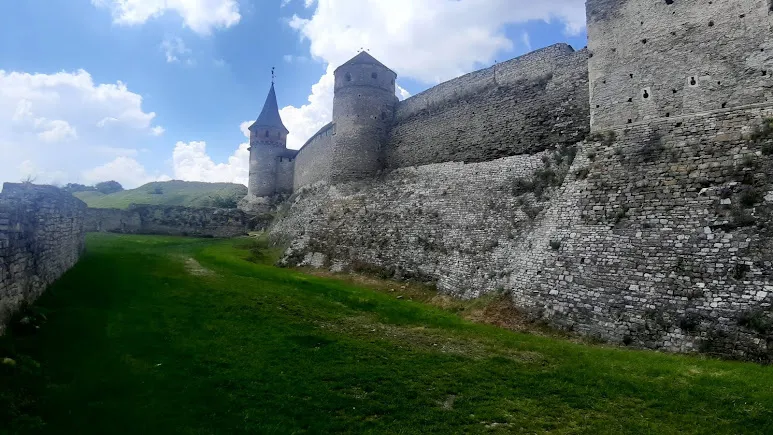
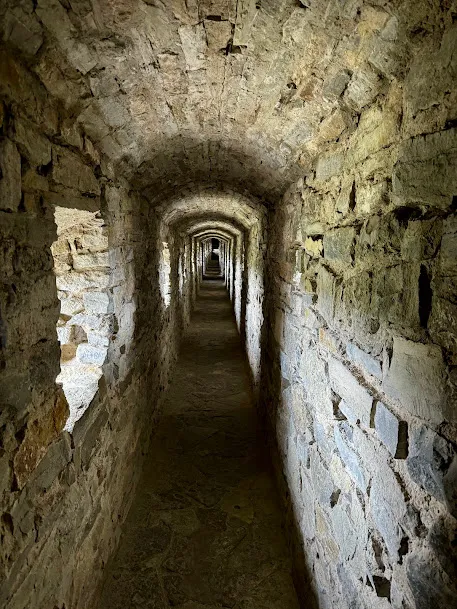
11 Towers: Each With a Name and a Function
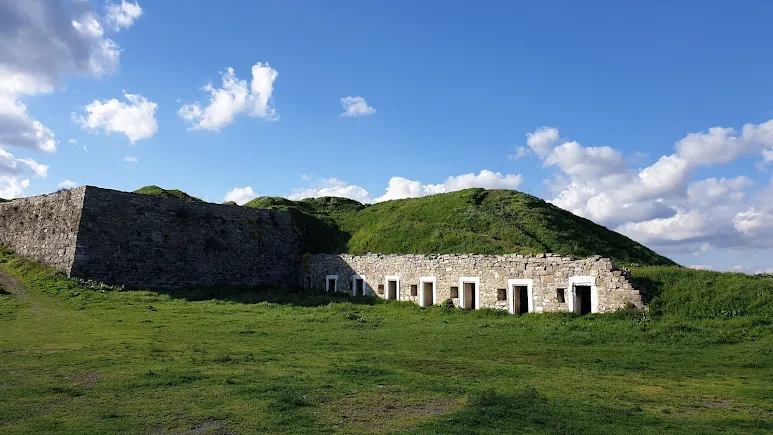
The fortress consists of the Old and New Castles. The Old Castle is stone, with towers. The New Castle is earthen, with ramparts and moats.
The Old Castle holds 11 stone towers. Each carries a name, and each name is earned:
- Denna (“Day”) Tower — the main observation post; the defense was commanded from here
- Tęczyński (Lanckoroński) Tower — built in 1505 at the expense of the Kraków castellan Jan Tęczyński; three-quarters of the tower projects outside the walls
- Papska (“Papal,” or Karmaliuk) Tower — corner tower No. 12; tied to the name of Ustym Karmaliuk, held prisoner here
- Nova (“New”) Tower — built for artillery; the upper firing slits were designed for cannons, the lower ones for muskets and pistols; the wall bears an inscription reading, in short, praise to God alone, dated 1544
- Vodiana (“Water”) Tower — standing outside the castle, in the Smotrych valley; it supplied the town with water during sieges, connected to the Rozhanka Tower by a secret tunnel known only to the commandant
- Rozhanka Tower — bearing a rose on its coat of arms; together with the New and Mala towers, it was ringed by a double moat
The remaining towers — Mala, Laska (White), Skalska, Kuznychna, Polna — each played its own tactical role.
Timeline: a Town as a Battlefield
14th century — the first stone fortifications; wooden ones existed before that.
15th century — major modernization: new towers, higher walls, an expanded castle perimeter.
1544 — extensive construction and repair under Hiob Bretfus (also recorded as Job Pretwicz); the New Tower with artillery firing slits and the outer wall are built.
16th century — Kamianets becomes Podillia’s most powerful fortress. It’s confirmed: the phrase “key to Podillia” wasn’t poetic flourish, but an official description used in diplomatic documents.
1672 — on August 25, after the Ottomans blew up a tower, the Polish defense surrenders. Kamianets becomes Ottoman territory for 27 years (1672–1699). The Ottomans rework the castle’s interior rooms and build a minaret at the cathedral.
1699 — under the Treaty of Karlowitz, Turkey returns Kamianets to Poland. Reconstruction begins.
18th–19th centuries — the fortress loses its military role and becomes a prison. It held participants of the Haidamaka uprisings, Polish rebels, and criminal offenders.
Ustym Karmaliuk — the legendary rebel leader — was imprisoned here three times and escaped three times. The Papal Tower carries his name.
1928 — the castle is declared a state historical-cultural reserve.
Architecture: No Symmetry, But a Clear Logic
There’s no “beautiful symmetry” of a Renaissance palace here.
There’s the logic of striking and defending.
The towers are arranged asymmetrically: four along each long side, two joined at the western end, one standing alone by the river. The triangular, conical roofs were added later, likely under Russian rule; originally the towers ended in battlements.
The entrance gate faces east, toward the town. A drawbridge crossed the moat, raised on stone pillars; the moat could be filled with water when needed.
What to See Nearby
The fortress is part of the larger Old Town complex:
- the Turkish Bridge — a scenic crossing over the canyon, built on the site of an older one, itself several centuries old
- the Cathedral Tower / minaret — left by the Ottomans as a reminder of the 27-year occupation
- the Town Hall — the town’s center
- the Polish, Armenian, and Ruthenian quarters — a living record of who once lived here
- a cable car — descending into the Smotrych canyon
A trip to Kamianets naturally extends to Bakota (~16 miles / ~25 km) and Medzhybizh (~31 miles / ~50 km).
Practical Information
- Address: 1 Zamkova St.
- Admission: paid; several ticket tiers (grounds / museum / towers)
- Hours: confirm on the official website; daily during the season
- Time needed: 2–4 hours (castle plus Old Town — a full day)
- Drones: allowed in certain zones — confirm in advance
How to Get There
- From Khmelnytskyi: ~62 miles (~100 km), ~1.5 hours
- From Chernivtsi: ~56 miles (~90 km), ~1.5 hours
- Minibuses run regularly from Khmelnytskyi
- Traffic in the town center is restricted; use GPS to 1 Zamkova St.
Little-Known Details
- The Vodiana Tower connects to the Rozhanka Tower by a secret tunnel, known only to the commandant — used to supply the town with water during sieges.
- The 1544 inscription on the New Tower is documented and still visible today.
- Karmaliuk escaped the fortress three times — each time differently. The Papal Tower now carries his name.
- In 1672, the destruction of a single tower by Ottoman forces decided the town’s fate — not a long siege, just one explosion and a surrender.
- The 27 years of Ottoman rule (1672–1699) mark the longest foreign occupation in the town’s history. It was during this period that the minaret appeared at the cathedral.
- The Tęczyński Tower (1505) was built by a specific person with specific funds: the Kraków castellan Jan Tęczyński paid for it out of his own pocket. A plaque on the wall confirms it.
Conclusion
Kamianets-Podilskyi Fortress isn’t romantic. It’s precise.
Precise in its function. Precise in its form. Precise in what it does to the person standing inside it.
Here you understand something simple: towns can be beautiful, but fortresses get built when the world promises nothing good.