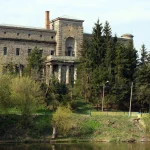
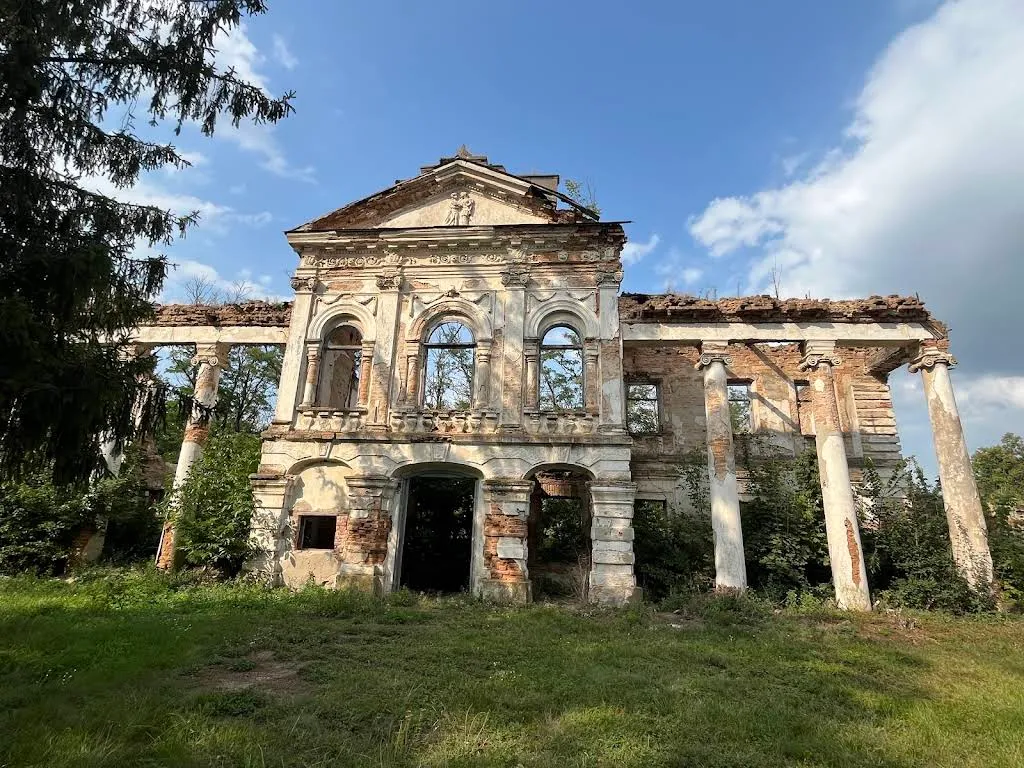
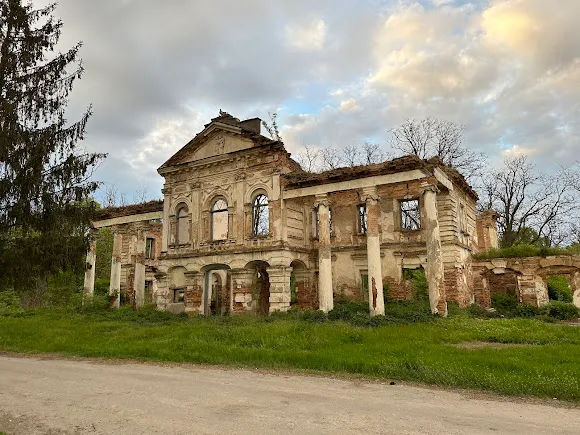
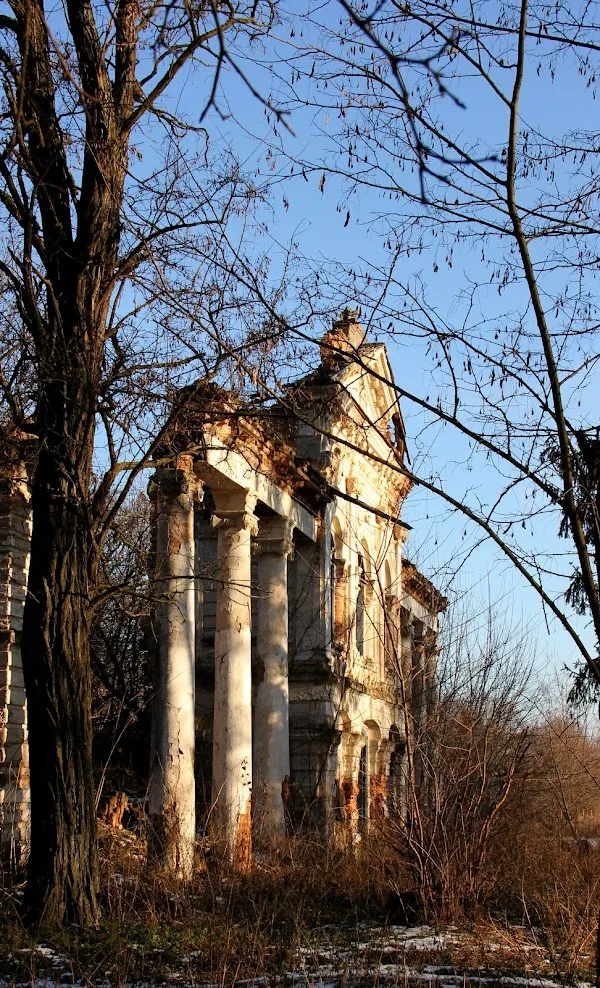
Rude Selo is an ordinary place. Roads, fields, a few houses. At its edge stands something unusual: two stories of open façade, no roof and no walls behind it. Windows without glass. Sky instead of a ceiling.
This is what’s left of a Palladian villa, built on the model of Andrea Palladio’s villas near Venice. The only one of its kind in Ukraine.
It was burned down in 1994 — deliberately, and with purpose.
General Information
| What? | Description |
|---|---|
| Name | The Zaleski Palace (mistakenly labeled “the Branicki Palace” in older literature) |
| Location | Rude Selo village, Fastiv district, Kyiv Oblast |
| Built | late 18th century (rebuilt in the mid-19th century) |
| Style | Palladian |
| Closest analogue | Villa Piovene, Vicenza province, Italy |
| Commissioned by | Stanisław Zaleski (of the Prawdzic coat of arms), starosta of Koropets |
| Fire | 1994 |
| Current condition | ruins (surviving façade, wing, cellar, and gate) |
| Status | architectural monument (listed in the register as “Branicki” — a documented error) |
Stanisław Zaleski and the Icon That Started It All
In the late 18th century, Rude Selo belonged to Stanisław Zaleski, starosta of Koropets and marshal of the nobility of Skvyra district.
Local historians tell it this way: Zaleski fell seriously ill with asthma and traveled for treatment. At one of several possible holy sites — accounts differ between Halychyna and Częstochowa — he acquired an icon of the Virgin Mary, after which he recovered.
Returning to Rude Selo, Zaleski decided to leave the icon in his home region. This became the occasion for building a church — and, as the story goes, the impetus for developing the entire estate on a grand scale.
But the icon wasn’t found right away. It was discovered walled up in the palace cellar — apparently hidden before the revolution. Today it’s kept in the Trinity Church and remains a site of pilgrimage.
Palladianism: Why This Palace Is Unique
Most researchers classify the palace as Palladian — an architectural style that reproduces the principles of Andrea Palladio’s villas on the Venetian plain in the 16th century. For Ukraine, this is the exception, not the rule.
Wikipedia names Villa Piovene, near Vicenza, as the closest analogue. The proportions, the arrangement of volumes, the character of the central avant-corps — all point to a deliberate reference to that source.
According to tradition, Zaleski had architectural expertise of his own and took an active role in the design. Sources don’t specify who executed the architectural plan. But it’s confirmed that the church and the palace in Rude Selo were built by the same architect.
What Stood, and What Remains
At the turn of the 18th–19th centuries, the estate included:
- a main two-story palace in the form of a villa
- a single-story wing
- a park with eight avenues radiating from the house
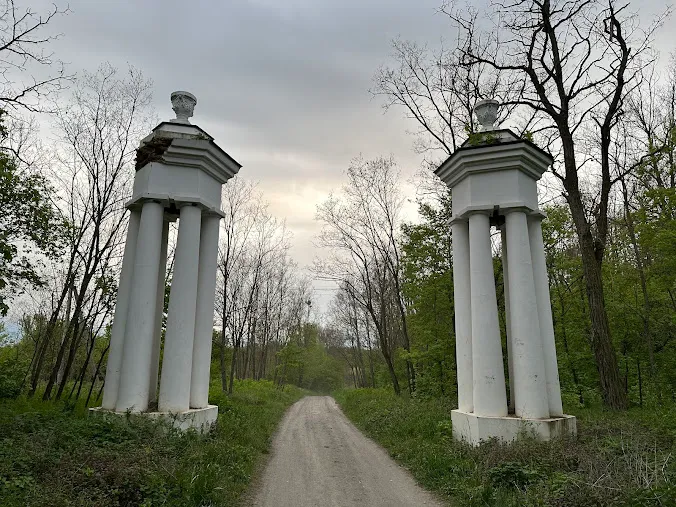
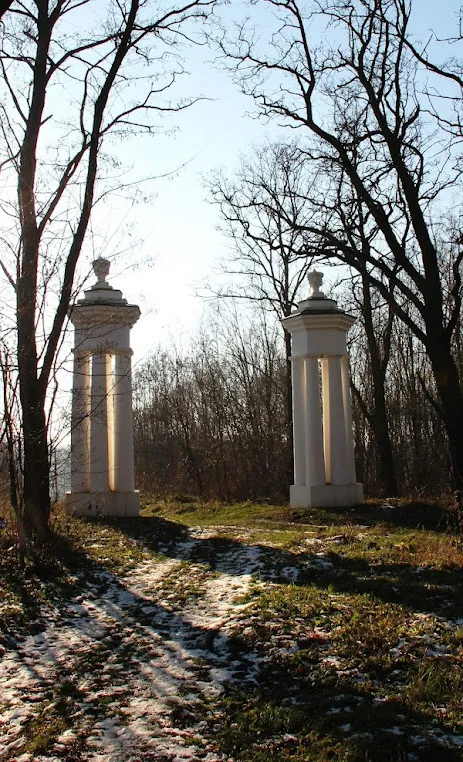
- gates at the entrance
- a cellar beneath the main building
On the triangular pediment of the main façade were the coats of arms of the owner and his wife. A bas-relief of two small figures survives — the only decoration to have outlasted the fire.
Before the fire, the palace housed a collective farm office. Its last owner, Zofia Rzewuska, lived mainly in Dashiv (Vinnytsia Oblast) and rarely visited Rude Selo. Older residents recall “fine finishes and lavish interiors” — confirmed by a 1970s register: “The vestibule and hall interiors, with their stucco work, survive.”
In 1994, the palace was set on fire. Deliberately. “Someone apparently wanted to make sure it went to no one” is the explanation locals give.
A Documented Error
Rude Selo and the Zaleski Palace carry another unfortunate entry in the record books: for several decades, in scholarly and tourist publications, and even in the official Register of Monuments, this site appeared as the “Branicki Palace.” This is a direct falsehood — the Branickis lived in Bila Tserkva and had no connection to Rude Selo whatsoever.
The error has been corrected, but the old name still turns up online.
What to See Nearby and How to Fit It Into a Route
Rude Selo itself has a few more points of interest:
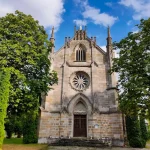
- Trinity Church (1825–1841) — built by the same Zaleski for the miraculous icon; active and well preserved
- The cellar beside the ruins — according to local tradition, exactly where the icon was found; accessible
- Remnants of the gate — restored around 2014
A route naturally runs through Skvyra → Rude Selo → Tkhorivka (the Strashynsky estate) → Bila Tserkva.
Practical Information
- Condition: ruins; surviving façade, wing, cellar, and gate
- Admission: free, unfenced
- Cellar: accessible (almost always open) — bring a flashlight
- Time needed: 30–60 minutes (palace, church, and gate)
- Road: Kyiv → Bila Tserkva → Skvyra → Rude Selo; ~75 miles (~120 km)
Little-Known Details
- This is likely Ukraine’s only example of Palladianism — a style widespread in Britain and northern Italy, but almost unknown on the Right Bank.
- Zaleski built both a Catholic church and an Orthodox church — for the two faiths among his subjects. The Bolsheviks destroyed the Catholic one; the Orthodox one survives.
- The miraculous icon that started it all was found walled up in the palace cellar — evidently hidden before 1917.
- The 1994 fire wasn’t accidental — locals describe it as a deliberate act of arson. Who did it, and why, has never been established.
- The estate’s gate has been restored, and, according to rumor, someone has even purchased the plot. But no rebuilding has happened yet.
- Architects documented the palace before its façade might collapse. “Even if the façade falls, it could be fully rebuilt from the existing documentation.”
Conclusion
The Zaleski Palace in Rude Selo is a place that resists the usual “beautiful ruin of the Kyiv region” framing.
There’s a Palladian villa here, the only one left in Ukraine. A miraculous icon, found in a cellar. A 1994 fire that settled the matter for everyone. And a façade still standing — with a bas-relief of two small figures where the family coats of arms once were.
Go while it’s still standing.