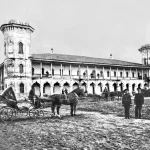
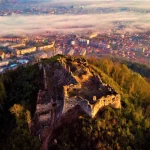
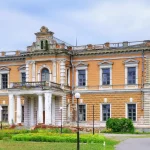
Above the arch of the main entrance to Uzhhorod Castle hangs a coat of arms with four thrushes. It belongs to the Drugeth family, who held the castle from 1322 to 1691.
No one has ever taken it down. It’s about 700 years old.
Hungary as a state effectively owes its name to this very town: Hungarians called Uzhhorod “Ungvár” — and “Ungarn” (Hungary) comes from “Ung.” One of Ukraine’s westernmost castles gave its name to one of Central Europe’s major states.
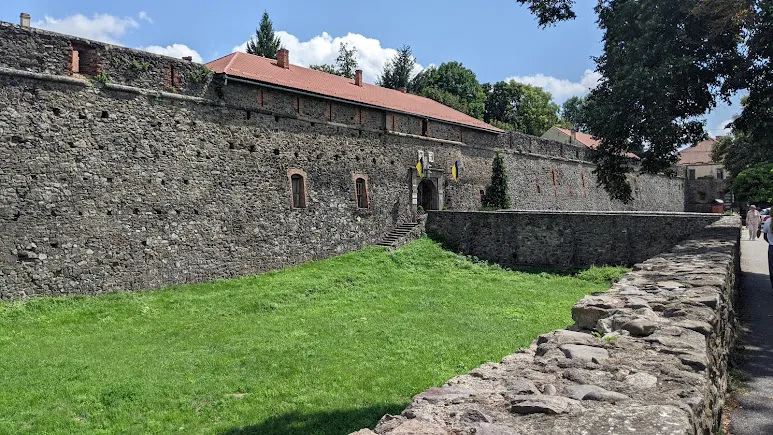
General Information
| What? | Description |
|---|---|
| Name | Uzhhorod Castle (Ungvár) |
| Address | 33 Kapitulna St., Uzhhorod, Zakarpattia Oblast |
| Location | Castle Hill, 98 ft (30 m) above the city, above the Uzh River |
| Area | ~3.7 acres (~15,000 m²) |
| First fortifications | 9th century (a wooden fortress of the White Croats) |
| Stone fortress | 13th century (after the Mongol invasion) |
| Reconstruction | late 16th century (1598, Italian engineers) |
| Main owners | the Drugeth family (1322–1691) — 350+ years |
| Style | Romanesque / bastion fortification |
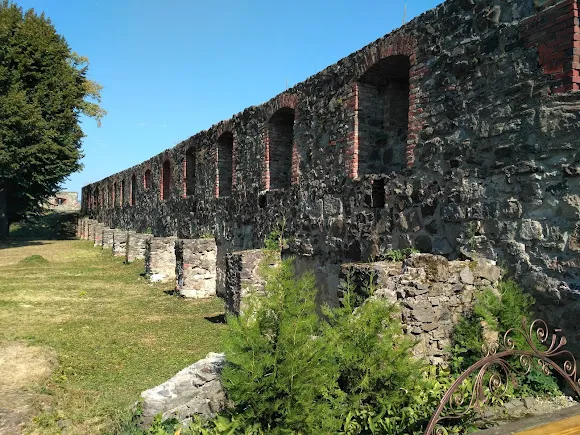
| Walls | 10 ft (3 m) thick, 33 ft (10 m) tall |
| Status | architectural monument of national significance; Zakarpattia Regional Museum (since 1947) |
| Admission | paid |
Who the Drugeths Were, and Why They’re Here
In 1312, the Drugeth brothers were introduced to the Hungarian king Charles Robert. They helped suppress a rebellion. Their reward: Uzhhorod Castle and the surrounding land.
The Drugeths weren’t Hungarian. They were a “wealthy dynasty of Franco-Italian origin”: the family came from the Kingdom of Naples along with the Angevin dynasty. For a time, Frenchmen and Italians commanded Hungarian troops from the Zakarpattia hills.
For 350 years — from 1322 to 1691 — the castle remained the Drugeth residence. Over that time:
- it was completely rebuilt several times to meet new weapons technology
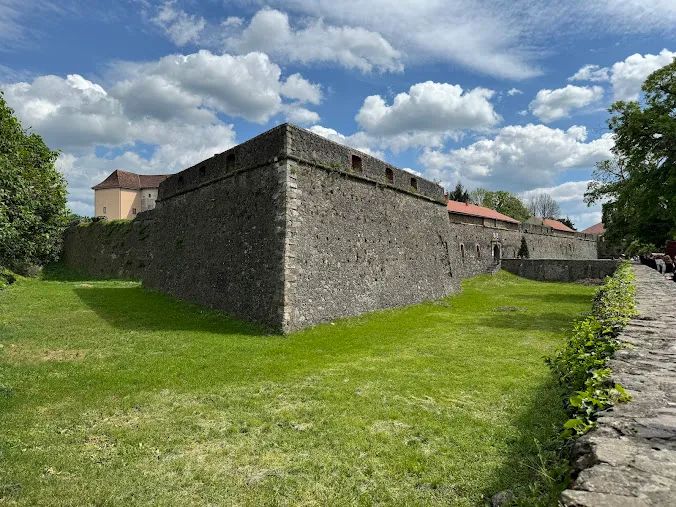
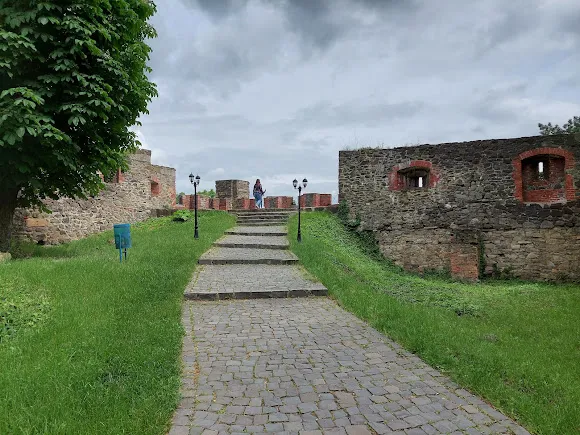
- 1598 — a major reconstruction: Italian engineers build new walls 10 ft (3 m) thick, with five bastions carrying cannon platforms
- the castle passed to Transylvanian princes and back again more than once
In 1684, the army of Imre Thököly captured Uzhhorod. The last Drugeth, who had remained loyal to the Habsburgs, was executed. The family’s line in Uzhhorod ended there.
In 1691, the castle passed to new owners. Then to the Greek Catholic eparchy. Then to a regional museum.
Architecture: Five Bastions and a 33-Foot Moat
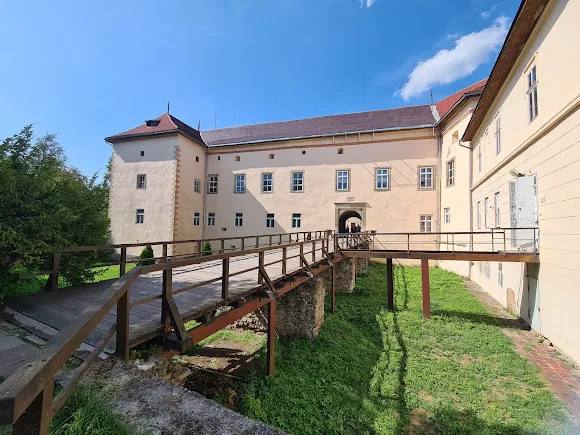
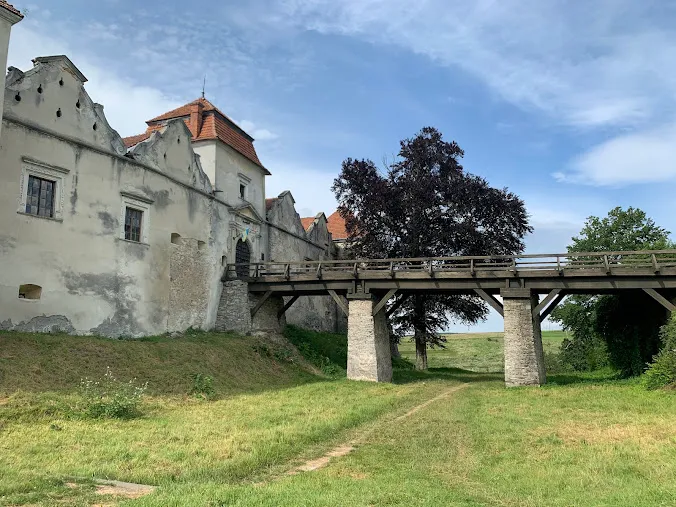
In plan, it’s an irregular quadrilateral — the terrain of Castle Hill dictated its shape. On three sides ran a moat 26–33 ft (8–10 m) deep, crossed by a drawbridge. Today a filled-in depression marks the moat’s former location, but the recesses for the drawbridge chains are still visible.
Five bastions: four at the corners and one keel-shaped bastion on the north façade. Cannons on the bastions covered every approach.
Above the arch of the inner courtyard hangs the Drugeth coat of arms: four thrushes. This image is more than 700 years old, and it’s still in place.
Inside the courtyard: the foundation of a 13th-century church — the very one where, in 1646, the Union of Uzhhorod was signed, uniting Zakarpattia’s Orthodox believers with Rome. The Uniate church became the foundation of the UGCC — this is the birthplace of the Greek Catholic Church in the region.
The Museum: 115,000 Exhibits and a Model Under Glass
Since 1947, the castle has housed the Tyvodar Legotsky Zakarpattia Regional Museum. Across 30 halls of the palace: more than 115,000 exhibits — archaeology, weapons, coins, Hutsul costumes, pysanky, craft tools.
There are specialized collections too: a museum of musical instruments, a museum of Zakarpattia clothing, a museum of nature.
Separately, a model of Uzhhorod Castle sits under a glass case in the courtyard. According to legend, foreigners have offered large sums for it — the administration refused.
In the former seminary chapel, frescoes by Ferdinand Vydra (1857) survive — worth a separate stop.
What Not to Expect
Uzhhorod Castle is the most-visited site in the city. In summer, especially on weekends, there’s a genuine tourist crush. If you want to see the castle without a crowd, come early on a weekday morning or outside the season.
One more thing: the castle is well preserved and orderly — but it isn’t an “untouched” medieval artifact. It’s a working museum with reconstructed sections.
What to See Nearby and How to Fit It Into a Route
Right beside the castle is the Zakarpattia Museum of Folk Architecture and Life (skansen): houses, churches, and farm buildings from every region of Zakarpattia, all outdoors. A combo ticket is available.
The linden alley along Nezalezhnosti embankment is Europe’s longest — more than 1.2 miles (2 km) along the Uzh — starting at the foot of Castle Hill.
From Uzhhorod, it’s easy to build routes across all of Zakarpattia:
- Palanok Castle, Mukachevo (~28 miles / ~45 km) — a different scale, a different era
- The Carpathian Biosphere Reserve and Dovbush’s Rocks (~62 miles / ~100 km)
- Wineries of the Berehove district (~31 miles / ~50 km)
Practical Information
- Address: 33 Kapitulna St.
- Admission: confirm current prices
- Hours: Tue–Sun, 10:00 a.m.–5:00 p.m.
- Skansen next door: separate ticket or combo
- Time needed: 1.5–2 hours (castle plus museum); 3 hours with the skansen
- From central Uzhhorod: a 10-minute walk along Kapitulna St.
Conclusion
Uzhhorod Castle isn’t Ukraine’s largest or most dramatic fortress. But it’s one of the few where the owner’s coat of arms, 700 years old, still hangs over the entrance. And where an agreement was signed within its walls that shaped Zakarpattia’s religious identity for centuries to come.
The Drugeths came from Naples. They stayed 350 years. Then they left. The thrushes on the arch remained.