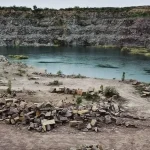
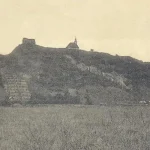
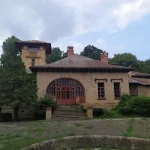
Skala-Podilska stands at the edge of a plateau, where Podillia breaks toward the Dniester canyon. The town sits above the Zbruch — protected on three sides by steep, rocky banks.
That’s exactly why a castle rose here. Not as a landscape ornament, but as an answer to the logic of the place.
Today, only ruins remain. But within those ruins are both a baroque palace burned by lightning and six centuries of changing owners.
General Information
| What? | Description |
|---|---|
| Name | Skala-Podilska Castle |
| Address | B. Khmelnytskoho St., Skala-Podilska urban-type settlement, Chortkiv district (the Borshchiv area), Ternopil Oblast |
| Coordinates | 48°51′09″N, 26°11′40″E |
| Type | a defensive castle on a rock outcrop above the Zbruch |
| First structure | 1360s–1370s (wooden, later stone) |
| First written mention | 1395 |
| Status | architectural monument of national significance |
| Condition | ruins |
The Site: Why Here
The castle stands on a high rocky outcrop on the right bank of the Zbruch. Its elongated shape follows the terrain. On three sides, natural protection comes from the river itself and the steep rocky banks. On the single accessible south side stood an artificial moat.
This isn’t a romantic location. It’s a combat position, chosen by the logic of maximum defense.
From Wood to Stone: a Timeline
1360s–1370s — the first wood-and-earth fortification on the site. Possibly an earlier Rus’ castle.
1393 — the Lithuanian prince Vytautas Koriatovych builds a stone defensive castle.
June 13, 1395 — the first written mention: King Władysław II Jagiełło grants Podillia’s castles, including Skala, to Spytek of Melsztyn.
1395 — Vytautas occupies Skala after Prince Fedir Koriatovych flees.
1441 — the town already holds Magdeburg Law.
16th century — the castle passes to the Lanckoroński family. Stanisław Lanckoroński reinforces the castle’s single vulnerable side: digging a moat, filling it with water, and strengthening the walls. This is the castle’s most powerful period.
17th century — several wars, Tatar raids, and captures. For a brief time, the castle belonged to the Transylvanian prince György II Rákóczi — an unusual owner for a Podillia fortress. Later, the Wiśniowiecki family.
A Baroque Palace, and Lightning
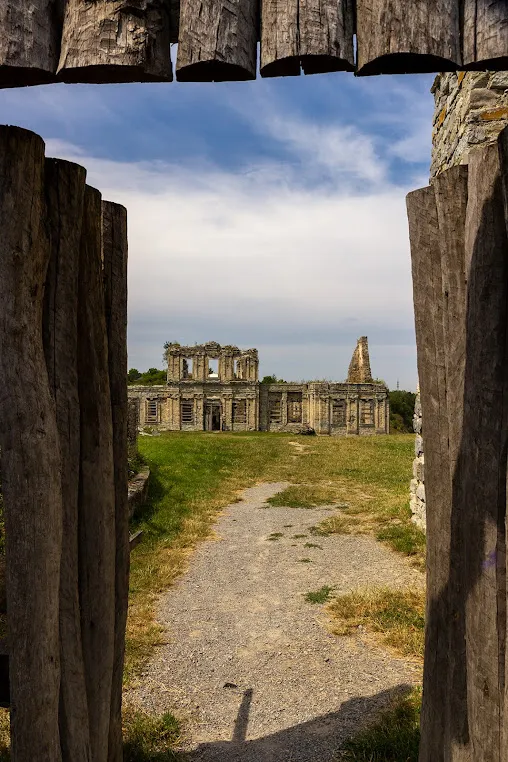
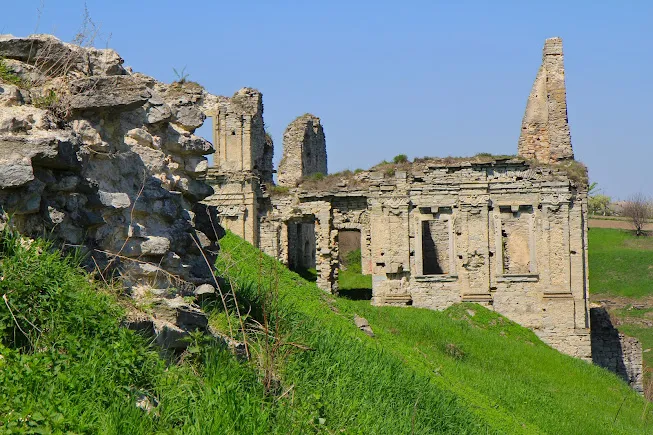
In the first half of the 18th century, the starosta of Skala, Adam Tarło (great-grandson of Konstanty Krzysztof Wiśniowiecki), decided to rebuild the castle. On the remains of the earlier structure, he raised a baroque-style palace, with white-stone decoration. Against the backdrop of ruins, it looked like a revival.
But a chronicle entry from 1765 records: “a few years after the restoration was completed, the palace was burned by a bolt of lightning, and now it stands empty, with the side annexes especially destroyed.”
Lightning burned the baroque palace.
Nothing was rebuilt after that.
What Survives
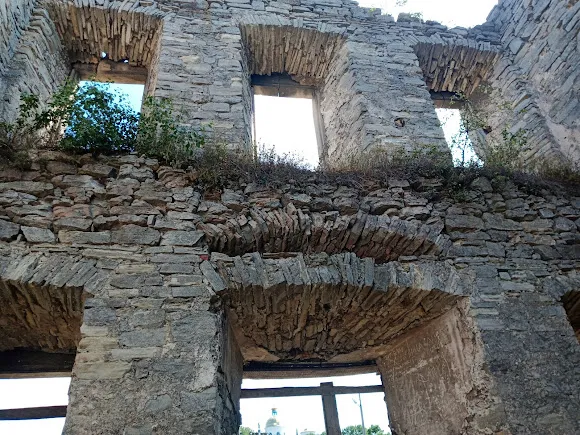
The ruins read like a floor plan:
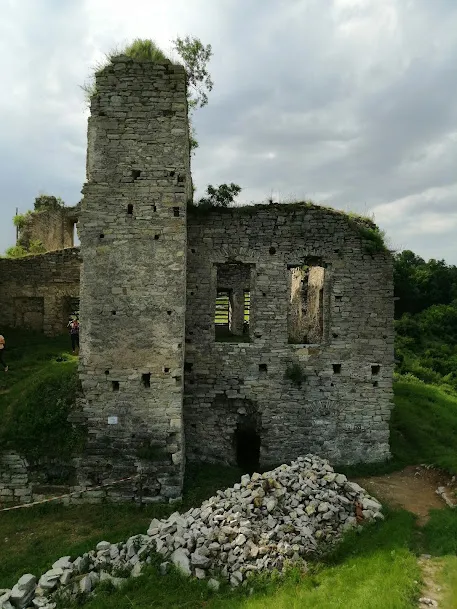
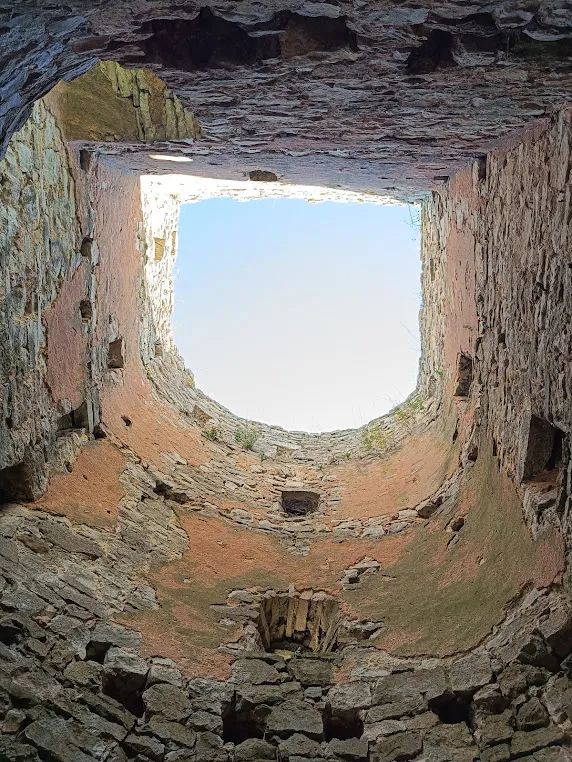
- ruins of a powder tower (16th century)
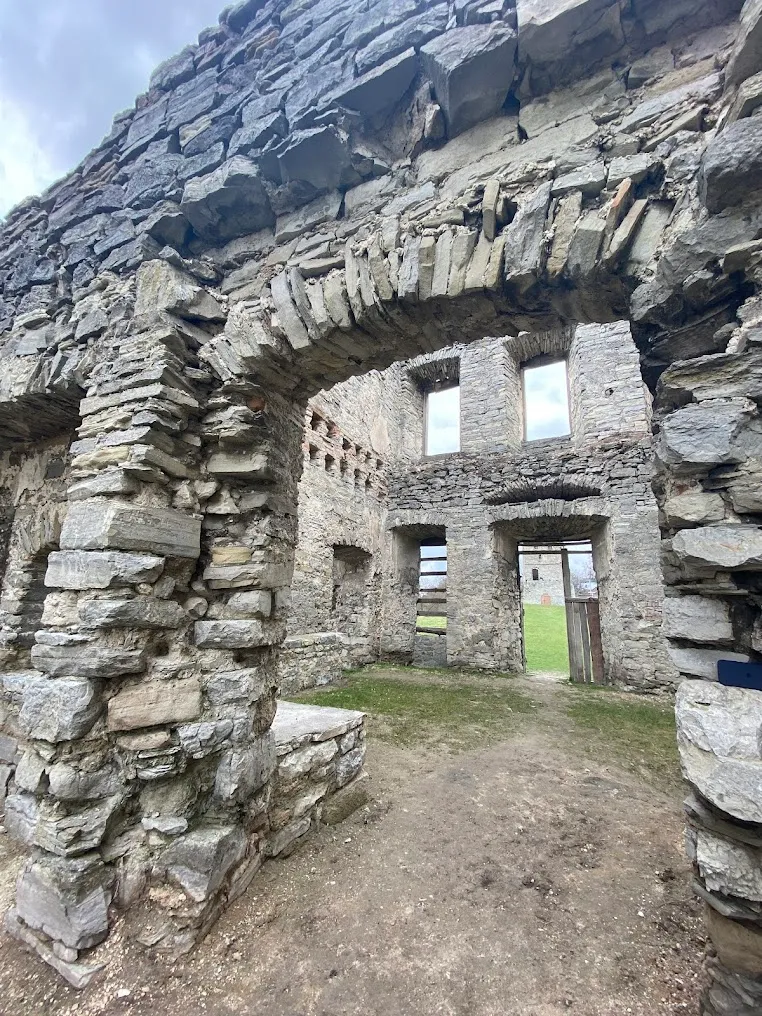
- fragments of defensive walls
- remains of the castle palace (Tarło’s baroque version, burned)
- a natural rock foundation — the castle literally grew out of the rock
- viewpoints over the Zbruch valley
On three sides: rock and river. From here, several kilometers of the valley are visible.
Elsewhere in Skala-Podilska
Skala-Podilska isn’t just the castle:
- the Holuchowski Estate and park (19th century) — a palace, an outbuilding, a conservatory, a chapel-mausoleum; a monument of landscape and garden art of national significance
- the Church of the Assumption of the Virgin Mary (1719)
- the Church of the Dormition of the Mother of God (1882) — where Mykhailo Hrushevsky married Maria-Ivanna Voiakivska
- the Zbruch River and its scenic banks
What to See Nearby and How to Fit It Into a Route
Skala-Podilska is in the Borshchiv area, one of the most tourist-dense districts of the Ternopil region:
- Kamianets-Podilskyi (~25 miles / ~40 km) — the fortress and a cable car
- Dzhurynsky Waterfall (~16 miles / ~25 km)
- Medzhybizh (~31 miles / ~50 km) — the castle and the grave of the Baal Shem Tov
- Bakota (~16 miles / ~25 km) — a flooded cliff monastery
- St. John Nepomucene Church in Turylche (~9 miles / ~15 km)
Practical Information
- Admission: free
- Security: none
- Time needed: 30–60 minutes (castle) plus 30 minutes (the Holuchowski Estate)
- After rain: slippery slopes — take care
- Footwear: hiking shoes or sturdy footwear
How to Get There
- From Ternopil: ~87 miles (~140 km) via Buchach and Borshchiv
- From Kamianets-Podilskyi: ~25 miles (~40 km) via Borshchiv
- The roads are paved; the approach to the castle is a dirt track
Little-Known Details
- The first written mention dates to 1395. The castle is older than most of the Podillia region’s “famous” fortresses.
- Contemporary sources rated the castle among the most impregnable in the region, alongside those of Vyshnivets, Kremenets, and Kamianets-Podilskyi.
- The 18th-century baroque palace was burned by lightning — recorded almost verbatim in the chronicle.
- György II Rákóczi, the Transylvanian prince, briefly became owner of a typical Podillia castle — an unusual detail in its history.
- Mykhailo Hrushevsky married in Skala-Podilska, at the local Church of the Dormition of the Mother of God.
- Its status is one of national, not local, significance.
Conclusion
Skala-Podilska Castle doesn’t look majestic. It looks worn out — like a place that did its job for a long time, absorbing blows and breaking down.
And even when someone in the 18th century tried to rebuild it all in baroque style — lightning struck, and put an end to it.
No one tried again. But the ruins remain.