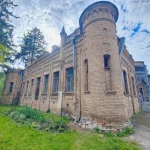
Bucha is now known around the world for a very different reason. But even before 2022, the town had its own architectural heritage — including the only surviving pre-revolutionary estate that looks like a small castle.
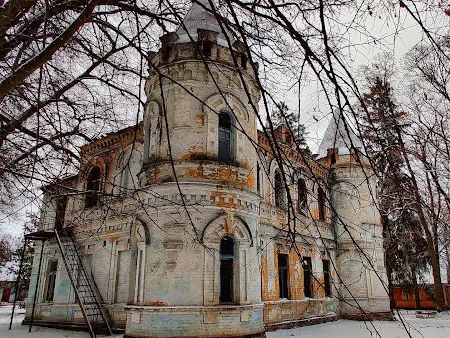
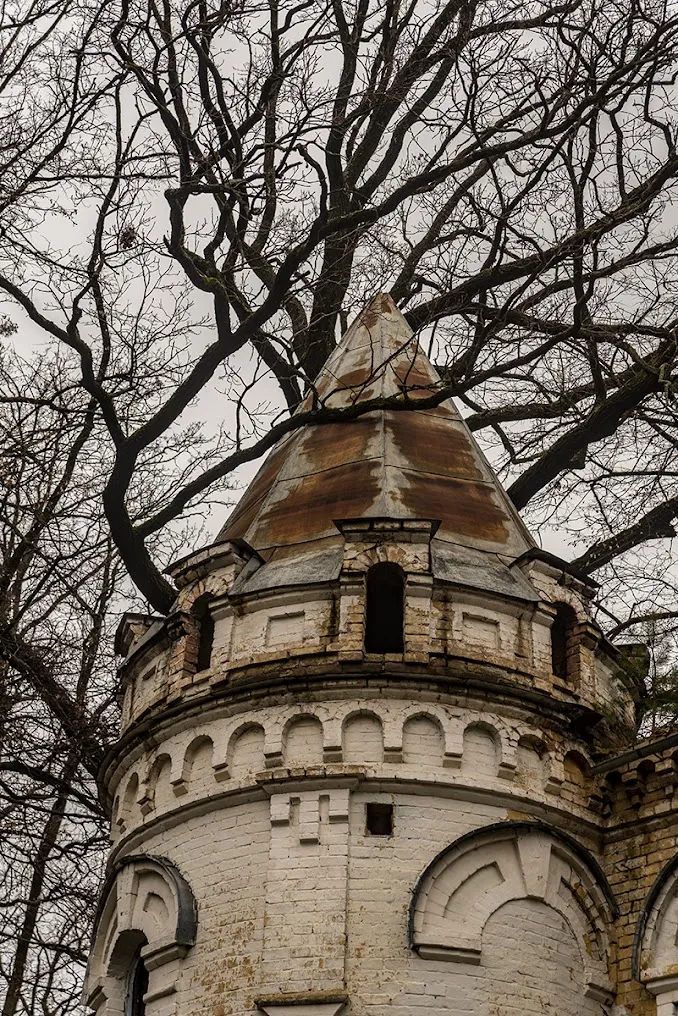
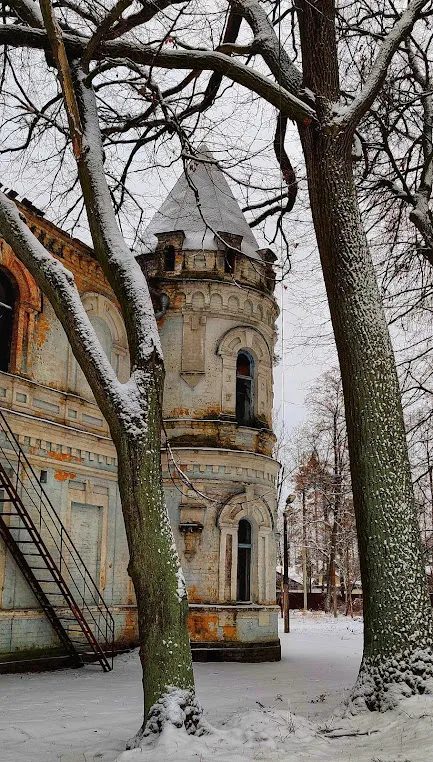
Yevhen Stamm’s estate stands in a pine forest on Kyievo-Myrotska St. Two towers. Neo-Romanesque style. The early 1900s.
General Information
| What? | Description |
|---|---|
| Name | The Stamm Estate (Stamm’s Castle) |
| Address | 133 Kyievo-Myrotska St., Bucha, Bucha district, Kyiv Oblast |
| Owner | Yevhen Stamm — board advisor to the Kyiv-Kovel line of the Southwestern Railway |
| Built | the 1900s (early 20th century) |
| Style | neo-Romanesque (pseudo-castle) |
| Jurisdiction | communal property of the city of Kyiv (despite its location in Bucha) |
| Status | newly identified object of cultural heritage (added to the register in 2019) |
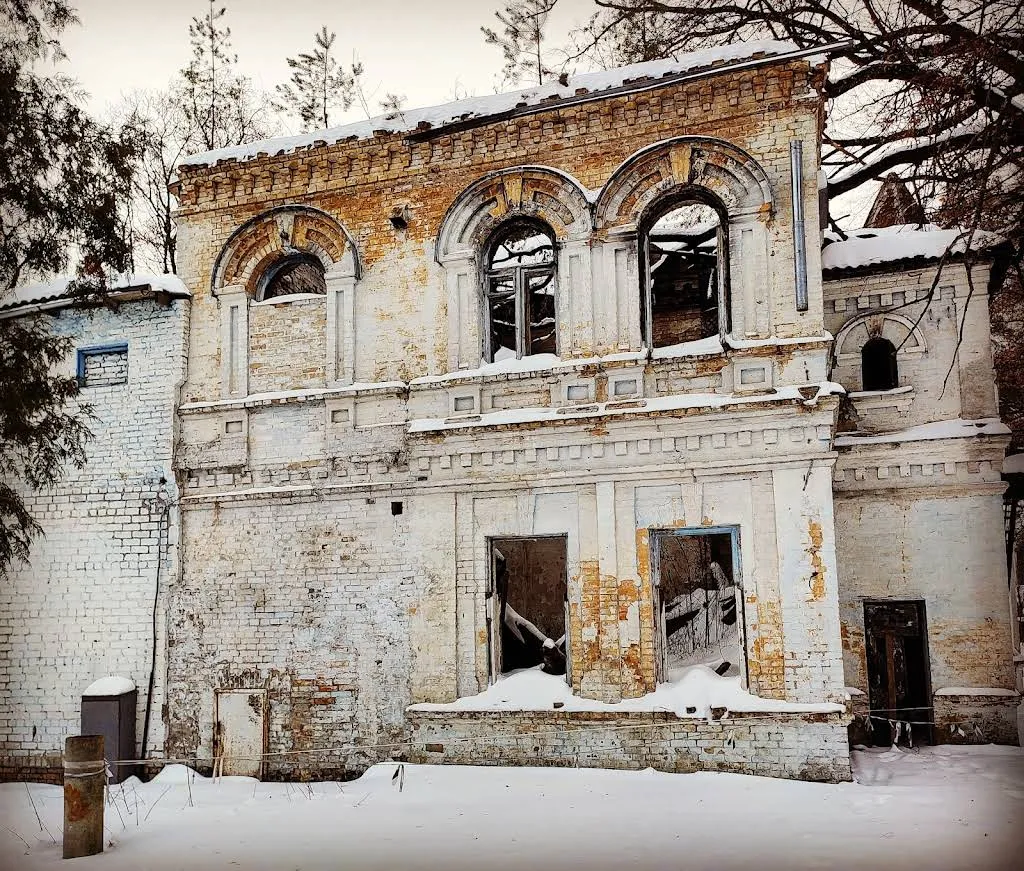
| Current condition | structurally unsafe, neglected |
Yevhen Stamm and His Castle
The town of Bucha grew up around the railway. After the Kyiv-Kovel line opened (1903–1908), dacha settlements began forming along it — Irpin, Bucha, Vorzel, Nemishaieve. Kyiv’s intelligentsia, officials, and entrepreneurs built summer residences here.
Yevhen Stamm — board advisor to the Kyiv-Kovel line of the Southwestern Railway — chose Bucha for permanent residence, not just as a summer dacha. On a plot in the pine forest, he built a neo-Romanesque pseudo-castle: a two-story building with two towers, stone walls, and narrow windows — all giving it the character of a medieval fortress, albeit a small one.
Stamm did more than simply live there. In one of the estate’s buildings, he set up a school for village children — free of charge, a rarity for a private estate in the early 20th century.
The owner lived at the estate until 1917, when the revolution changed everything.
Bucha’s Last Pre-Revolutionary Estate
The Stamm Estate is Bucha’s last surviving pre-revolutionary estate in recognizable form. This is a crucial detail: a town that grew out of early 20th-century dacha culture has preserved almost none of its original architectural face.
The complex includes:
- the main house, shaped as a pseudo-castle with two towers
- five smaller structures
- a park
The Chronicle of Its Fate: From School to Neglect
1917 — the Bolsheviks nationalized the estate. Stamm was forced to leave.
After the revolution — a children’s home opened here.
After World War II — Children’s Home No. 5, under the health department.
Later Soviet years — gradual neglect.
2014 — the Bucha town council appealed to the Kyiv City State Administration to hand the estate over for sports and recreation use. There was no substantive response.
2017–2019 — lawyer and Kyiv Oblast Council deputy Roman Tytykalo secured the estate’s inclusion in the register of newly identified cultural heritage sites. Protected status was granted in December 2019.
Today, the building is structurally unsafe. Its jurisdiction — formally Kyiv, not Bucha — complicates any practical decision about restoration.
Bucha After 2022
Bucha is a town known worldwide since February 2022 for the crimes committed here during Russian occupation. The Stamm Estate on Kyievo-Myrotska St. physically survived.
It’s neither possible nor appropriate to discuss this building apart from what happened in the town. But that’s exactly what makes the old estate, with its pre-revolutionary towers, a special place: it’s part of Bucha not just as a tourist site, but as a physical witness to the town’s long and complicated history.
What to See Nearby
Bucha district has preserved a few sites of similar character:
- Countess Uvarova’s House in Vorzel (~5 miles / ~8 km) — a 1902 art nouveau dacha, now a museum
- Irpin (~3 miles / ~5 km) — also affected in 2022; the bridge over the Irpin River became a symbol of evacuation
- Old Bucha center — individual early 20th-century dacha houses
Practical Information
- Access: exterior viewing free; the building sits within a forested area
- Condition: structurally unsafe — don’t go inside
- Time needed: 20–30 minutes
- Getting there: from Kyiv, route 381 from Akademmistechko metro station to the stop on Bohdana Khmelnytskoho St., then a ~30-minute walk. Or by car — ~16 miles (~25 km) from Kyiv.
Little-Known Details
- The owner built a “castle” in the forest rather than a classic dacha — a neo-Romanesque style with towers is rare in the early 20th-century dacha context.
- Stamm ran a school for village children at the estate — a social function unusual for a private manor.
- The estate is formally communal property of Kyiv, though physically located in Bucha. This jurisdictional confusion has been the main barrier to restoration.
- The estate received protected status only in 2019 — after two years of effort by a single lawyer.
- Its old folk name — “Stamm’s Knight’s Castle” — shows that people recognized the building’s pseudo-fortress character as soon as it was built.
Conclusion
The Stamm Estate is the least-known of Bucha’s architectural sites, and at the same time the only one that preserves the memory of what the town looked like before 1917.
A small castle in a pine forest. A school for children. A children’s home. Structural collapse. Protected status a hundred years after construction.
If you’re heading to Bucha, it’s worth the stop.