1661. A Turkish army laid siege to Nyalab Castle. They failed to take it.
1672. The Austrian king Leopold I ordered his own castle destroyed.
Not because it was useless. Because the Austrian monarch feared its powerful owners, the Perényi barons, who held the castle. Their loyalty was in doubt, and Leopold decided to eliminate the fortress along with the problem.
The Ottomans couldn’t take it. Its own king could.
General Information
| What? | Description |
|---|---|
| Name | Nyalab Castle (Korolevo Castle, Nyalab fortress) |
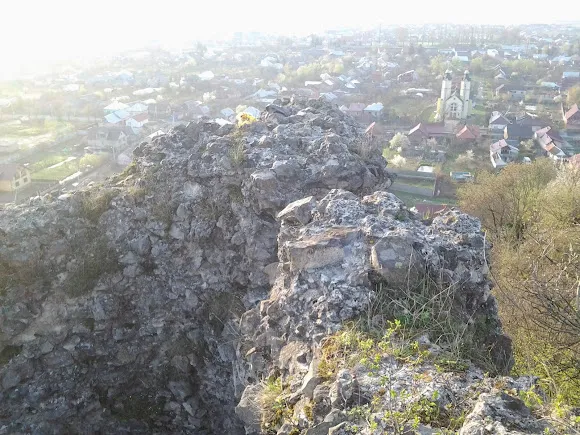
| Address | castle hill, Korolevo urban-type settlement, Vynohradiv district, Zakarpattia Oblast |
| First mention | 1264 (a letter from Pope Urban IV) |
| Stone fortifications | 1272–1315 |
| Purpose | a summer residence for Hungarian kings, plus protection of the salt road |
| Main owners | Hungarian kings, then the counts of Ugocsa, then the Perényi family |
| Destroyed | 1672 (by order of Leopold I) |
| Radio station | 1945–1947 (Soviet military) |
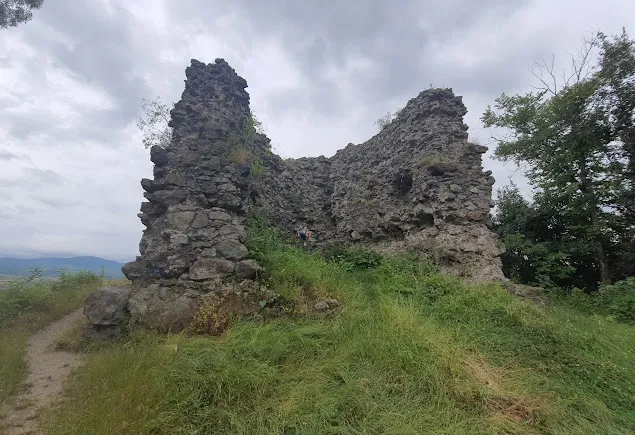
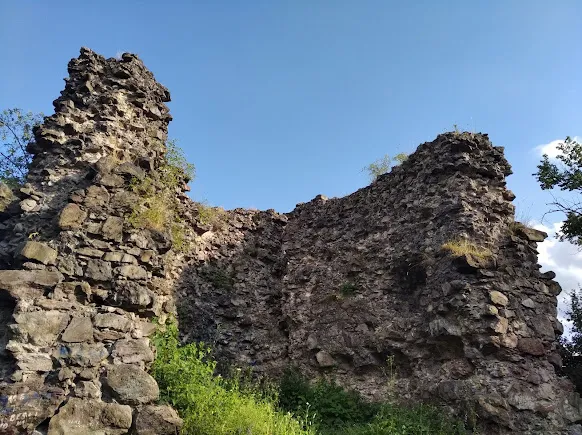
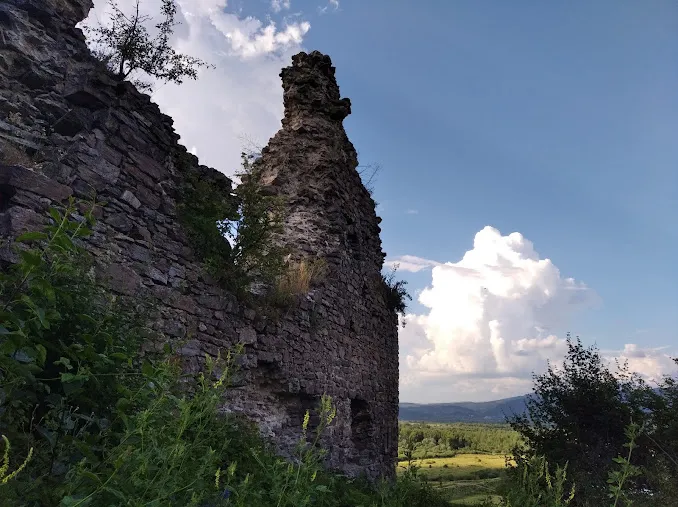
| Surviving structure | a keel-shaped tower (walls 8.5 ft / 2.6 m thick), wall fragments |
| Condition | ruins, overgrown; free admission |
A Name From an Outlaw, and a Pope’s Letter
The first written mention dates to 1264: a letter from Pope Urban IV to the Hungarian king Stephen V. The Pope called for the castle to be returned to the king’s mother, Queen Maria Laskarina — meaning the castle was already the subject of family disputes as early as the 13th century.
According to legend, the name “Nyalab” comes from a knight-turned-outlaw named Nyalab, who seized the castle in the late 13th century and ran it for a time.
Between 1272 and 1315, stone fortifications were built. The castle became a watch post on the salt road from the Maramureș valley.
From a Royal “Getaway” to a Baronial Estate
Its main function was as a summer residence for Hungarian kings hunting in the Carpathian forests. Together with Khust and Kankiv, the castle controlled the safe transport of salt down the Tysa.
In 1279, the castle itself is first mentioned in writing, under the name “Nyalab.”
In 1312, Beke Borsa, son of the count of Ugocsa, rose in revolt against King Charles Robert and seized the castle. The count of Bereg, Tamás Mester, besieged the fortress and recaptured it.
From the early 15th century, the castle passed to the Perényi barons, one of Hungary’s most influential noble families, who held it for more than two centuries.
In 1661, a Turkish army laid siege to it. They failed to take it.
1672: A King Against His Own Castle
In 1672, the situation was this: the Perényis had grown too powerful, and Leopold I suspected their loyalty. A castle in the hands of a potentially independent magnate was a danger.
The decision: destroy it.
The order was carried out. The castle was blown up from within.
A castle that had withstood the Mongols (saved by the Tysa River in 1241), the Ottomans in 1661, and several Hungarian pretenders to the throne — fell to its own monarch.
A Soviet Radio Station and Overgrowth
In the 1920s, Czechoslovak authorities organized excavations on the castle hill.
Between 1945 and 1947, a Soviet radar station was built on the summit. The castle became a closed military site, and the construction work on the hill accelerated the destruction of its walls.
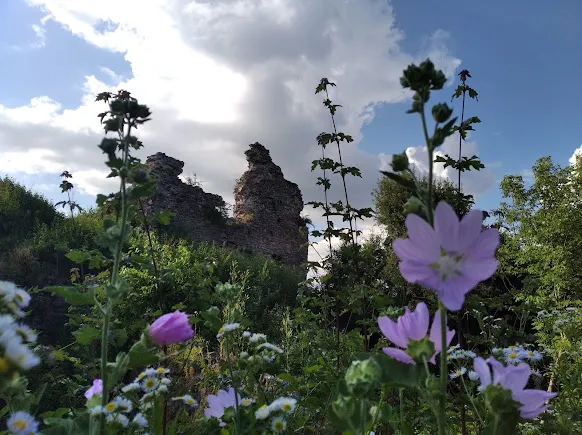
After the station was decommissioned, the castle gradually became overgrown with bushes and trees. Today the hill is, in local researchers’ words, “smothered in green.”
The Keel-Shaped Tower: the Strongest Surviving Element
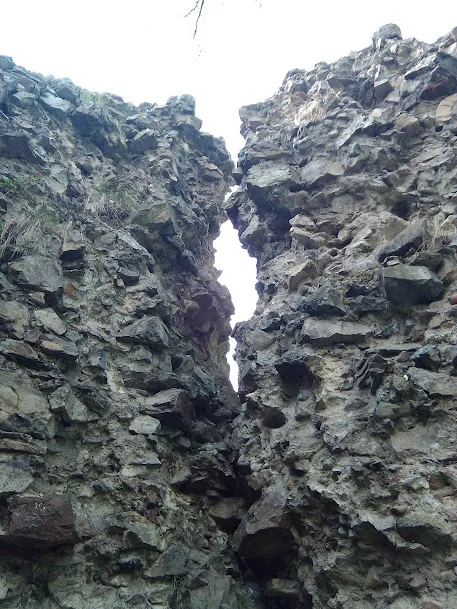
The most valuable and unexpected surviving element is a keel-shaped tower. Its walls, 8.5 ft (2.6 m) thick, are comparable to the walls of the main castle.
Its shape is unique among the castles in this series. The tower stands on the southern terrace of the hill, separate from the main castle core on the northern terrace.
The Mongols and the Tysa
In the spring of 1241, Batu Khan’s horde crossed the Verecke Pass. The spring flood on the Tysa was exceptionally severe. The Mongols moved along the right bank and couldn’t cross to the left. Korolevo wasn’t destroyed.
The castle survived the Mongols thanks to the river, not thanks to its walls.
What Not to Expect
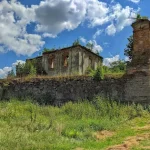
The castle is overgrown with bushes and trees. The climb up the hill follows an uneven path. Little remains of the main fortifications. The keel-shaped tower is relatively well preserved, but reaching it also means pushing through vegetation.
How to Fit It Into a Route
Korolevo is in Vynohradiv district, between Khust and Vynohradiv.
- Khust Castle (~19 miles / ~30 km) — destroyed by lightning in 1766
- Vynohradiv (~6 miles / ~10 km) — Kankiv Castle, also in ruins above the Tysa
- Mukachevo (Palanok) (~37 miles / ~60 km)
Three Zakarpattia castles above the Tysa in a single day: Khust, Korolevo, Vynohradiv.
Practical Information
- Admission: free
- Climb: a trail up the castle hill, ~20–30 minutes
- Condition: ruins, overgrown — take care
- Time needed: 30–60 minutes
- From Vynohradiv: ~6 miles (~10 km)
- From Khust: ~19 miles (~30 km)
Conclusion
The Mongols couldn’t cross the river. The Ottomans couldn’t take it by storm.
Its own king blew it up from within, out of fear of the barons.
Then came a Soviet radio station. Then came the bushes.
The keel-shaped tower still stands.