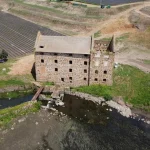
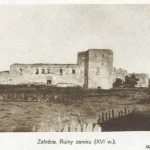
In 1644, the Transylvanian prince György I Rákóczi captured Nevytske Castle and ordered its walls torn down.
Nearly 400 years have passed since. No one ever rebuilt it.
This isn’t neglect. It’s the result of one specific decision that turned out to be final.
General Information
| What? | Description |
|---|---|
| Name | Nevytske Castle |
| Address | Castle Hill, between Nevytske and Kamianytsia villages, Uzhhorod district, Zakarpattia Oblast |
| Coordinates | ~48.55°N, 22.22°E |
| Distance from Uzhhorod | ~7 miles (~12 km) |
| First fortifications | 12th century (wooden) |
| Stone castle | 14th century (the Drugeth family) |
| Destroyed | 1644 (György I Rákóczi) |
| Three defensive lines | ramparts, a moat, a wall with four towers, a keep |
| Elevation | 853 ft (260 m) above sea level |
| Admission | free |
Three Owners, Three Fates
First era — the Aba-Amadé family. The first written mention comes in 1278: the castle belongs to Amadé, one of Hungary’s most influential magnates. He served as Palatine of Hungary — “on par with the king within his own lands.” A wooden fortress on a strategic hill above the Uzh valley controlled a trade route from the Carpathians. In 1317, Amadé’s son László rebelled against the king and lost: royal forces captured the castle.
Second era — the Drugeth family. From 1328, the castle belonged to the Drugeths — the same family from the Kingdom of Naples who simultaneously held Uzhhorod Castle. They rebuilt Nevytske twice: once in the late 14th–early 15th century, and again in the late 15th–early 16th century, adapting it for firearms. Three defensive lines appeared, a fourth tower, a water-filled moat, and a water supply through wooden pipes from a neighboring hill (in use from the mid-15th to the early 17th century — more than 150 years!).
But feuds broke out among the Drugeths: in the late 16th–early 17th century, the castle changed hands between different branches of the family several times. The dispute escalated so far that the matter had to go to the Vatican — which ruled in favor of the Jesuit-aligned György III Drugeth (1602).
Third era — the end. In 1644, the Transylvanian prince György I Rákóczi captured the castle and ordered its walls destroyed. When, in 1691, the Drugeths’ Uzh holdings passed to Count Miklós Bercsényi, he chose to invest in Uzhhorod Castle, leaving Nevytske in ruins.
That’s the key turning point: Bercsényi made a choice, and Nevytske lost out.
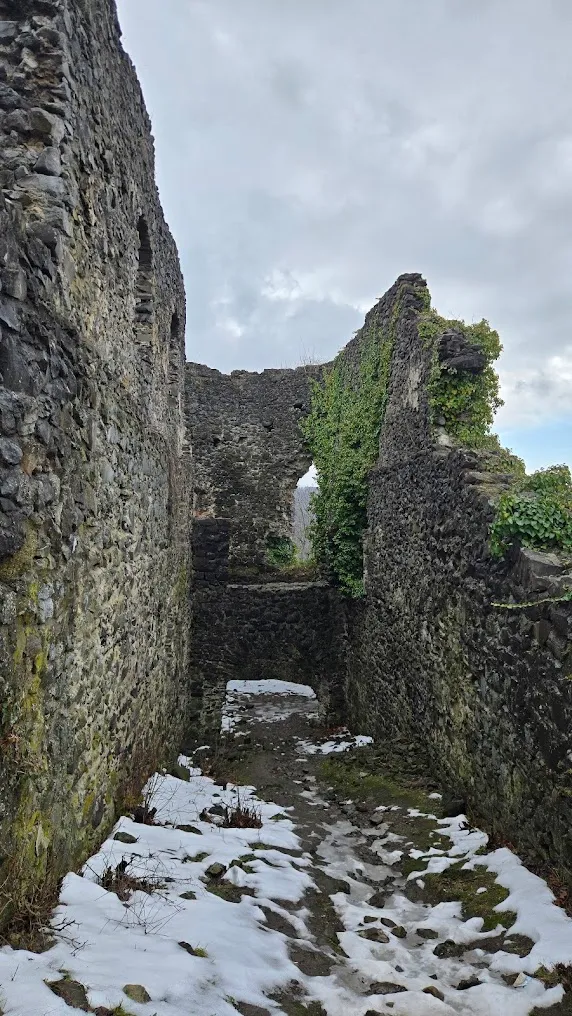
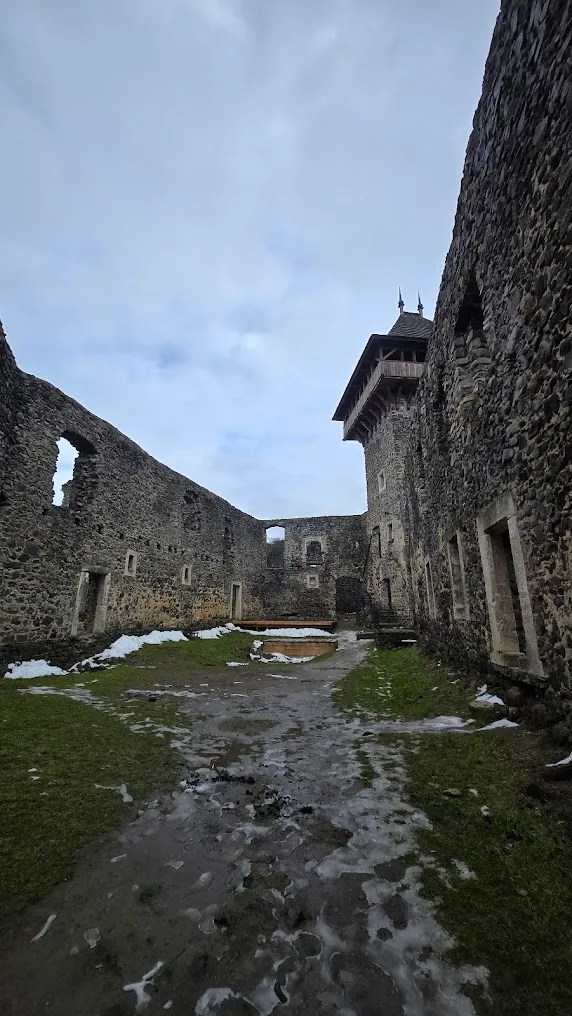
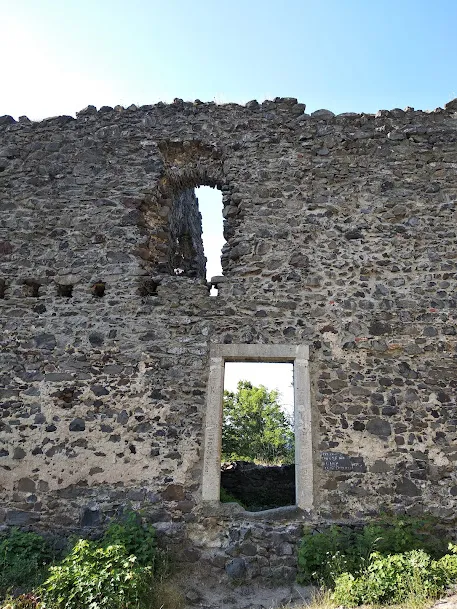
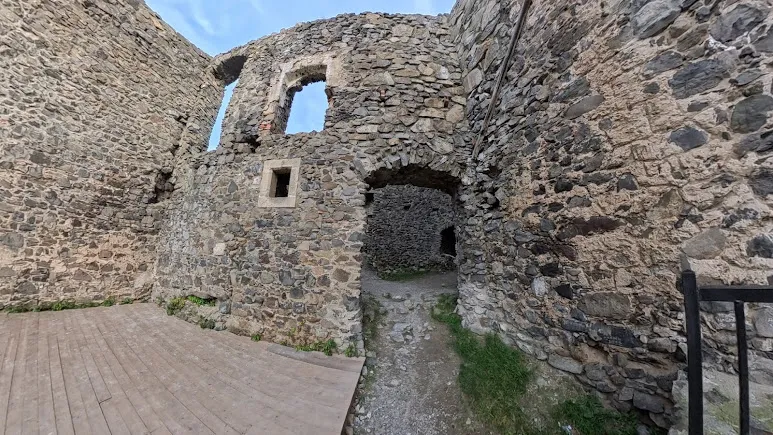
The Ruin’s Architecture
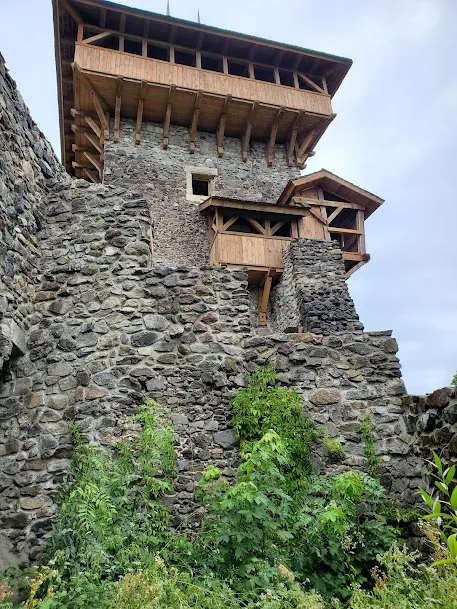
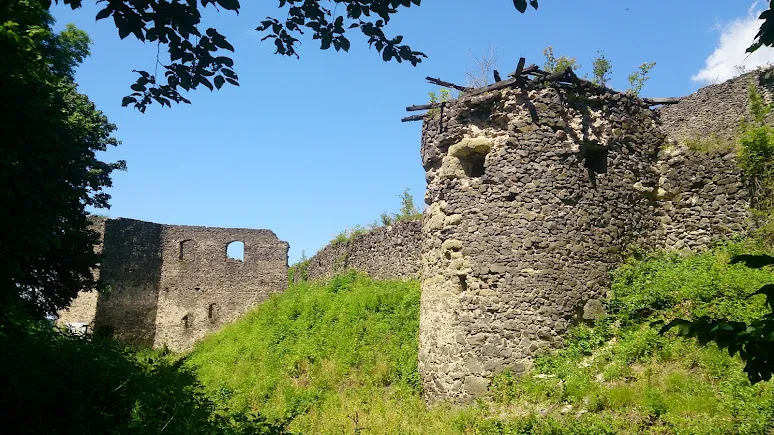
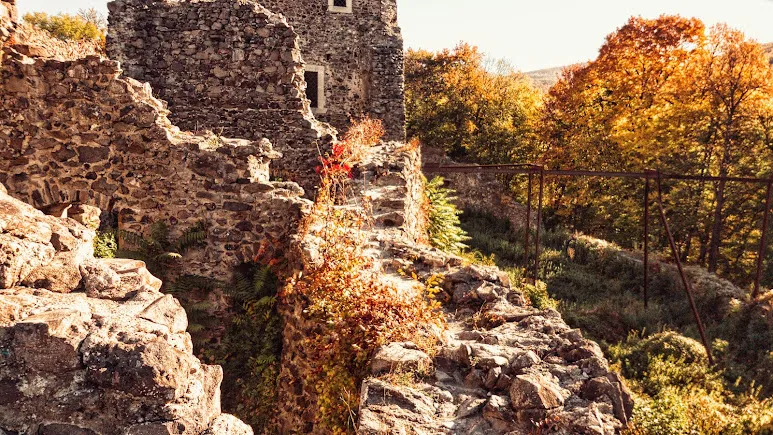
Despite its ruined state, the castle clearly illustrates the development of European fortification from the 13th to the 16th century:
- three defensive lines: outer rampart → moat → inner wall
- four towers on the inner rampart
- an entrance tower
- a keep (the oldest element, the castle’s original core)
- between the second and third lines, traces of a craftsmen’s settlement that served the castle in peacetime
Its elliptical plan is unique in Ukraine, recalling Irish medieval castles. The hill is of volcanic origin, standing 853 ft (260 m) above sea level.
From the castle wall: a panorama of the Uzh valley.
Jules Verne: a Plaque and a Doubt
An information board on site claims Nevytske Castle inspired Jules Verne’s novel “The Castle of the Carpathians” (1889).
Wikipedia notes plainly: “The claim needs verification, since according to that same plaque, the writer visited the castle in 1892” — that is, after the novel was written.
A beautiful legend. But with a logical problem.
The Nevytske Pillar Nearby
About 330 ft (100 m) from the base of Castle Hill stands the Nevytske Pillar — a natural volcanic tuff formation shaped like a phallic column. According to tradition, women in pagan times came here to pray for children. A small tree has grown on top of the pillar, which locals take as confirmation.
A documented and unusual site — worth the stop.
What Not to Expect
Admission is free — but there’s no infrastructure of any kind. No ticket booth, no guides, no café, no restrooms. There’s a trail up to the castle, but it turns slippery after rain.
Restoration work in 2019–2021 was “emergency conservation” — securing what might otherwise collapse. The castle remains a ruin, not a restored site.
What to See Nearby and How to Fit It Into a Route
Nevytske Castle is a stop along the way, not a destination in itself. A natural route:
Uzhhorod → Nevytske Castle (~7 miles / ~12 km) → Antalovetska Poliana mountain → return via Kamianytsia. The hiking route takes 3–4 hours.
Or pair it with Uzhhorod Castle (~7 miles / ~12 km back) — two Drugeth castles in a single day: one became a museum, the other, ruins. The difference comes down to one decision made in 1691.
Practical Information
- Admission: free
- Trail: from Kamianytsia village, ~30 minutes uphill on foot; slippery after rain
- Time on site: 1–1.5 hours
- Footwear: hiking shoes
- Infrastructure: none
- From Uzhhorod: ~7 miles (~12 km), by minibus or car to Kamianytsia
Conclusion
Nevytske Castle has been falling apart for 380 years. Not from neglect — from the decision of 1644, and the choice made in 1691.
It looks the part: the walls have collapsed, but the outlines of the three defensive lines can still be traced. The Uzh valley, seen from the summit, looks much the same as ever.
The Drugeths had two castles. One became a museum, the other, a ruin. The difference lay in a single choice made by the next owner.