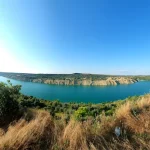
You drive through the Zaporizhzhia steppe, and the landscape barely changes. Field. Sky. Horizon.
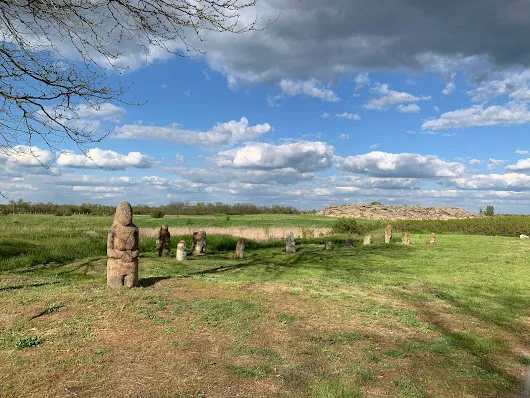
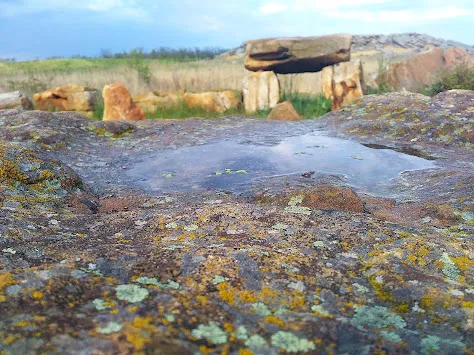
And then, suddenly, in the middle of all that flatness, a stone island appears.
Kamiana Mohyla is possibly the oldest sacred site on the territory of Ukraine. People came here for tens of thousands of years, and left their marks.
General Information
| What? | Description |
|---|---|
| Name | Kamiana Mohyla (National Historical and Archaeological Reserve) |
| Address | 1 Zapovidna St., Myrne urban-type settlement, Melitopol district, Zaporizhzhia Oblast |
| ⚠️ Status | temporarily occupied by Russia (since 2022) |
| Hill dimensions | ~787 × 525 ft (240 × 160 m), up to 39 ft (12 m) tall |
| Number of petroglyphs | several thousand |
| Timespan | from the late Paleolithic to the Turkic era |
| Monument status | National Reserve (since 2008); one of the 7 natural wonders of Ukraine |
| Geology | a sandstone outcrop, likely hardened sediment from the Sarmatian Sea |
What It Is
Kamiana Mohyla is a small, isolated sandstone massif in the valley of the Molochna River. Modest in size, at 787 by 525 ft (240 by 160 m), but of global significance.
Geologically, it’s likely a remnant of the ancient Sarmatian Sea. When the water receded, the sand mass hardened under the influence of local iron-bearing minerals. Long erosion followed — wind, water, time — forming slabs, grottoes, and crevices. For a long period, the hill was an island in the Molochna River.
Archaeologically, people discovered this place as far back as the late Paleolithic and kept returning for millennia — not to live here, but to leave a mark.
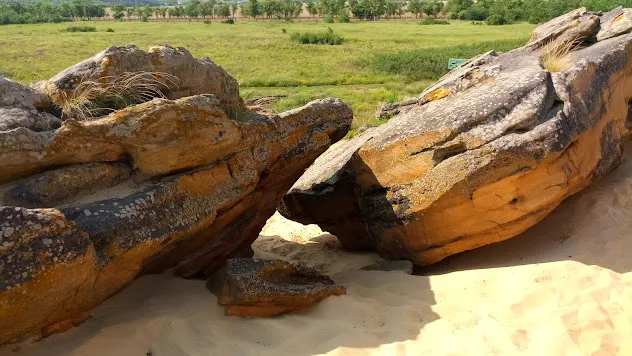
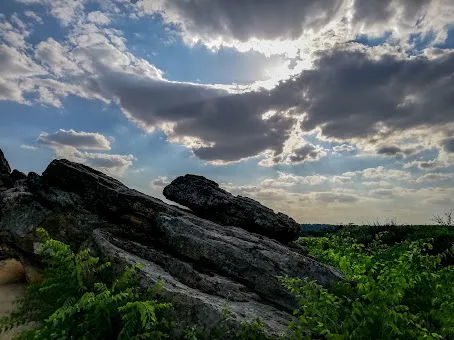
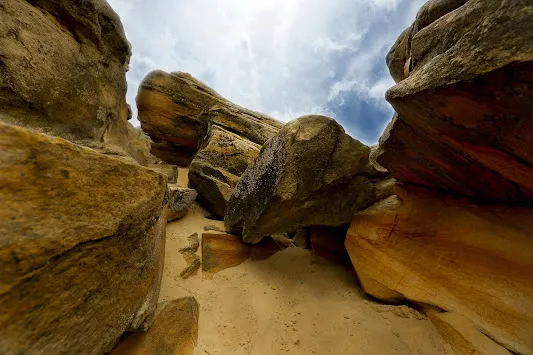
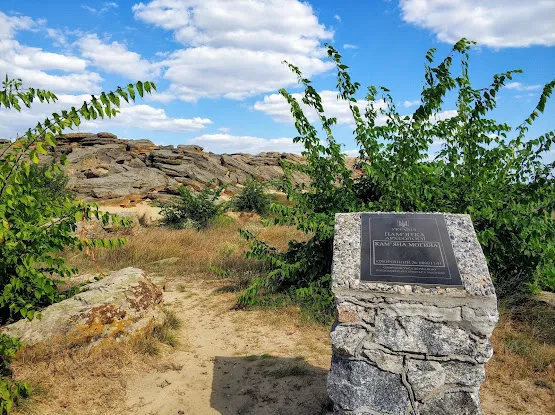
Petroglyphs: Several Thousand Across Millennia
The grottoes and slabs hold thousands of rock carvings, spanning an enormous stretch of time:
- late Paleolithic — the oldest images (hunting scenes, animals)
- Neolithic and Eneolithic — more complex symbols and ritual scenes
- Bronze Age — anthropomorphic figures
- Scythian-Sarmatian era
- Turkic era — the latest inscriptions
In other words, the hill served as a sacred site for at least 15,000 to 20,000 years. Every new people that arrived on these steppes found Kamiana Mohyla, and left something of their own.
Inside the grottoes, the carvings survived better, sheltered from wind and rain.
Why Here
Kamiana Mohyla stands in a completely flat steppe. It’s visible from a distance in every direction. For the nomadic peoples of the steppe, it was a natural landmark, a meeting place, a sacred center.
From the top, the view stretches for dozens of kilometers, and it becomes clear why people gathered here from across the steppe. The place “reads” the surrounding space better than any artificial marker could.
What Visitors Could See Before 2022
The reserve featured:
- a museum complex with replicas of the petroglyphs and artifacts
- developed trails among the grottoes and rock faces
- guided tours (Monday–Sunday, 9:00 a.m. to 4:30 p.m.)
- a research base, where scholars from various countries worked
The site was included among the “7 Wonders of Ukraine” and held international scholarly recognition.
The Site’s Fate After 2022
Since February 2022, Melitopol district has been under occupation. The fate of the reserve, and the state of the petroglyphs since occupation, are unknown. The museum’s collections and research archives may have been damaged.
Little-Known Details (Pre-Occupation)
- The petroglyphs’ timespan runs from the late Paleolithic (~15,000–20,000 BC) to Turkic-era inscriptions (a few hundred years AD).
- For a long period, the hill was an island in the Molochna River.
- Its official name, the “National Historical and Archaeological Reserve,” underscores its archaeological significance specifically.
- Nearby are Terpinnia village and Myrne settlement — this area is also known as the site of heavy fighting during World War II.
- Kamiana Mohyla isn’t the only site with a similar name: there are also the “Kamiani Mohyly” in Donetsk Oblast (a reserve on the border with Zaporizhzhia). The names are similar, but these are different monuments.
Conclusion
Kamiana Mohyla isn’t just a stone hill. It’s a place people chose for their most important undertakings across 15,000 to 20,000 years — an altar, a temple, an archive, a landmark.
It now lies on occupied land. But it stood here long before any states or borders, and it will remain after them.
This article stands as a record of what it was, and of what it must return to being.
⚠️ TEMPORARILY OCCUPIED TERRITORY
Kamiana Mohyla is located in Myrne settlement, Melitopol district, Zaporizhzhia Oblast — territory temporarily occupied by Russia. As of 2025, all of Melitopol district remains under occupation. Visiting is impossible and dangerous.
This article is written in an archival format, to preserve the memory of a unique world monument until de-occupation.