In the village of Verhuny, on its highest point, stands a church that’s hard to mistake for any other.
Not wooden. Not typical. Round, with two towers, remnants of murals, and a gap in the floor where a crypt once lay. It was built in memory of murdered men — and its very shape still bears witness to that.
General Information
| What? | Description |
|---|---|
| Name | the Nativity Church (Church of the Nativity of Christ, the Bazylevsky Family Pantheon-Church) |
| Location | Verhuny village, Khorol urban community, Lubny district, Poltava Oblast |
| Type | a brick rotunda church with a family crypt |
| Built | 1801–1807 |
| Consecrated | September 16, 1801 |
| Style | Empire (Neoclassical) |
| Probable architect | Nikolai Alexandrovich Lvov (a St. Petersburg architect; attribution debated) |
| Status | architectural monument of national significance No. 596 |
Why It Was Built — and What Lies Behind It
To understand this church, you need to know one event: the Turbai Uprising of 1789–1793.
It was one of the largest anti-serfdom peasant revolts in Left-Bank Ukraine. Serfs from villages belonging to the Bazylevsky family — one of the wealthiest landowning dynasties in the Myrhorod area, who by the 1780s owned 12 villages and more than 10,000 serfs — rose in rebellion. During the uprising, three Bazylevsky landowners were killed. The revolt was only crushed in 1793, with the help of a regular Jäger regiment. Its organizers were exiled to Siberia.
The church in Verhuny was built specifically as a crypt and memorial to the dead. The idea belonged to landowner Petro Fedorovych Bazylevsky; funding came from his brother Ivan, who died before construction was finished but left the money for it. Bricks from the Bazylevskys’ own factories in Verhuny were used in construction.
Who May Have Designed It
Researchers believe the design belongs to Nikolai Alexandrovich Lvov (1751–1803) — a well-known St. Petersburg architect, poet, and polymath, a master of Empire-style rotundas. He designed several similar churches in Russia and Ukraine. No documentary proof of authorship survives, but the stylistic resemblance and timing align.
By tradition, Bazylevsky, who often traveled to Rome, became fascinated there with rotunda forms — and researchers point to the Pantheon in Rome as the main model for the Verhuny church.
Architecture: a Rotunda in the Steppe
The church is unusual for the Poltava region, both in form and in the scale of its ambition.
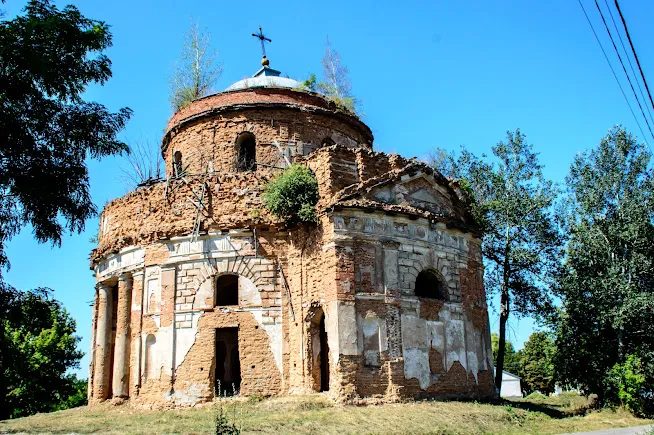
Shape: circular (a rotunda) in plan. The outer radius measures 43 ft (13.1 m), the inner chamber 24 ft (7.4 m). Wall thickness: about 5 ft (1.5 m).
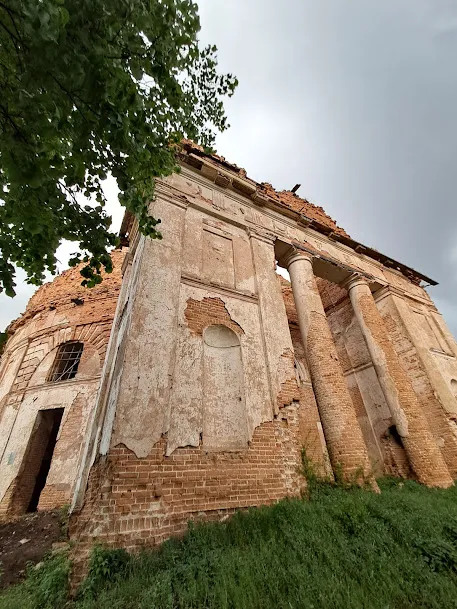
Façade: an entrance section with two square bell towers, joined by a deep loggia — a design that recalls a Catholic church more than an Orthodox one. Decoration includes Tuscan columns and pilasters, with stucco friezes of garlands and mascarons.
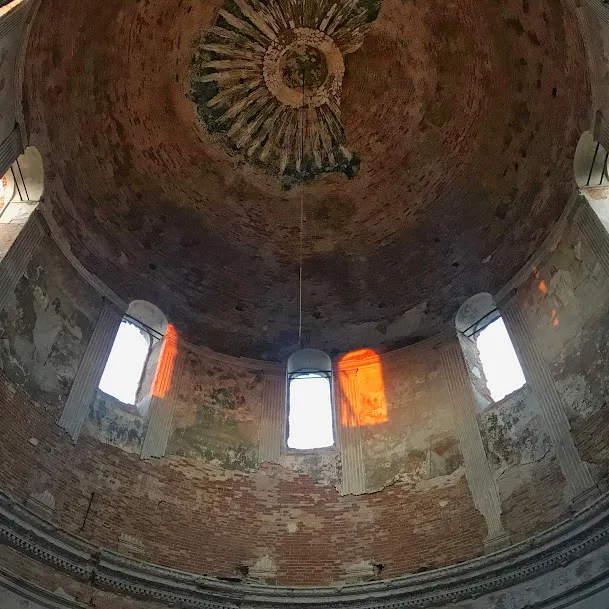
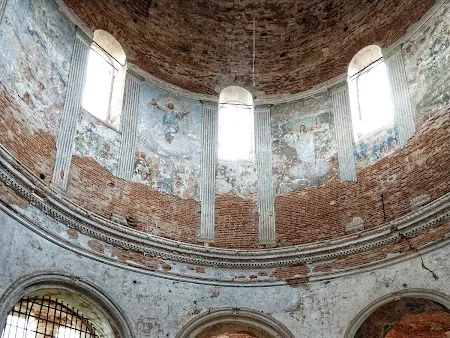
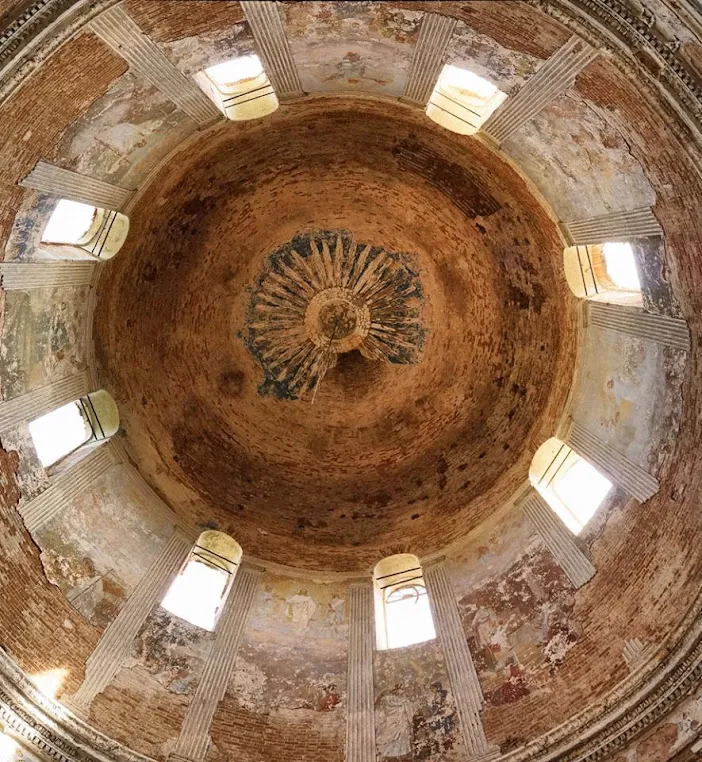
Dome: large, lit by eight windows at its base, filling the central space with even, diffused light.
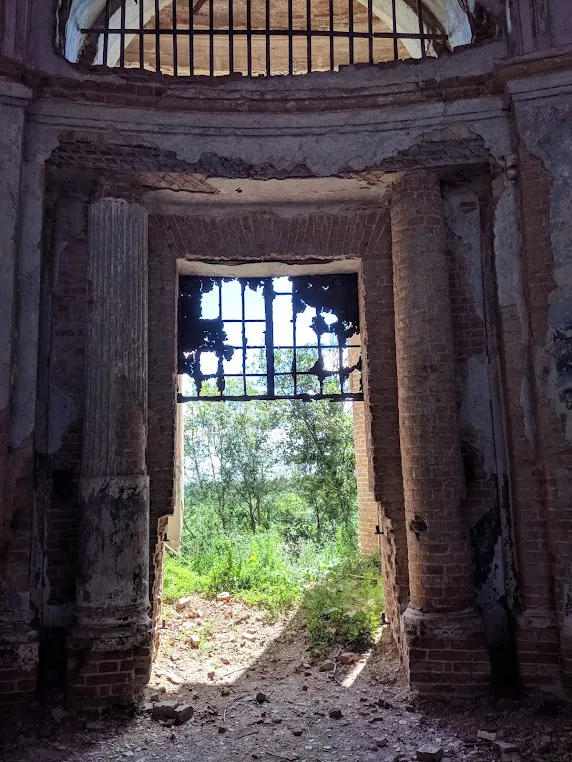
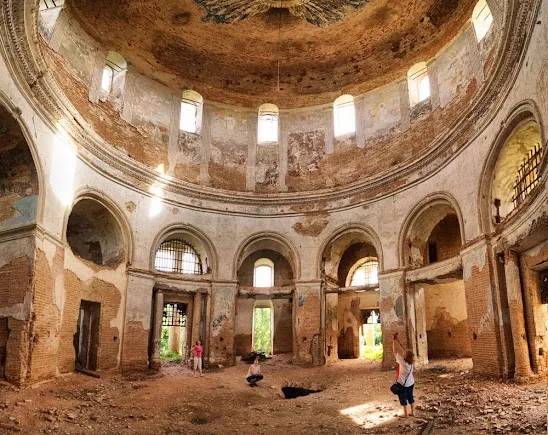
Crypt: beneath the floor of the central section lay the Bazylevsky family crypt. Today it’s a gap yawning open in the middle of the rotunda floor.
Above the west doors once hung a plaque with a Latin inscription: “From Thy own gifts, brought unto Thee” — a concise formula of donation that serves as both dedication and justification.
Murals and Interior Decoration
In 1911, the walls and vaults were painted by students of the St. Petersburg Academy of Arts. The murals covered most of the walls: Christ, the Mother of God, angels. Some of these images survive today, gazing from the walls onto an empty space, without windows or a roof.
The church once held two precious Gospels, along with silver and gold chalices — a personal gift from Bazylevsky.
What Soviet Rule Did to It
In 1936, the bells were removed, the tops of the bell towers dismantled, and the building repurposed as a storage facility for a local collective farm. Later it served as a grain store, then a potato store. The family crypt was opened, its valuables taken, and the remains of the buried left unattended.
In the late 1980s, restoration began, and the roof was reinforced before the work stopped with the collapse of the USSR.
In 2019, through a court ruling initiated by the prosecutor’s office, the building was transferred to the ownership of the Khorol urban community for preservation.
Today, the church is formally under community ownership. Services have resumed — the parish registered as an OCU (Orthodox Church of Ukraine) congregation in 2000. But the building’s condition is critical: no windows or doors, a gap in the floor, crumbling decoration, and murals at risk.
What to See Nearby and How to Fit It Into a Route
Verhuny lies in what is now Lubny district (formerly Khorol district), in agricultural Poltava region. Nearby:
- Khorol (~2.5 miles from Verhuny to the bank of the Khorol River) — a district town with its own landmarks
- Myrhorod (~25 miles / ~40 km) — a well-known spa resort and Gogol’s town
- Dykanka (~37 miles / ~60 km) — the Kochubei family’s Church of St. Nicholas, a monument the Bazylevskys clearly rivaled in scale of ambition
Practical Information
- Admission: free, the building is open
- Services: held (OCU); confirm the schedule locally
- Condition: structurally unsafe — be careful inside, avoid the gap in the floor
- Time needed: 30–45 minutes
- Photography: the most striking view is from the southeast, showing the apse and the towers’ silhouette
How to Get There
Verhuny is in Khorol urban community, Lubny district, Poltava Oblast.
- From Khorol: ~3 miles (~5 km) north
- From Poltava: ~75 miles (~120 km) via Myrhorod and Khorol
- From Kyiv: ~155 miles (~250 km) via the M03 highway (the Kharkiv route), through Lubny and Khorol
- The road to Verhuny is paved; from the highway, it’s a village road
Little-Known Details
- The church was built from the Bazylevskys’ own brick — the family had brickworks right in Verhuny.
- The Turbai Uprising, in memory of whose victims the church was built, was one of the largest anti-serfdom revolts in 18th-century Ukraine. It took four years to suppress, with the help of regular troops.
- The Bazylevsky who commissioned the church died before construction was finished, leaving the funds in his will — the church was completed without him.
- Restoration began in the 1980s, and the roof was reinforced — but the work stopped with the collapse of the USSR. In other words, a certain level of preservation had already been achieved, and was then lost again to inaction.
- This is the most notable rotunda church in the Poltava region — officially recognized as an architectural monument of national significance, No. 596.
Conclusion
The Church of the Nativity of Christ in Verhuny is a place with a very specific, unsettling backstory. It wasn’t built out of piety in the abstract — it was built because rebels killed specific people, and their descendants chose to memorialize that in stone.
The rotunda, the Latin inscription, the St. Petersburg murals — all of it sits atop a gap in the floor where the dead Bazylevskys once lay.
This is architecture of memory. And its ruin is part of that memory too.