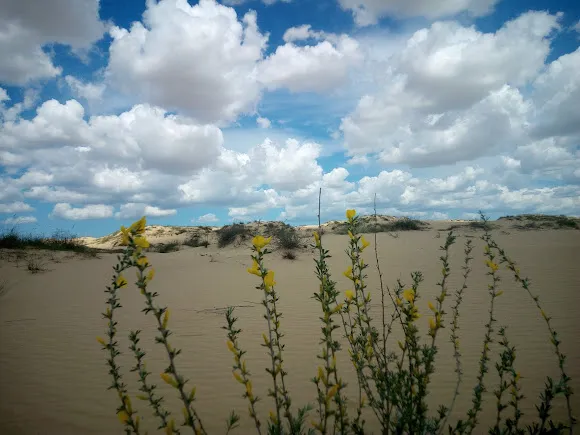
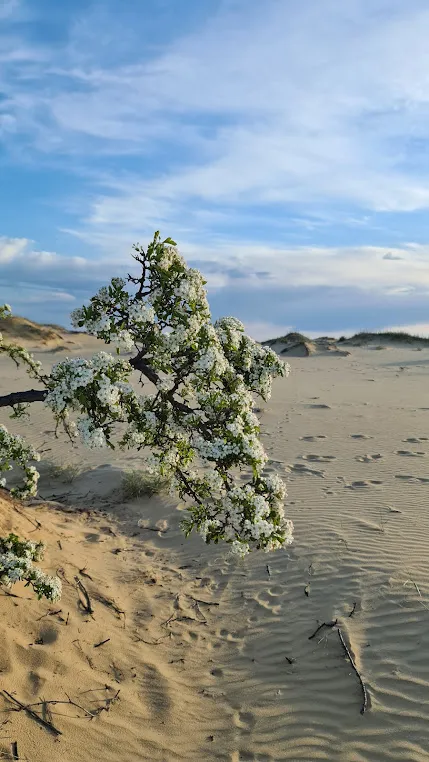
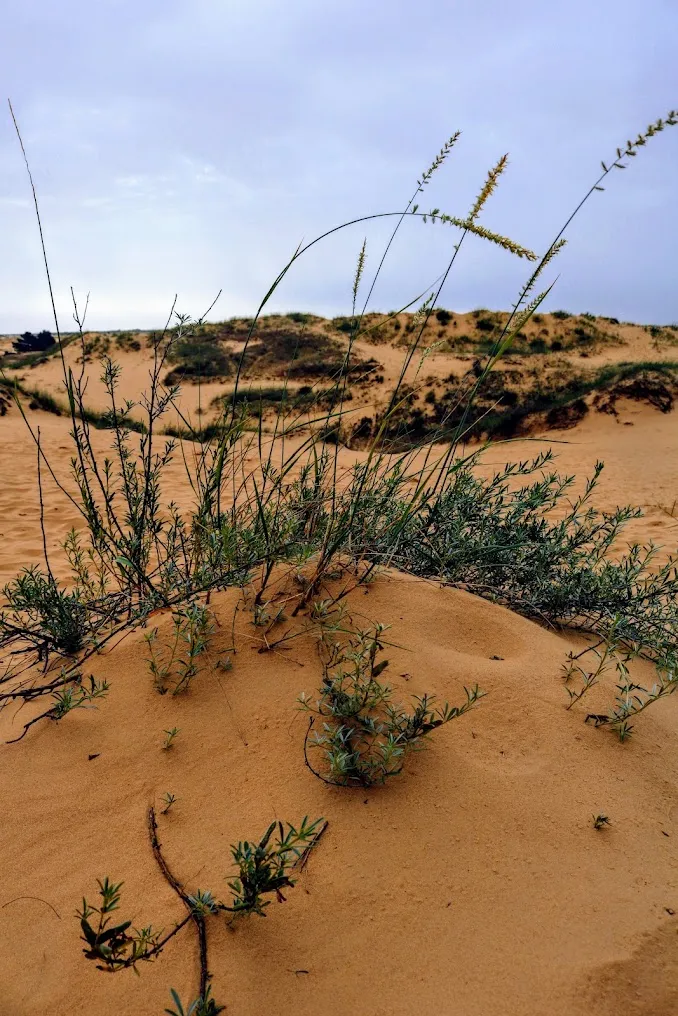
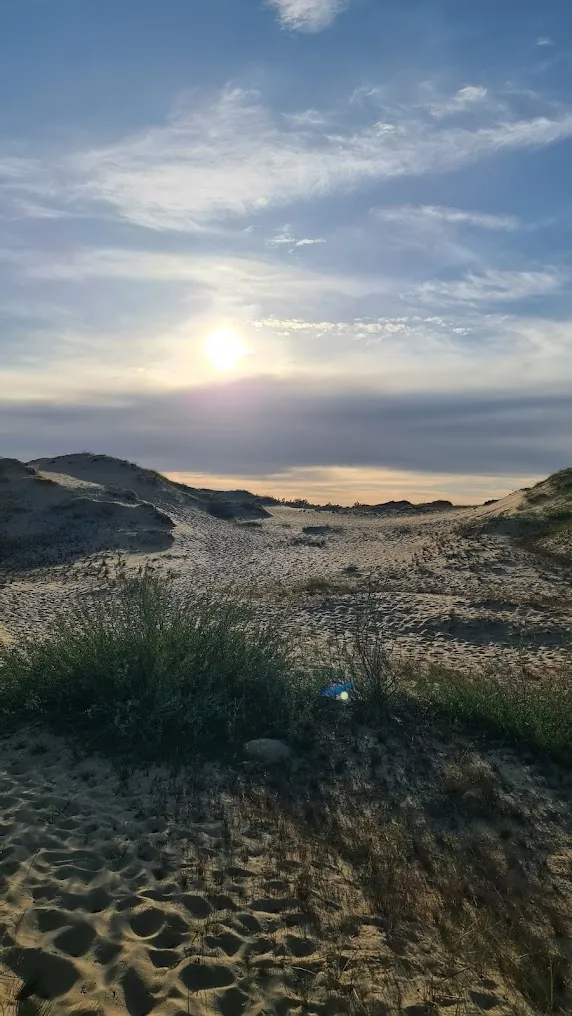
Until 2022, the Oleshky Sands were one of Ukraine’s strangest landscapes and one of the largest sand massifs in Europe.
You drive through the south, expecting the usual — fields, tree lines, villages. Then the road simply ends and the sand begins. Not a beach, not a quarry. Real dunes to the horizon. Your mind refuses to believe this is Ukraine.
General Information
| What? | Description |
|---|---|
| Name | Oleshky Sands (the Oleshky Desert) |
| Location | the left-bank part of the lower Dnipro, Kherson Oblast |
| ⚠️ Status | temporarily occupied by Russia (since February 2022) |
| Area | ~160,000–220,000 ha (~618–849 sq mi; 7 sand “arenas”) |
| Length | 98 miles (158 km) — from the Black Sea coast to Kakhovka |
| Standing in Europe | one of the largest sand massifs; only the sands of the northern Caspian region are larger |
| Status before 2022 | Oleshky Sands National Nature Park |
What It Is and How It Formed
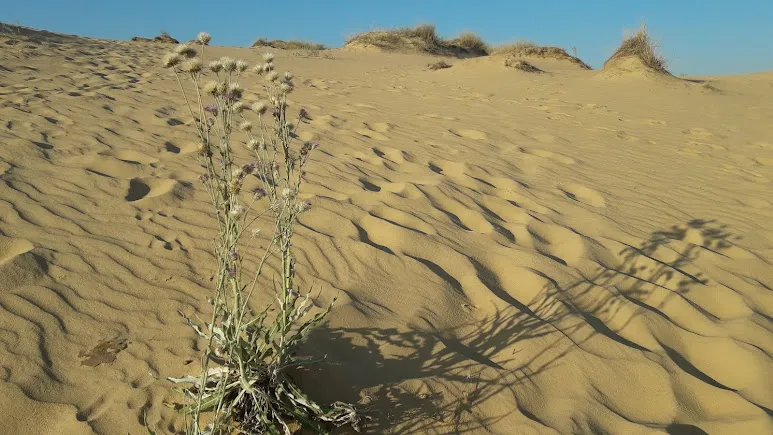
The scientifically accurate term is a dry-steppe intrazonal landscape, not a “desert” — Ukraine has no true desert zone. But by its characteristics, it comes close: in summer the sand heats up to 158°F (70°C), and rising columns of hot air disperse rain clouds, so precipitation is rare here.
Sand in the lower Dnipro has always existed — the Dnipro’s ancient delta region formed sand arenas over millennia. But the large-scale deflation and spread of sand trace back to the 19th century: massive overgrazing by sheep (including, by some accounts, the million-strong flocks of Baron Falz-Fein) destroyed the steppe vegetation that had served as a natural barrier against the sand. Wind erosion did the rest.
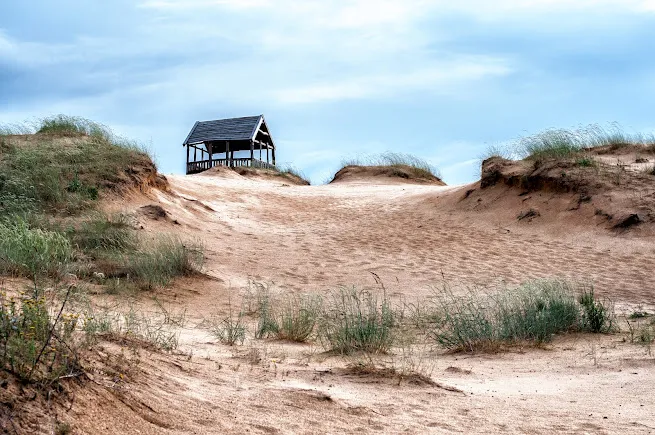
The massif consists of seven hilly sand arenas with varying degrees of vegetation and desertification. The dunes (locally called “kuchuhury”) reach 16 ft (5 m) in height.
The Protective Forest and a Unique Ecosystem
In the 1970s–80s, a protective forest belt about 2.2 miles (~3.5 km) wide was planted around the sands, to hold back sandstorms that could bury gardens under half a meter of sand overnight.
This same area holds a concentration of protected sites: the Black Sea Biosphere Reserve, the Bilobeerezhzhia Sviatoslava National Nature Park, the Oleshky Sands National Nature Park, and the Kinburn Spit. Endemic species found nowhere else live here, including the steppe birch mouse (Nordmann’s birch mouse).
What Happened After February 2022
February 2022 — the Oleshky Sands were occupied on the first day of the full-scale invasion.
March 2022 — raids on the protected territory began, along with the killing of wildlife.
2022–2023 — according to Global Forest Watch satellite monitoring, the park lost nearly half its protective forest within a few months. The forest is being cut down to build fortifications and trenches. Trenches and bunkers are under construction, vegetation cover is being destroyed, and military vehicles are scattering the sands.
April 2023 — Russia illegally registered “Oleshky Sands National Nature Park” under Russian law, appointing as director the founder of several Russian companies.
June 2023 — the destruction of the Kakhovka Dam flooded 90% of Oleshky town; part of the sands was also affected by the resulting deluge.
Today, the Oleshky Sands serve as a military training ground and a staging area for shelling right-bank Kherson region.
What It Was Like Before 2022
Before the full-scale invasion, it was a popular tourist destination, offering:
- ecological trails (“Berezovyi Hai,” “Dyvosvit,” starting from Radensk, 1.2–1.5 miles / 2–2.5 km each)
- quad bike and off-road vehicle safaris
- drift races
- festivals and commercial film shoots
- paid admission (a small fee)
The favored visiting seasons were spring and autumn (summer brings sand heat up to 158°F/70°C).
Little-Known Details (Pre-War)
- In 2015, the National Bank of Ukraine issued a commemorative coin featuring the Oleshky Sands.
- The word “Oleshshia” (the area’s old name) is thought to derive either from “alder forest” (Old Slavic “Olüšüje”) or from other sources — there’s no single agreed origin.
- In summer, the sand heats up to 158°F (70°C) — hotter than most African beaches.
- The massif consists of 7 sand arenas, each with a different character of vegetation and relief.
- The dune topography (barkhans, “kuchuhury”) results not only from overgrazing but also from fluvial, aeolian, and suffosion processes that unfolded over millennia.
Conclusion
The Oleshky Sands are a unique landscape that no longer exists anywhere else in Ukraine, and almost nowhere else in Europe. Today it lies under occupation and is undergoing deliberate destruction.
This article stands as a record — of what this place was, and of what it must become again once Kherson region is liberated.
⚠️ CRITICAL: TEMPORARILY OCCUPIED TERRITORY
The Oleshky Sands are located on the left bank of the Kherson region, on territory temporarily occupied by Russia. Visiting is impossible and dangerous.
The area has been under occupation since February 2022. The national park has been converted into a military training ground: heavy weapons are stationed there, right-bank Kherson region comes under shelling from it, and trenches and bunkers are being built, destroying a unique ecosystem in the process. The protective forest belt planted around the sands in the 1970s–80s lost half its extent within a few months of occupation.
This article is written in an archival format, to preserve the memory of a unique landscape until de-occupation.