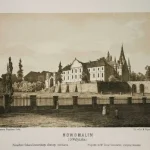
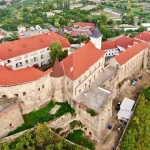
Amid the forests of Volhynia, off the tourist routes, stands a structure that looks neither like a castle nor a ruin.
Tarakaniv Fort is military logic embodied in concrete and earth. Not beauty. Not a symbol. A system built for war — and, notably, for a specific war that almost never reached this place.
General Information
| What? | Description |
|---|---|
| Name | Tarakaniv Fort (Dubno Outpost Fort, New Dubno Fortress) |
| Location | Tarakaniv village, Dubno district, Rivne Oblast, above the Ikva River |
| Type | earthen-and-concrete fortification |
| Built | 1885–1890 |
| Area | ~10 acres (4 ha) |
| Wall thickness | up to 16 ft (5 m) |
| Casemates | 105, for 800 people |
| Status | historical monument, structurally unsafe |
Why and How It Was Built
After the third partition of Poland (1795), Dubno became a border town of the Volhynian Governorate of the Russian Empire. The border with the Austrian (later Austro-Hungarian) Empire ran nearby, and the Lviv–Kyiv railway line, which passed through Dubno, became a strategic vulnerability.
The chief architect of the new border fortification system was Adjutant General Eduard Totleben — hero of the defense of Sevastopol and Russia’s most distinguished military fortification engineer. In 1873, 66 million rubles were allocated from the imperial treasury for the fort’s construction.
Direct construction was overseen by engineer-colonel Borisov. Earthworks began as early as the 1860s, first raising a hill. Main construction ran from 1885 to 1890. Materials included brick, cement, rubble mortar, cast-iron fittings — and concrete, still a cutting-edge, not-yet-widespread material at the time.
In 1890, members of the imperial family under Alexander III inspected the fort — signaling its official readiness.
An Engineering Machine: What’s Inside
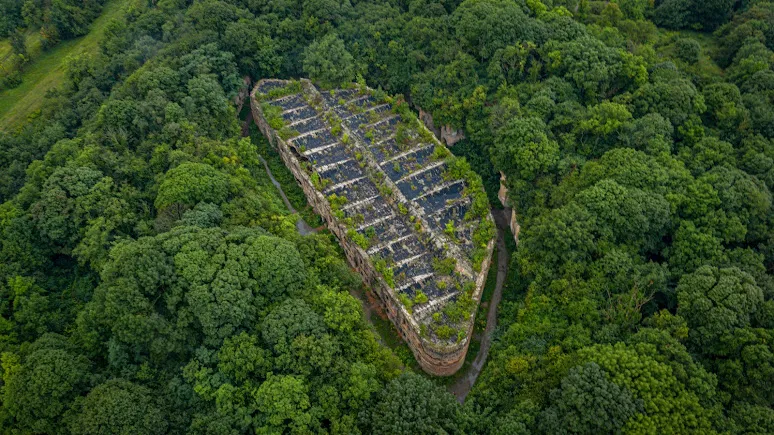
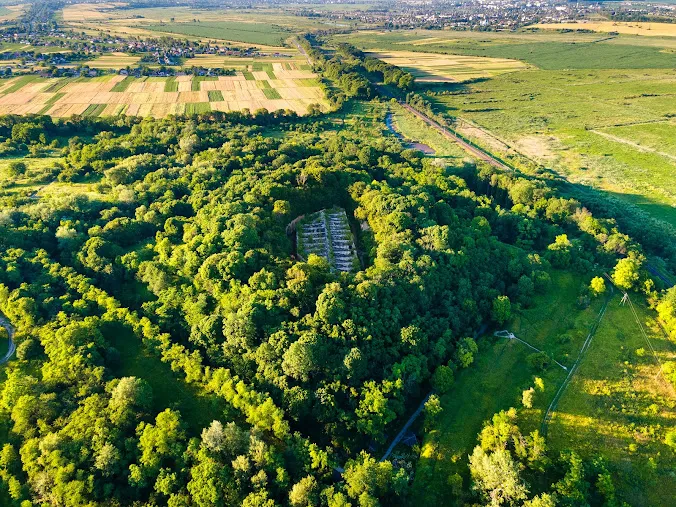
Tarakaniv Fort isn’t a single building. It’s a self-contained, autonomous complex covering 10 acres (4 ha), with walls up to 16 ft (5 m) thick.
At its center stands a two-story barracks for command staff, storage, and the artillery company’s service rooms. Around the perimeter are 105 casemates, built for 800 people, equipped with heating, ventilation, running water, and sewage. The fort also had its own electrical grid and telephone line (installed in 1899). In 1901, a garrison church in the Russo-Byzantine style was built inside.
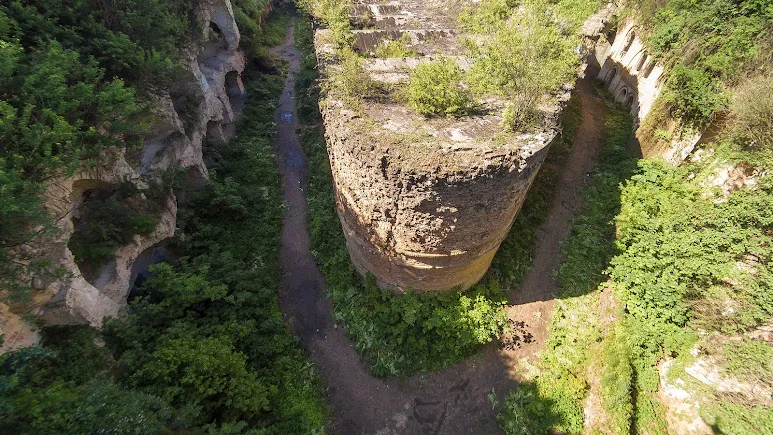
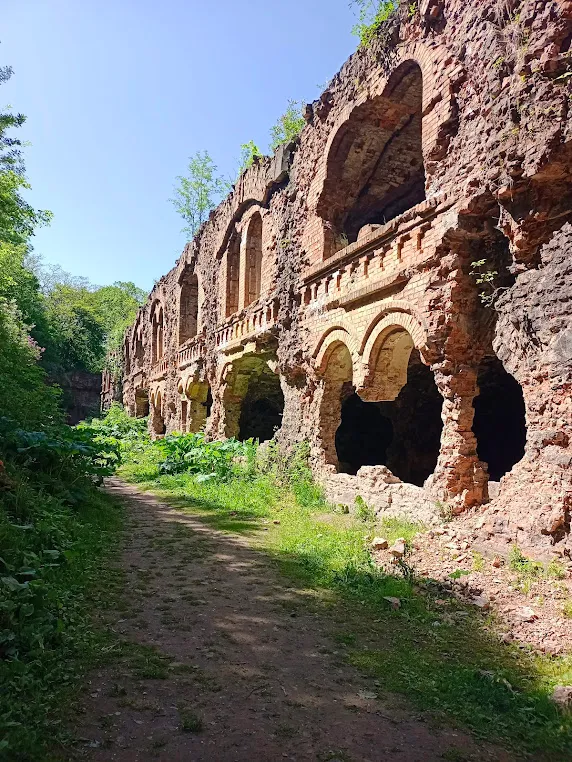
The whole complex is threaded with underground passages and wells. From outside, the fort is nearly invisible — it hides within the contours of the hill and doesn’t “announce” itself from the road.
Why the Fort Never Fulfilled Its Mission
The fort became obsolete before any serious war even began.
The reason wasn’t poor construction — it was that artillery evolved faster than fortification. Concrete sufficient against 1880s shells proved inadequate against 1910s weapons. By 1900, the fort was repurposed as a warehouse, and later as a military prison.
It was never used for its intended purpose: as a forward fort holding back an enemy advance.
A Military Biography: Three Episodes
Despite failing its core mission, the fort still found itself at the center of several real combat events.
1915. As Austrian forces advanced deep into Volhynia, the Russian garrison abandoned the fort without a fight. The irony: a fortification built against the Austrians was taken by them without a single shot.
1916, the Brusilov Offensive. In the summer of 1916, Russian forces returned and stormed their own former fort, driving out the Austrians. In these battles, 200 Austrian soldiers were killed. Their cemetery still stands beside the fort — one of the few physical monuments to these events.
1920, the Polish-Soviet War. Budyonny’s Red Cavalry Army failed to take the fort on the first attempt. The Polish garrison, commanded by W. Matczyński, held out under siege until its supplies ran out — then successfully broke through. Aviation and the armored train “Khorobryi” (“The Brave”) took part in the fighting.
Reliable information on combat in 1941 is lacking: the Polish garrison had abandoned the fort without a fight in 1939, and although the Dubno–Brody tank battle raged in this area in 1941, the fort itself isn’t directly documented as part of it.
What Survives Today
The fort still stands — no small feat for a structure that has never received systematic restoration.
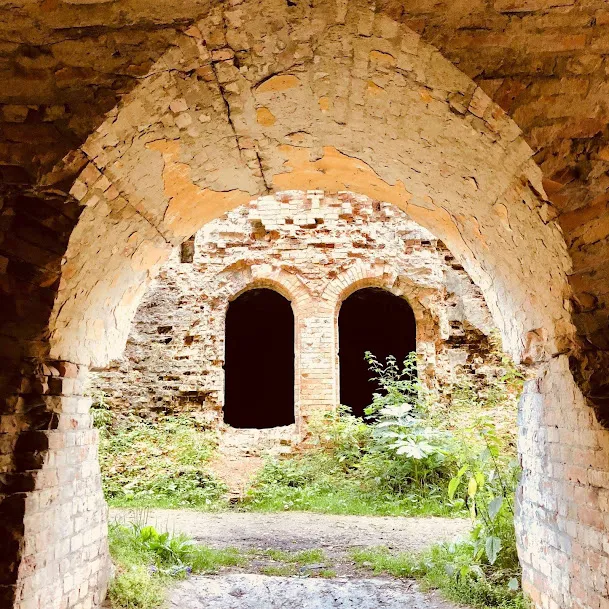
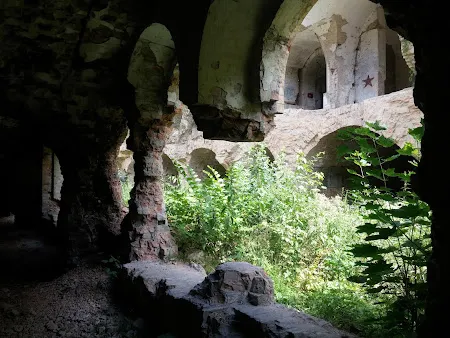
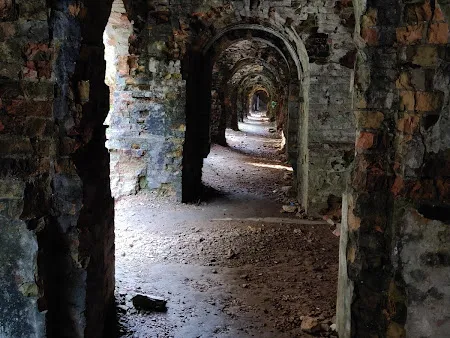
Outside: ramparts, moats, arcades. Inside: dark corridors, casemate remains, collapsed sections. Trees grow through the walls. The masonry crumbles in places. This isn’t a “picturesque ruin” — it’s an abandoned military machine, slowly being reclaimed by vegetation.
The fort has appeared in several feature films — for the sheer visual force of industrial decay, it has no equal among the sites of the Rivne region.
⚠️ Safety
The fort is a structurally unsafe site. This isn’t a figure of speech.
- open, unfenced well-shafts
- dangerous collapses in the casemates and tunnels
- confusing underground navigation — easy to get lost
- total darkness without a flashlight
- no rescue infrastructure whatsoever
Real accidents have been recorded here in peacetime, more than one. Basic rules: never enter without a flashlight, never go alone, and never approach the edge of the well-shafts.
What to See Nearby
- Dubno Castle (~3 miles / ~5 km) — fully preserved, with a museum
- Tunnel of Love (~25 miles / ~40 km, Klevan) — the best-known “green” landmark in the Rivne region
- Ostroh and the Ostroh Academy (~37 miles / ~60 km) — the oldest institution of higher education in Ukraine
The fort fits into the “Mystical Castles of Ukraine” route — given its atmosphere and military biography, it fully earns a place on that list.
How to Get There
The fort is 3 miles (5 km) from Dubno, along the M06 highway (Kyiv–Chop).
- Drive the M06 toward Lviv and pass through Tarakaniv village, nearly to its end.
- Turn left by the second cemetery in the village.
- From the turn, it’s ~2,300 ft (700 m) on an unpaved road. A regular car can manage it in dry weather.
- There’s a parking area by the forest in front of the fort.
From Rivne: ~43 miles (~70 km); from Lviv: ~81 miles (~130 km); from Kyiv: ~211 miles (~340 km) via the M06.
Public transport: a bus or shuttle from Rivne to Dubno, then a taxi or a walk (~3 miles / 5 km).
Practical Information
- Admission: free, open around the clock
- Security: none
- Infrastructure: none
- Time needed: 1–2 hours (exterior); 2–3 hours (exterior plus casemates)
- Essential: a flashlight, sturdy footwear, and company — never go alone
Little-Known Details
- 66 million rubles were allocated for construction — for comparison, the cost of several battleships at the time.
- Alexander III personally inspected the fort, during the major military maneuvers of 1890.
- 200 Austrian soldiers, killed during the 1916 Brusilov Offensive, are buried directly beside the fort — the cemetery survives.
- The fort was never used for its intended purpose as a forward line of defense against an enemy advance. Both times (1915 and 1920), it either surrendered without a fight or became the target of an assault only after changing hands.
- The 1901 garrison church inside the fort is one of the strangest examples of religious and military space combined in a single structure.
- In plan, the fort is a trapezoid, not a rectangle like most forts — a shape that maximized the coverage of approach routes under fire.
Conclusion
Tarakaniv Fort isn’t a romantic ruin. It’s broken military logic, left standing in the middle of a forest.
A place where you can see how quickly technology renders even the most powerful structures obsolete. How a cemetery for 200 men can lie a hundred meters from a tourist parking lot. How a fort built against an enemy twice became that same enemy’s spoils — and then simply stood there, waiting.
It doesn’t frighten. It warns. That any system — even one costing 66 million rubles and designed to last forever — outlives its own era. And then stands in a forest.