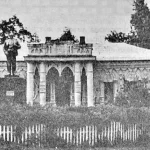
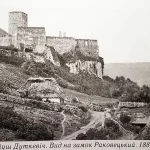
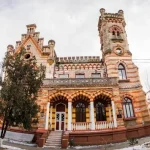
Medzhybizh stands at the confluence of the Boh and Buzhok rivers — and for five centuries, this exact spot has been where roads, armies, religions, and fates crossed paths.
On a hill above the water stands a castle. Nearby, the ruins of a church. A few hundred meters away, the grave of the founder of Hasidism, drawing thousands of pilgrims from around the world every year.
Three landmarks. Three different civilizations. One small settlement in the Khmelnytskyi region.
General Information
| What? | Description |
|---|---|
| Name | The Holy Trinity Church |
| Address | 9 Sviatotroitska St., Medzhybizh urban-type settlement, Khmelnytskyi district, Khmelnytskyi Oblast |
| Coordinates | 49°26′19″N, 27°24′10″E |
| Type | ruins of a Catholic church |
| Built | 1632 (the first stone structure dates to the late 16th–early 17th century) |
| Style | Gothic with baroque elements |
| Commissioned by | Adam Hieronim Sieniawski |
| Status | architectural monument of national significance; ruins |
| Demolished | 1962 |
Dating: Why Sources Disagree
A quick note: different sources give different construction dates — 1600, 1632, 1660. The confusion has a simple explanation: the church was built in several phases and repeatedly rebuilt after damage.
The fullest timeline looks like this:
- 1576 — Rafał Sieniawski, castellan of Kamianets, supports building a stone church-chapel on the castle grounds
- 1586 — the wooden church is destroyed; a chapel of St. Stanislaus is built the same year
- 1600 — Yavoriv starosta Adam Hieronim Sieniawski begins building a new Holy Trinity church
- 1632 — the structure is completed, or substantially rebuilt, in baroque style with Gothic elements
- 1660 — after further damage, Hieronim Sieniawski builds a “new church in the Gothic style,” consecrated by Bishop Nowodworski
- 1706 — repairs after damage
- 1741 — restoration; consecrated by Bishop Sierakowski
- 1812 — Adam Czartoryski adds a bell tower
So what we see today is the result of several construction phases spanning more than two centuries.
The Sieniawskis, the Czartoryskis, and Medzhybizh’s Context
Medzhybizh is one of the oldest fortified towns in Podillia. From 1540, for nearly 200 years, it belonged to the Sieniawski family — a Polish magnate dynasty that played a key role in defending Podillia against Tatar raids.
It was the Sieniawskis who built the Holy Trinity church and turned Medzhybizh into a full-fledged town. In 1648, Bohdan Khmelnytsky’s Cossack army was stationed here. Between 1672 and 1699, the fortress and town fell under Ottoman control. After the Peace of Karlowitz in 1699, Podillia returned to Poland.
After the male line of the Sieniawski family died out in 1726, Medzhybizh passed to the Czartoryski family through Maria Sophia Sieniawska — along with thirty towns and seven hundred villages. It was the Czartoryskis who modernized the church’s façade in baroque style and built the bell tower.
Architecture: Gothic in a Baroque Shell
Ihor Zapadenko, deputy director of the “Medzhybizh” State Historical-Cultural Reserve, describes the style precisely: “The church combines features of Gothic and baroque. This kind of stylistic mix is typical of Polish-Lithuanian Commonwealth churches of the period, especially in its more remote areas.”
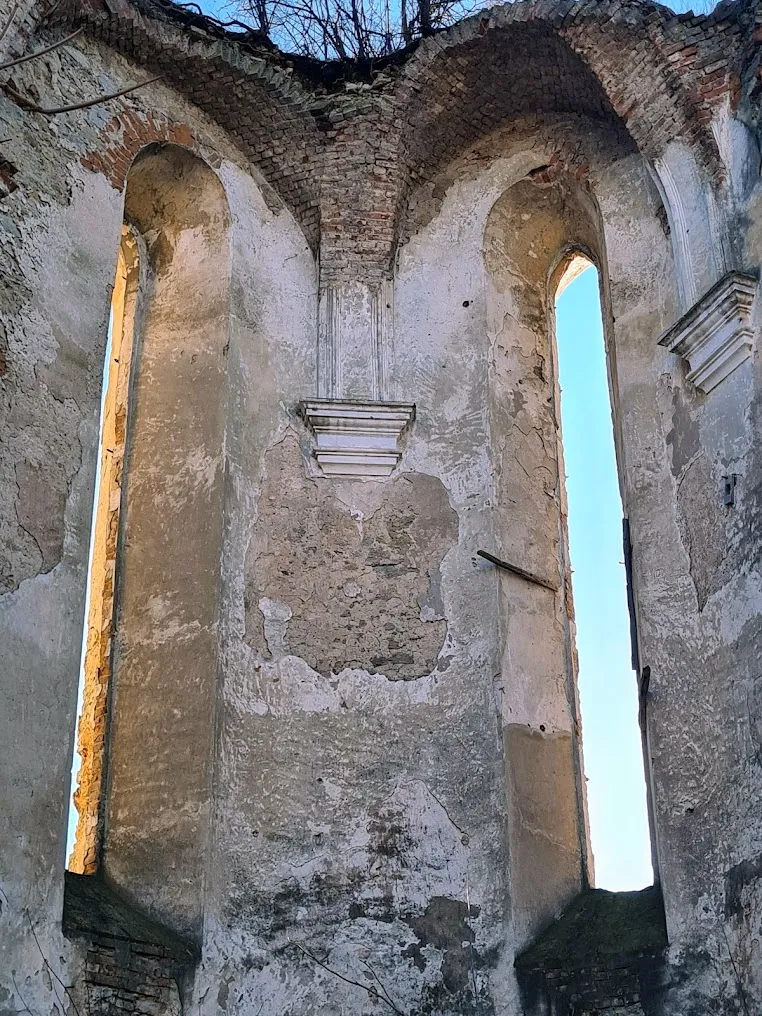
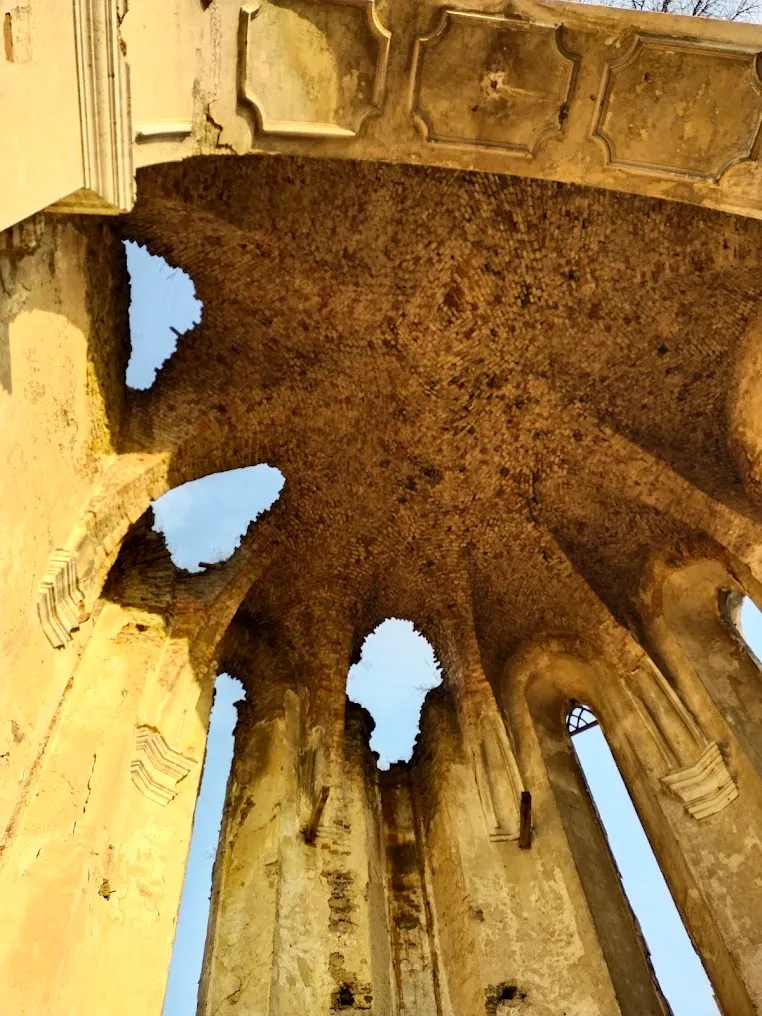
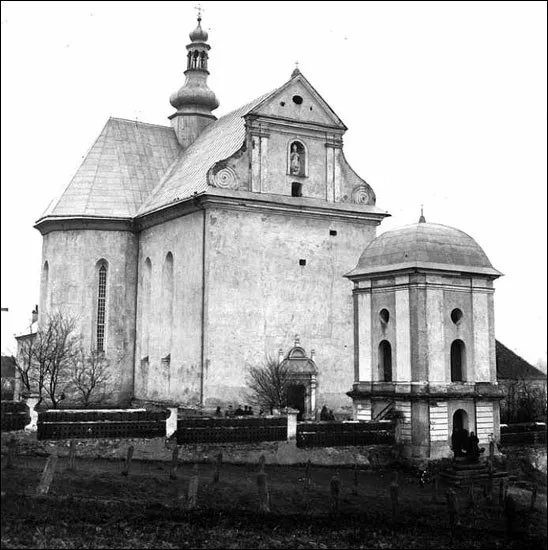
The building had a cruciform plan — a single-nave, cross-domed structure. Its base was a rectangle measuring 69 × 33 ft (21 × 10 m). The altar and side arms were pentagonal. The ceilings were vaulted. The roof was tall and shingled, topped with a small dome on an octagonal drum. The windows were narrow, tall, and pointed-arch.
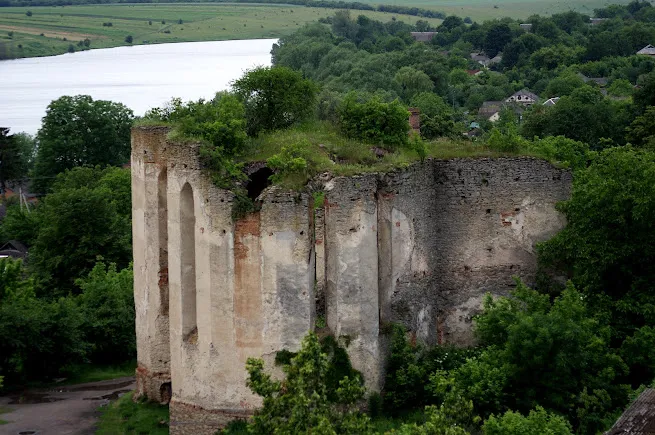
To the west stood a rectangular vestibule. The church was part of Medzhybizh’s defensive fortification system — evident from the massive stone retaining wall that still survives today.
Inside were 10 altars. The largest held an icon by Marcello Bacciarelli (court painter to Polish kings Augustus III and Stanisław August Poniatowski), depicting the patron saints of the Sieniawski and Czartoryski families — Saints Raphael, Jerome, Nicholas, and Adam. At the top of the altar was the Sieniawski family’s Leliwa coat of arms.
In addition, Duke Czartoryski, Voivode of Rus, established a fund at the church to support 12 poor residents, and a two-grade parish school operated there.
The 1962 Demolition
In the 1930s, Soviet authorities closed the church.
Photos from the 1950s show the building already being dismantled — for practical reasons: the stone was needed “for the construction of communism.” In 1959, the roof collapsed.
In 1962, the church and bell tower were blown up. That same year, the Cherche, Zinkiv, Sataniv, and Tynna churches of Podillia were also destroyed — a planned campaign to eliminate sacred heritage.
The paradox: under Soviet rule, Medzhybizh received status as an architectural monument of republican significance. The ruins are state-protected — but they’re ruins precisely because of what survived the demolition.
What Remains
Today you can see:
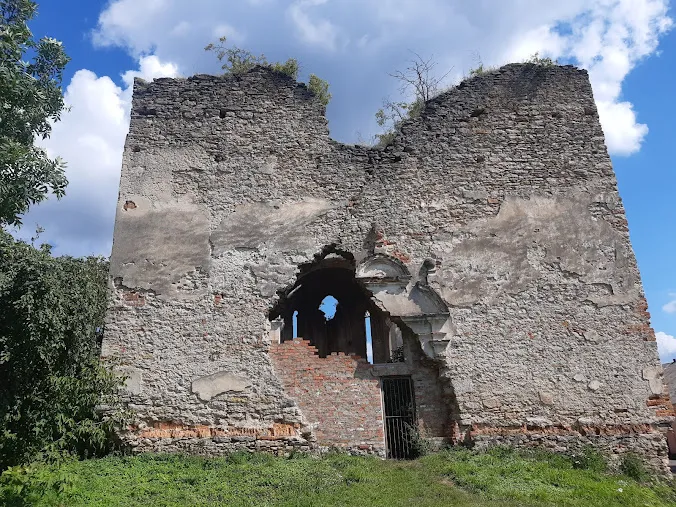
- a massive stone retaining wall around the perimeter — well preserved
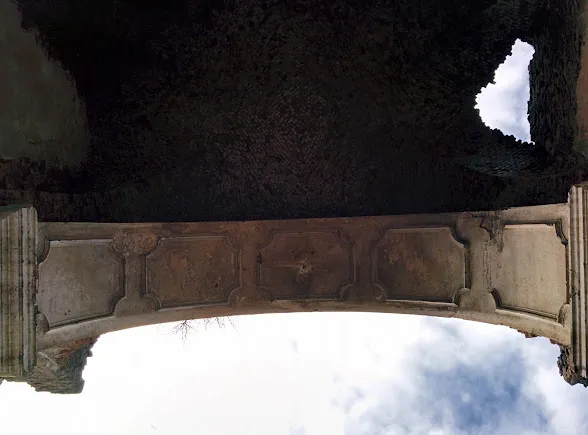
- the nave walls, with traces of arched vaults and a choir loft on the second level
- surviving arched vaulting and altar ceiling — now a shelter for pigeons
- an entrance to the crypt in the southern section — half-filled in
- a breach where the portal once stood — the former entrance
In 2011, four volunteers from Kyiv cleared the church of debris.
The Baal Shem Tov and Medzhybizh’s Three Religions
Medzhybizh is a rare place where three religious traditions have left an equal mark: a Catholic church, an Orthodox church, and a Jewish cemetery.
Around 1740, Israel ben Eliezer — a healer and spiritual teacher known as the Baal Shem Tov (Besht) — came to Medzhybizh. He settled here with sixty disciples, formed a community, and died in Medzhybizh in 1760. His grave in the Jewish cemetery became one of the most important sites of Hasidic pilgrimage in the world. Every year, on the holiday of Shavuot, thousands of Hasidim travel here from across the globe.
So it happens that the hill above the Boh holds, all at once:
- the ruins of a Catholic church with vaulting and a crypt;
- a 15th–18th-century castle with a museum;
- the grave of the founder of Hasidism, visited by thousands every year.
Three civilizations in one place — and none of them “won.”
What to See Nearby and How to Fit It Into a Route
Medzhybizh itself already makes for a full half-day route:
- Medzhybizh Castle (15th–18th centuries) — 1 Zamkova St.; a museum, with some buildings restored and open to visitors
- The grave and synagogue of the Baal Shem Tov — the Jewish cemetery; a new synagogue and pilgrim hotels were built nearby in 2000
- The church ruins — next to the castle
- The Boh and Buzhok rivers — their confluence, and the landscape around it
Medzhybizh combines easily with a Medzhybizh–Khmilnyk–Medzhybizh loop, or with a route through Kamianets-Podilskyi (~62 miles / ~100 km).
Practical Information
- Admission to the ruins: free, unfenced
- Crypt: accessible but half-filled in; a flashlight is essential
- Castle: paid admission; confirm hours
- Time needed: 30 minutes (ruins) plus 1.5–2 hours (castle and Jewish cemetery)
- Address of the ruins: 9 Sviatotroitska St.
How to Get There
- From Khmelnytskyi: ~50 miles (~80 km), the R33 highway via Letychiv; ~1 hr 20 min
- Public transport: regular Khmelnytskyi–Medzhybizh buses
- Coordinates: 49°26′19″N, 27°24′10″E
Little-Known Details
- The painting on the main altar was the work of Marcello Bacciarelli, court painter to two Polish kings. This wasn’t provincial work — Bacciarelli produced dozens of well-known portraits and allegorical canvases for the Royal Castle in Warsaw.
- Adam Czartoryski, who built the bell tower in 1812, was the father of the well-known Polish statesman Adam Jerzy Czartoryski, leader of the Polish emigration after the 1830 uprising.
- In 1784, the Polish writer and public figure Julian Ursyn Niemcewicz was stationed in Medzhybizh — later personal secretary to Tadeusz Kościuszko during the 1794 uprising.
- The 1962 demolition was part of a targeted campaign: that same year, the Cherche, Zinkiv, Sataniv, and Tynna churches were also destroyed, alongside the Medzhybizh church.
- A two-grade parish school operated at the church — one of the few schools in the region in the 17th–18th centuries.
- The Baal Shem Tov died in Medzhybizh on May 22, 1760. Buried near him are his grandson and several other Hasidic rabbis — the cemetery gathers an entire “spiritual constellation.”
Conclusion
The Holy Trinity Church in Medzhybizh isn’t Ukraine’s most dramatic ruin. But it stands in a place where a single hill above the Boh holds a castle, a Catholic church, an Orthodox church, and the grave of the founder of Hasidism.
Few places like it exist.
Demolished in 1962 and officially protected since 1979 — that too is part of the same Podillia truth: destruction that never quite finished, and restoration that never quite began.