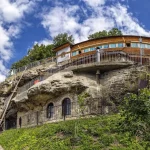
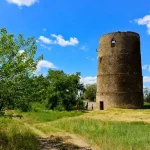
The castle stands in the center of the small town of Zolotyi Potik. Residents’ houses sit almost right up against its walls. No ticket booth, no guides, no plaques. Admission is free.
It’s one of the best-preserved castles in the Ternopil region.
Most people driving the Pidhirtsi–Zbarazh–Buchach route don’t even know it’s here.
General Information
| What? | Description |
|---|---|
| Name | Zolotyi Potik Castle |
| Address | Zolotyi Potik urban-type settlement, Chortkiv district, Ternopil Oblast |
| Coordinates | 48°54′27″N, 25°20′18″E |
| Built | ~1599–1615 |
| Commissioned by | Stefan Potocki (1568–1631), Voivode of Bratslav |
| Commissioner’s wife | Maria Amalia Mohylanka-Potocka |
| Shape | a square, 4 corner pentagonal towers plus a gate tower |
| Material | local dark-red sandstone |
| Coat of arms | the Potocki family’s “Pilawa,” on the gate tower |
| Status | architectural monument of national significance; free admission |
A “System of Strongholds” and a Royal Commission
Zolotyi Potik Castle was built on the order of Polish king Sigismund III Vasa, as part of a system of strongholds — a program to build a chain of fortresses along the Podillia borderlands.
The commission fell to Stefan Potocki, Voivode of Bratslav. Zolotyi Potik was his favorite residence: he lived here with his wife, Maria Amalia Mohylanka-Potocka (of the Moldavian ruling Movilă family, related to Petro Mohyla).
The castle was built from dark-red sandstone, characteristic of this corner of Podillia. The gate tower bears the Potocki family’s “Pilawa” coat of arms.
Architecture: Five Towers and a Palace Within the Walls
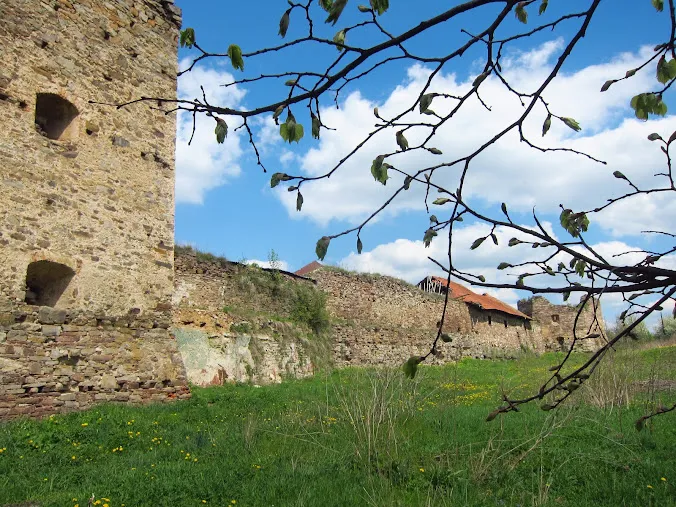
The castle is built of local sandstone and limestone: a square fortification with four three-tiered, pentagonal corner towers and a gate tower. The gate tower is three-tiered, square in plan, decorated with the Potocki “Pilawa” coat of arms.
A palace adjoined the walls from the inside. A moat protected the southwest side.
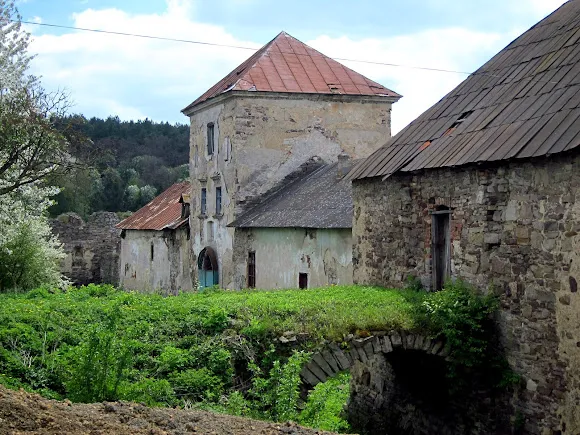
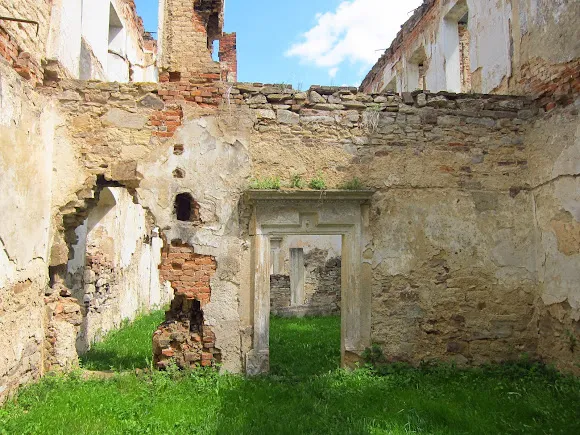
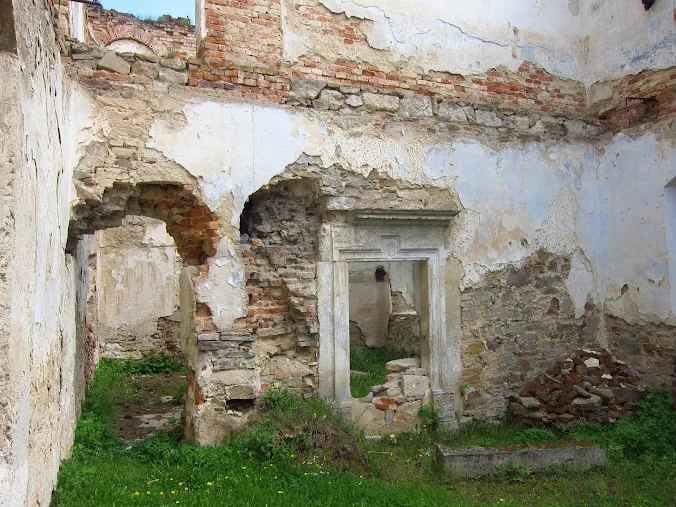
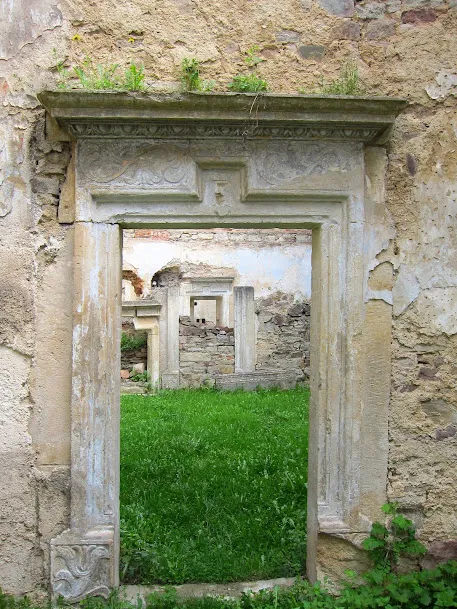
After a siege and damage in the 17th century, the castle was restored several times. Between 1839 and 1840, under its new owners the Olszewski family, a single-story palace was built to an Italian architect’s design. Part of the castle walls were dismantled to build it. These changes are clearly visible today: sections of the original walls are gone, replaced by a grand staircase and a colonnaded terrace.
From the Potockis to a Tzadik: a Chain of Owners
The Potocki family (~1599–1703) — Stefan built it, and his descendants lived here. In 1672, the Ottomans occupied the town, damaging the castle. The town was looted.
In 1703, the castle passed to another branch of the Potocki family — Michał Potocki of Buchach, who oversaw both Buchach Castle and this one.
The Olszewski family (1839–?) — commissioned a rebuild in a romantic classicist spirit. A new palace, built at the cost of part of the walls.
Jan Stojowski (19th century) — bought the estate and sold it to a Hasidic tzadik from Sadhora, Israel Friedman. A Polish nobleman selling to a Jewish spiritual leader — an unexpected turn in the ownership record.
The Gniewosz family (until 1939) — the first owner from this family, Włodzimierz-Hipolit Gniewosz, was a well-known Polish public and political figure of the late 19th and early 20th centuries. He gained particular fame among Poles for a saber duel with a German official named Wolff, who had insulted the Polish people. The last noble family to hold the castle — and the most colorful.
Current Condition: the Best Among the Forgotten
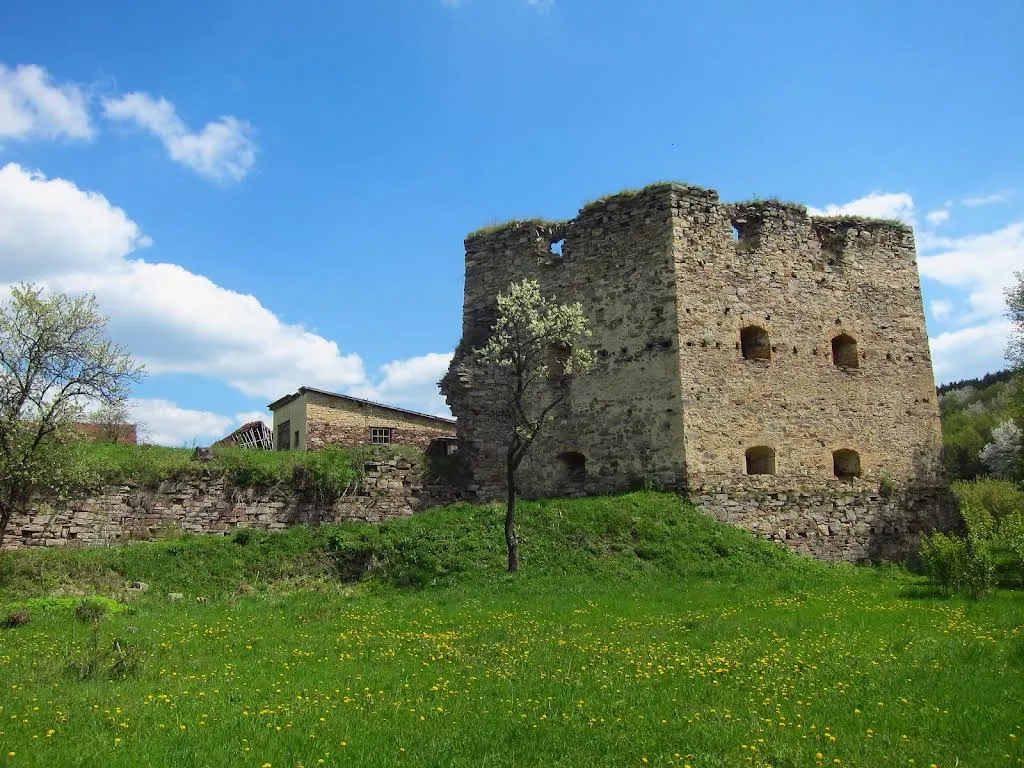
Among the other castles of the Ternopil region, Zolotyi Potik can be considered one of the best preserved — even though it stands neglected and partly ruined. The monument sits in the center of the town, near where a small stream flows into the Zolotyi Potik reservoir. Residents’ houses stand almost right against the stronghold’s walls.
Three of the four corner towers survive to a significant height. The gate tower with the coat of arms still stands. Part of the walls remains intact.
What Not to Expect
There’s no tourist infrastructure of any kind. These are open ruins in yards between houses. No marked routes, no explanatory signs, no security. You can walk around and look — but entirely at your own discretion and risk.
How to Fit It Into a Route
Zolotyi Potik is 22 miles (35 km) from Buchach, 34 miles (55 km) from Ternopil.
- Buchach (~22 miles / ~35 km) — Agnon’s town, Bernard Meretyn’s town hall, castle ruins
- Zbarazh (~34 miles / ~55 km) — the castle and “With Fire and Sword”
- Pidhaitsi (~12 miles / ~20 km) — another little-known Ternopil-region castle
The castle isn’t part of any major tourist route — but if you’re driving through the Ternopil region with your eyes open, it’s worth the stop.
Practical Information
- Admission: free
- Condition: partial ruins, but well preserved compared to others
- Time needed: 20–40 minutes
- From Buchach: ~22 miles (~35 km)
- GPS: Zolotyi Potik urban-type settlement, Zamkova St., or coordinates 48°54′27″, 25°20′18″
Conclusion
Stefan Potocki built the castle on royal order — and made it his favorite residence.
Then came a man who fought with sabers for the honor of his nation. Then, a Hasidic tzadik.
The castle still stands. Almost no one knows it.