There is a village in the Odesa region that first had a serial number, then a German name, then “Paris,” and only in 1945 became “Veselyi Kut.” Behind these four names lies the history of one of the Bessarabian colonies, full of tragedies and wonders — and its Lutheran church, built in 1903–1905, still stands in the middle of the steppe.
Загальна інформація
| What? | Description |
|---|---|
| Name | Lutheran Church (Evangelical Lutheran Church) |
| Location | Veselyi Kut village (until 1945 – Paris), Teplytsk rural community, Bolgrad district, Odesa region. |
| Year of construction | 1903–1905 (new church); first church — 1838 (dismantled in 1906) |
| Confession | Evangelical Lutheran |
| Community | German colonists from Mecklenburg and Pomerania |
| Coordinates | 45°50′ N, 29°10′ E (approximate) |
From “Steppe No. 10” to “Paris”
Few Ukrainian villages can boast of so many names.
1816 — the first settlers received a plot of land, which was officially designated as “Steppe No. 10”. No poetic pretensions.
Soon a practical name appeared: “Alexjuswerth” — perhaps associated with the name of one of the first residents or founders.
And then — “Paris”. In honor of the victory over Napoleon. This habit of giving Bessarabian colonies high-sounding names has been preserved: the region includes Leipzig, Berlin, and Strasbourg. The victory over Napoleon in 1812–1813 inspired more than one generation.
November 14, 1945 — the Soviet authorities renamed Paris to “Veselyi Kut”.
Who founded and where did they come from
The founders of the Veselyi Kut were from Mecklenburg and Pomerania (north of modern Germany), who moved through the Duchy of Warsaw.
They were not direct immigrants from Rhine Bavaria or Swabia, as in most Bessarabian colonies. The Mecklenburg and Pomeranian character of the colony explains a certain restraint in the names and in the building tradition.
Each family received a yard with an area of 1 dessiatina (200–220 m long and 55 m wide) and 60 dessiatina of land – and began to build.
By 1886, the Paris colony, which became the center of the Paris volost of the Akkermansk district of the Bessarabian province, had 2,022 people living in 187 yards. There was a Lutheran church, a post office and three shops.
Three churches in one place
1824 – the first separate buildings of the school and the prayer house were built. Divine services were held here.
1838 – the construction of the first real church began. It served the community for more than six decades.
1906 – the first church was dismantled. By this time, a new one was already standing.
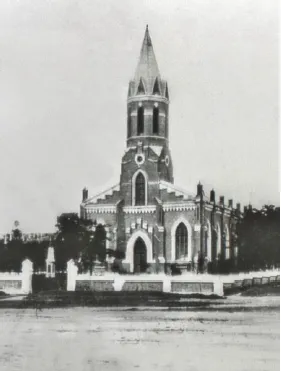
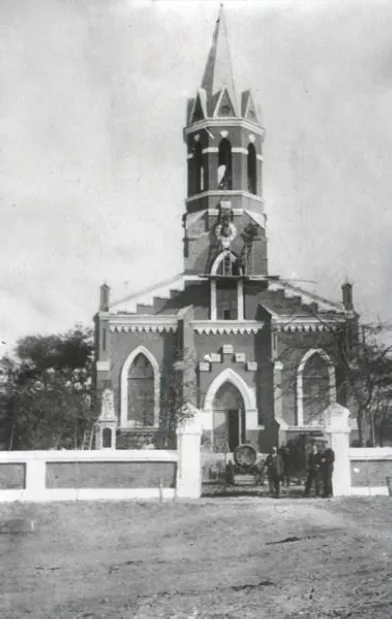
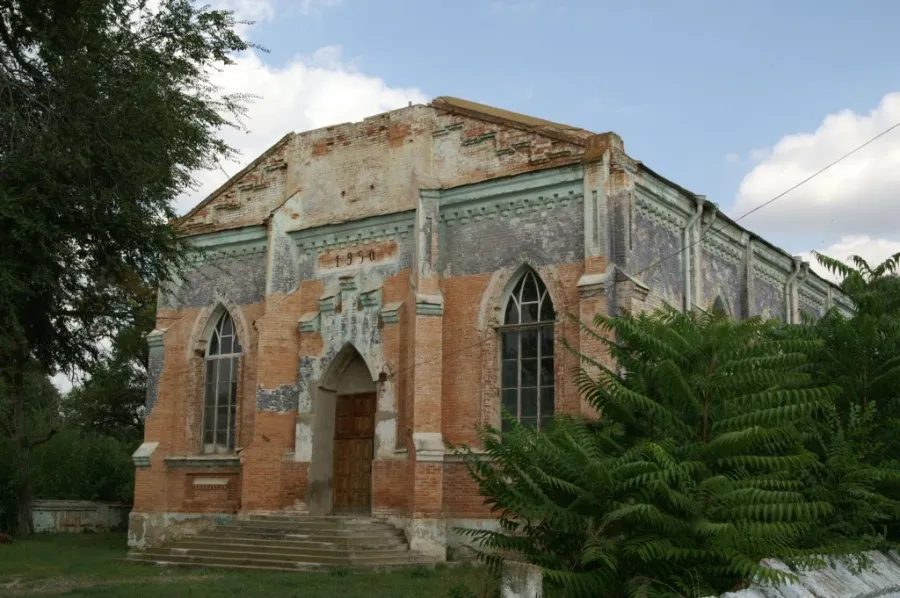
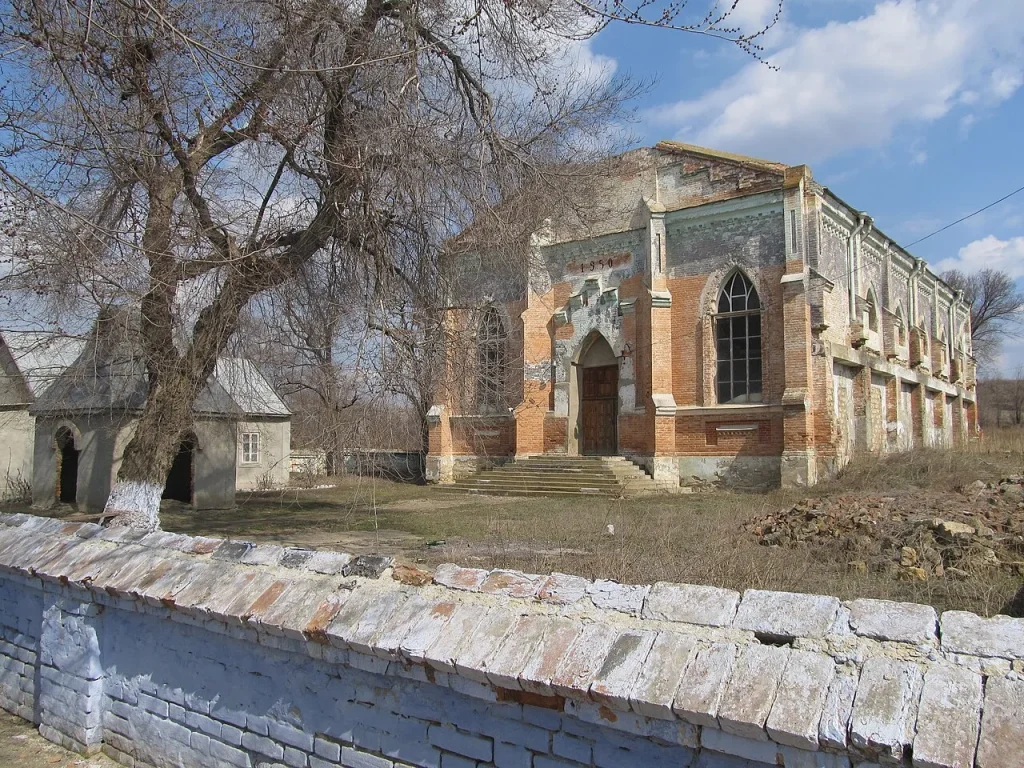
1903–1905 – a new church was built, which still stands today. New Lutheran churches of the late 19th – early 20th centuries in the Bessarabian South were built mainly in an eclectic style with elements of Romanticism and Neo-Gothic – in accordance with the pan-European wave of neo-styles. There is no clear description of the architecture of the Vovkovsk church in the available sources, but the general type of buildings of this type: a brick rectangular structure with a tower or two towers, large windows, and restrained facade decor.
Context: Bessarabian Colonies and Their Architecture
Veselyi Kut is just one point in a whole system of 46 officially registered colonies in the Bessarabian province. Settlements were established along rivers and gullies, planned according to uniform standards.
Researchers of the architecture of Bessarabian colonies note that their churches and kirkhs were the most important public buildings – and the most well-kept. They stood in the center of the village, often on an elevation, and were the only monumental building next to one-story private buildings.
Until 1940, the households of Bessarabian colonists were considered exemplary – and their architectural ensemble was generally well preserved. The Lutheran church in Veselyi Kut survived – thanks to the fact that Bessarabian colonists had a special fate compared to the colonists of mainland Ukraine.
The fate of the community: the 1940 resettlement and the empty church
The Bessarabian Germans did not experience what their fellow tribesmen on the mainland of Ukraine experienced.
When the USSR occupied Bessarabia in 1940 under the Ribbentrop-Molotov Pact, an agreement was concluded between the USSR and Nazi Germany on the “repatriation” of the Volksdeutsche — the so-called “Heim ins Reich” (“Home to the Reich”). Thousands of Bessarabian colonists, including residents of Paris, left their farms and went to Germany or occupied Poland.
This meant that, unlike the colonists of the Dnieper region, who were deported to Kazakhstan and Siberia in 1941, the Bessarabian colonists left voluntarily (or under pressure) even before the Soviet regime. They took the most valuable things, but left the farms.
The church in Paris is the same. There is no community. The building remains standing.
What has survived and its current state
There are few detailed recent reports on the condition of the building in open sources — Veselyi Kut remains a little-visited tourist spot.
Following the general pattern of churches in the former colonial Odesa and Mykolaiv regions: most of the buildings have received new functions — a warehouse, a village club, and some are simply abandoned. The specific fate of the church in Veselyi Kut requires verification directly on site.
It is known that the building exists — this is confirmed by Wikipedia and a general tourist description. The condition is unknown without a personal visit.
Why go: three levels of interest
For those interested in architecture. The churches of Southern Ukraine are a specific and little-studied layer of sacred architecture. They differ from Galician churches and Orthodox churches – more restrained, more functional, but not devoid of quality.
For those interested in history. Veselyi Kut is a document of an entire civilization that arose, flourished and disappeared over 125 years. From “Steppe No. 10” to “Paris” to “Veselyi Kut” – these names contain all the hope and tragedy of the colonial project in the South.
For those who collect routes. Bolgrad district is the richest region of Odesa region in the traces of various colonial communities: Bulgarian, Gagauz, German, Moldovan.
What to see nearby and how to fit it into the route
The Bolgrad district is a separate cultural landscape, where dozens of villages of different ethnic origins with their own architecture coexist.
Nearby – Bolgrad (~25 km) with Bulgarian Orthodox churches and characteristic town buildings, Izmail (~70 km), Kiliya (~90 km).
Practical information
- Building condition: to be confirmed on site
- Entrance: external inspection – free
- Distance from Bolgrad: ~25 km
- Distance from Odesa: ~180 km via Artsyz
- Road: via Artsyz or Bolgrad – asphalt; the last section – rural roads
How to get there
- From Odesa: M15 highway → Artsyz → Tarutyne → Vesely Kut; ~180 km, ~2.5 hours
- Through Bolgrad: highway to Bolgrad, then ~25 km north
- The Bessarabka–Izmail railway line passes through the village; the station is “Paris” — the old name was preserved on the railway, unlike the official name of the village
Little-known details
- The railway station in Veselyi Kut is still officially called “Paris” – the name “Paris” was abolished for the village, but not for the station.
- The colonists came from Mecklenburg and Pomerania – this is the north of Germany, and not the traditional “Swabian” South, from where most of the Bessarabian colonists came.
- The Bessarabian Germans did not survive the Soviet deportation of 1941 – they were evicted earlier, in 1940, under the agreement between the USSR and Nazi Germany on “Heim ins Reich”. This fundamentally distinguishes their fate from the fate of the Volga or Dnieper colonists.
- The first church stood from 1838 to 1906 – almost 70 years. That is, the current building is already the third on this site (if you count the prayer house of 1824 as the first).
- 2022 people – the population of the Paris colony in 1886. A whole small city in the middle of the Bessarabian steppe, which now has less than half that number of people.
Editorial note: fair warning
There is little information about the church in Veselyi Kut in open sources. Wikipedia confirms the date of construction and the fact of its existence; there is no detailed architectural description and recent data on the condition of the building.
If you are planning a trip, we recommend that you clarify the current condition through local historians or the Bolgrad district community. And take a camera: such places deserve documentation.
Conclusion
The Church in the Veselyi Kut is a place that does not impress with its scale. It impresses with the fact that it exists at all.
The colony, founded in 1816 by immigrants from Mecklenburg, lost its inhabitants after 125 years. The building remained – without a community, without services, perhaps without a roof. But it stands in the steppe of the Bolgrad district and remembers four names of the same place.