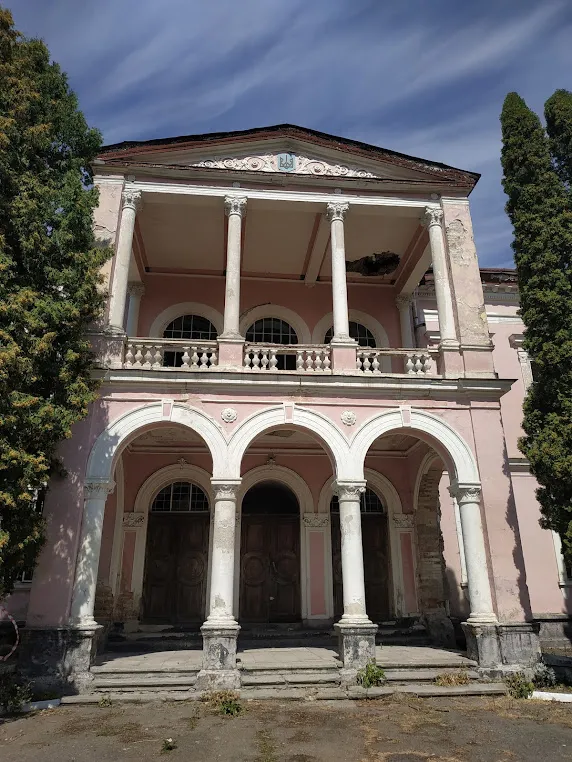
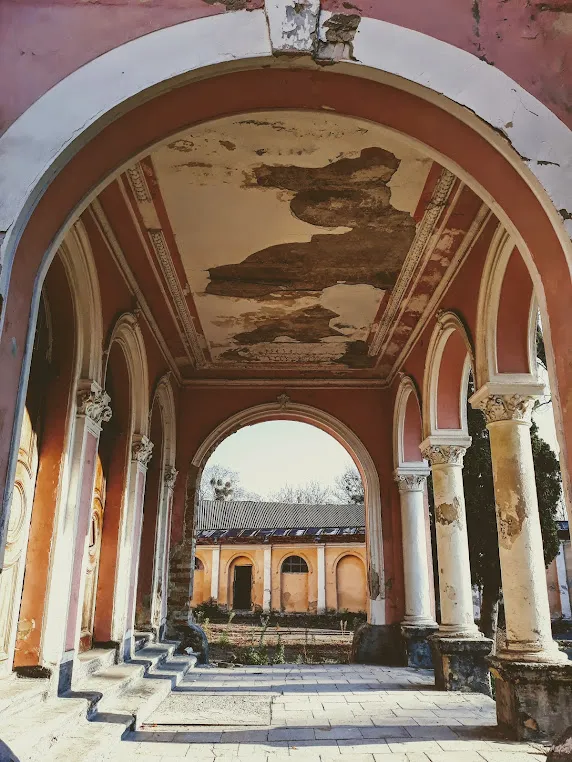
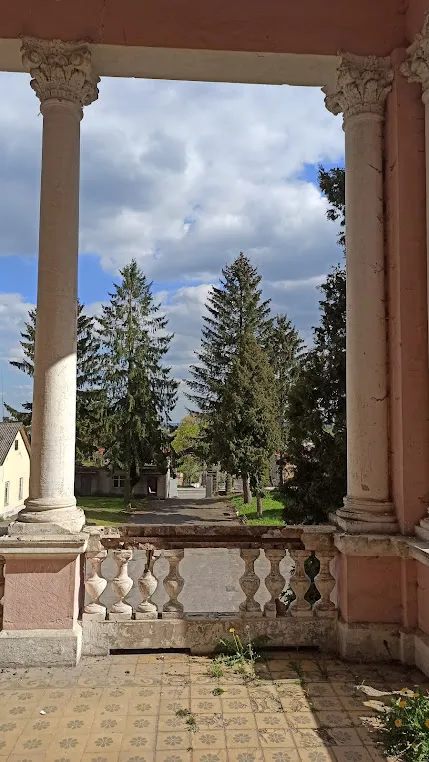
The palace at the center of Busk is more than two hundred years old. It has outlasted three states, two owning families, fires, a military unit, and a transfer to community ownership. It looks the part: a restrained façade, two stories, a portico over the entrance, a balcony overlooking the Buh.
Nothing excessive. That’s exactly what a strong Galician house used to look like.
General Information
| What? | Description |
|---|---|
| Name | The Badeni Palace (Palace of the Lords of Busk) |
| Address | Petrushevycha St., Busk, Zolochiv district, Lviv Oblast |
| Built | 1810 (by Wojciech Mier) |
| Style | neoclassical (original); neo-renaissance (after Badeni’s rebuild) |
| Current use | the Busk Museum of History and Local Lore |
| Status | architectural monument of local significance |
From a Wooden Castle to a Stone Residence
Buildings have stood on this hill since the 17th century: in 1698, a property inventory of the Busk starostwo records a wooden defensive palace of the Busk starostas here — small, defensive, and typical of a fortified town of the time.
The family later changed. From 1776, the Polish magnate family Mier, who also owned Radekhiv, Kholoiiv, Sokal, and a townhouse in Lviv, took possession of Busk and the surrounding land. In 1810, Wojciech Mier began building a stone residence — the same building that stands today. Initially single-story and modest, it was later expanded by Wojciech’s successors, Henryk and his son Feliks, who added a second floor and two side wings.
The Mier family held Busk until 1879. When Feliks Mier died without heirs, his widow, Anna Wierer, briefly became the owner. Then in 1880, in exchange for a lifetime annuity, she signed the building over to her late husband’s nephew — Kazimierz Feliks Badeni.
Kazimierz Badeni: a Controversial Figure in a Restrained House
Kazimierz Feliks Badeni (1846–1909) is the man under whom the palace took on its current appearance and its name.
In 1888, Badeni became Governor of Galicia, and in 1895, Prime Minister of Austria-Hungary. His two years as prime minister were turbulent: a language reform granting equal status to Czech and German in Bohemia sparked mass protests, and in 1897, Badeni was forced to resign.
In Ukraine, his legacy remains contested. He supported the development of Galicia and backed Catholic institutions. At the same time, the “Badeni elections” were criticized for limiting Ukrainian representation in the Galician Sejm. His brother Stanisław held comparable influence in the region — together, the two controlled tens of thousands of hectares of land, breweries, and mills.
In Busk, Kazimierz founded a brewery, partly rebuilt the palace — adding neo-renaissance elements to its neoclassical forms — and turned it into a summer residence.
Architecture: Neoclassicism With a Neo-Renaissance Heart
The palace is two stories, elongated, restrained in decoration. It stands on a gentle hill in the center of Busk: the entrance faces Petrushevycha St.; to the left runs the Western Buh River; on the two other sides are a deep moat and a slope leading down into the Ivan Franko city park.
Main façade: at the center, a portico, restrained and free of excessive decoration. The building is symmetrical, with rectangular windows and horizontal lines.
Rear (garden) façade: more expressive — pseudo-avant-corps, a long balcony, and stone vases on the balustrade. It looks out onto the park and the river.
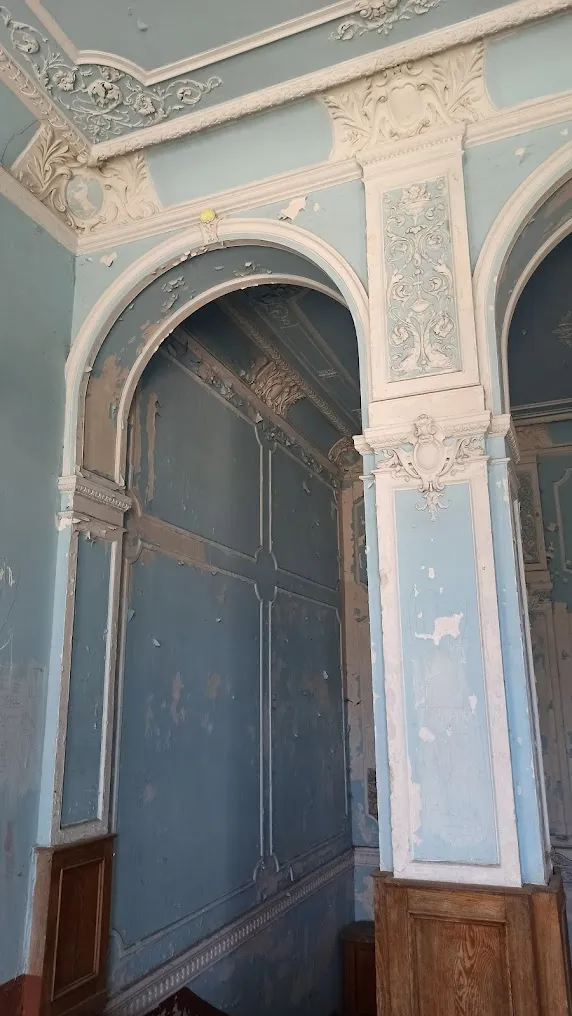
Interiors: the vestibule, salon, and main staircase were done in neo-renaissance style by master Petro Harasymovych, with rich stucco work. Some of the decoration survives.
What Happened After 1939
1939 — Bolshevik authorities nationalized the palace.
1961 — a military unit was stationed in the building. This continued for more than 40 years.
2005 — the building effectively fell out of use and began to deteriorate.
2014–2015 — fires broke out twice in the neglected structure.
May 25, 2016 — by resolution of the Cabinet of Ministers of Ukraine, the palace was transferred to the ownership of the Busk community.
Today, the palace houses the Busk Museum of History and Local Lore. The building is finally in use. Restoration and full-scale revival remain under discussion, years on.
What to See Nearby
Busk is a thousand-year-old town with a well-preserved old center and several landmarks worth a separate stop:
- St. Stanislaus Church (1768–1780) — stone, architect Bernard Meretyn; a film archive under Soviet rule, now returned to the community
- St. Onuphrius Church (1680) — wooden, on an ancient hillfort above the Solotvyna
- St. Nicholas Church (1910s–1920s) — architect Yevhen Nahirny
- Ivan Franko city park and the banks of the Buh — right beside the palace
Practical Information
- Current use: the Busk Museum of History and Local Lore
- Exterior viewing: free; the building stands on an open hill
- Museum: confirm hours directly before visiting
- Time needed: 40–60 minutes (palace, park, and the riverbank)
How to Get There
- From Lviv: ~40 miles (~65 km) via the M06 (E40) highway, turning toward Busk after Krasne
- Via Olesko: ~53 miles (~85 km) — convenient if combining with the “Golden Horseshoe”
- The road is paved; parking is available by the palace or on nearby streets
Little-Known Details
- The palace was built by the Mier family in 1810 — the Badenis merely bought and rebuilt an already-standing structure. The house is older than the family that gave it its name.
- Feliks Mier’s widow, Anna Wierer, didn’t hand over the palace for free: in exchange for a lifetime annuity from Badeni, she moved to Vienna.
- Ludwik Badeni’s wife — the Swede Alicja Elizabeth Ankarcrona — inherited the estate in 1916 and managed it until 1939.
- The interior stucco work was created by master Petro Harasymovych — his name survives in the records, a rarity for Galicia at the time.
- Kazimierz Badeni — Prime Minister of Austria-Hungary — kept a home in small, provincial Busk rather than in Vienna or Kraków. For him, it was a family retreat and an estate base.
- In 2014–2015, while the building stood neglected after the military left, fire broke out twice. Its transfer to the community in 2016 effectively saved it from further ruin.
Conclusion
The Badeni Palace in Busk isn’t the grandest of Galicia’s manor houses. But it’s one of the most thoroughly documented, and one of the most honest.
Two hundred years on a hill above the Buh. Four changes of state. From the Mier magnates, to Austria-Hungary’s prime minister Badeni, to Soviet soldiers, to fires, and finally to a town museum.
Worth the visit — and worth stopping in the town itself. Busk earns it.