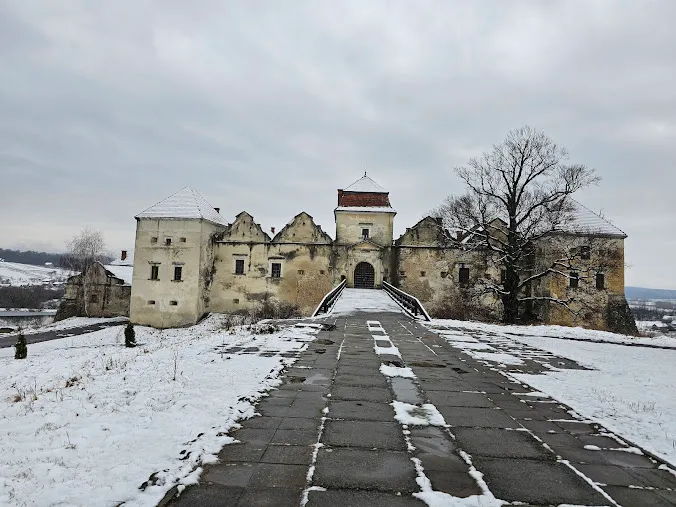
There is a date carved into the gatehouse tower of Svirzh Castle: “1530.”
It is not the year the castle was founded, nor the year it was finished. It is the year the fortress was reinforced and marked — so no one would forget who did it and when.
The same Oleksandr Cetner who bought the castle in 1641 and turned it into one of the most impressive residences in Galicia also founded a botanical garden in Lviv and gave his name to an entire city district — Cetnerivka. The owner of a modest castle 25 miles from the city left his name on the map of Lviv itself.
General Information
| What? | Description |
|---|---|
| Name | Svirzh Castle |
| Address | village of Svirzh, Peremyshliany district, Lviv region, Ukraine |
| Distance from Lviv | ~25 miles (~40 km) |
| First fortifications | 1427 (wooden) |
| Stone fortress | 1530s–1550s (Svirzh family) |
| Major reconstruction | mid-17th century (Oleksandr Cetner) |
| Restoration | 1907–1917 (Robert Lyamezán de Salins) |
| Wall thickness | up to 6.5 ft (2 m) |
| Plan | rectangle, 4 corner towers |
| Concession | 2010, 50-year private lease |
| Status | national architectural monument |
| Entry | paid (confirm locally) |
The Svirzh Family and the Date on the Stone
The Svirzh family — Ruthenian nobility who had converted to Roman Catholicism — received Svirzh in the mid-15th century and laid the foundations of the castle. The first fortifications are recorded from 1427 — a wooden stronghold.
1530 — the stone fortifications were completed, and the date was carved into the gatehouse tower. Construction had taken more than 20 years.
The building is rectangular, measuring approximately 82 × 170 ft (25 × 52 m), with two defensive towers. Walls reach up to 6.5 ft (2 m) thick, pierced with arrow slits. The ground floor contained casemates and utility rooms; the upper floor was the owner’s residence.
Cetner: He Bought the Castle and Named Part of Lviv
1641 — Count Oleksandr Cetner, husband of Hanna Zamoyska, purchased the castle from the Svirzh family. The coats of arms of the couple still decorate the entrance gate.
Under Cetner the castle was substantially enlarged and reinforced. The likely architect was Pavlo Hrodzitsky, an artillery general and military engineer who built both of Lviv’s arsenals (the Royal and the Senyavsky). The same specialist who fortified Lviv may have built Svirzh.
The Cetner family held the castle until the end of the 19th century. Their mark on Lviv endures to this day: Cetnerivka district and the botanical garden both carry the family’s name.
1648: Tatars, Cossacks, and the Griffin
1648 — the Tatars burned the castle. During the Khmelnytsky Uprising, Cossack detachments seized the fortress repeatedly.
Yet the castle was rebuilt each time. The Baroque gables, white-stone portals and the griffin on the south-eastern tower all date from the mid-17th-century reconstruction. Surviving Renaissance details and new Baroque ornament sit on the same walls — two historical layers in plain sight.
Lyamezán de Salins: From Ruin to Residence
Frequent changes of ownership in the late 19th century took their toll. Surveys from 1882 and 1892 record serious deterioration: the northern and eastern wings were collapsing.
1907 — the castle was purchased by Robert Lyamezán de Salins — an officer in the Austro-Hungarian army, later a general and diplomat. He invested heavily and transformed the ruin into a luxurious residence with richly furnished interiors.
1917 — the restoration was complete. A commemorative inscription was carved above the gate — the castle’s second date cut in stone, after 1530.
After Lyamezán came his daughter Irena and son-in-law Count Tadeusz Komorowski, who continued restoration work until 1939.
“The Three Musketeers” and the 2010 Concession
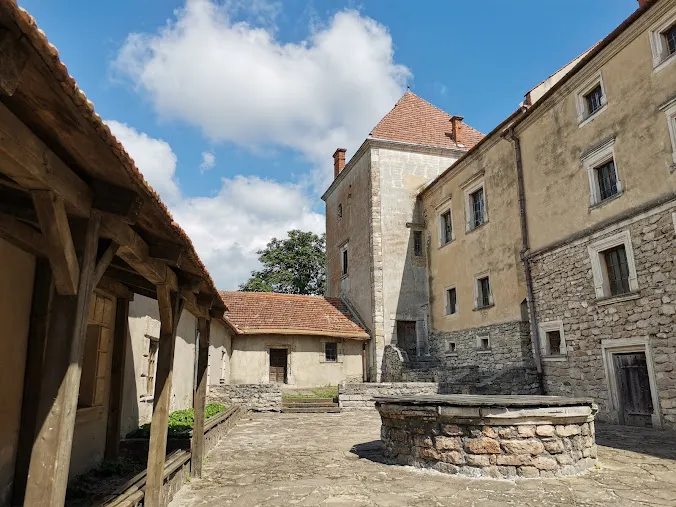
The courtyard of Svirzh Castle served as a filming location for the Soviet film “D’Artagnan and the Three Musketeers” (1978). For visitors who know the film, the space is immediately recognizable.
2010 — the castle was handed over on a 50-year concession to a private investor — a scenario similar to Stary Sil Castle, though Svirzh at least has a precedent of successful private restoration (Lyamezán). The current state of the concession should be confirmed locally before visiting.
What Survives Today
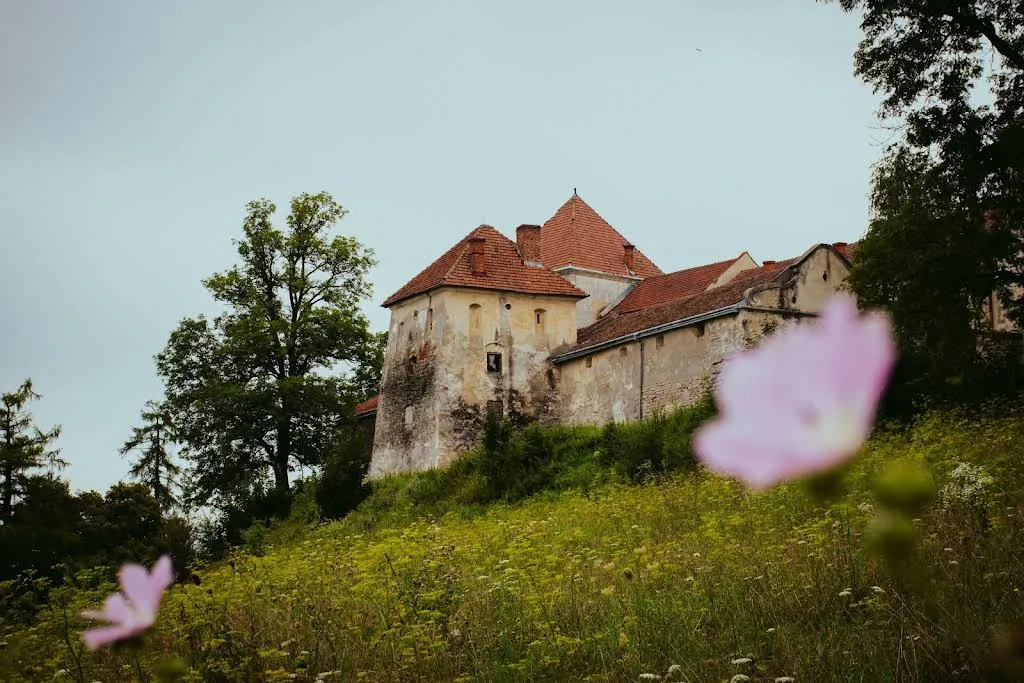
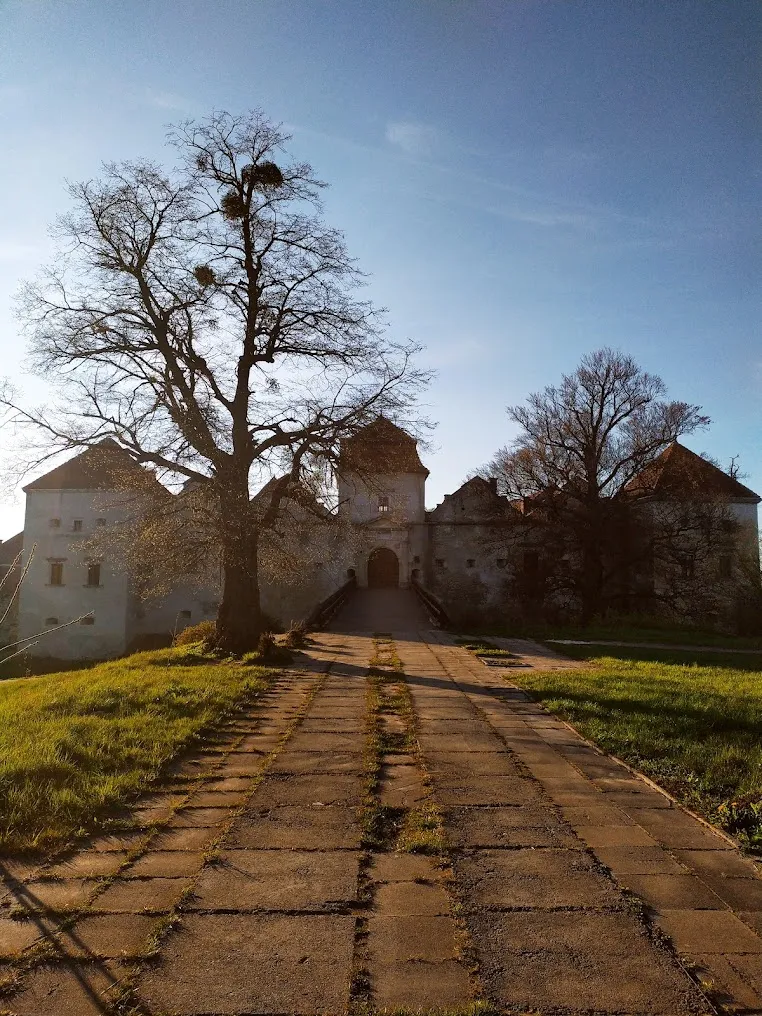
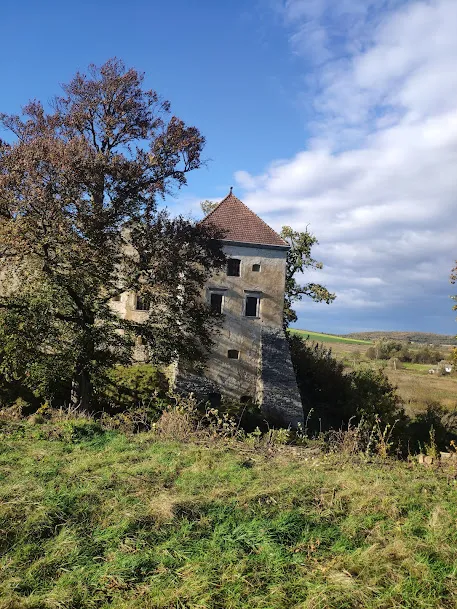
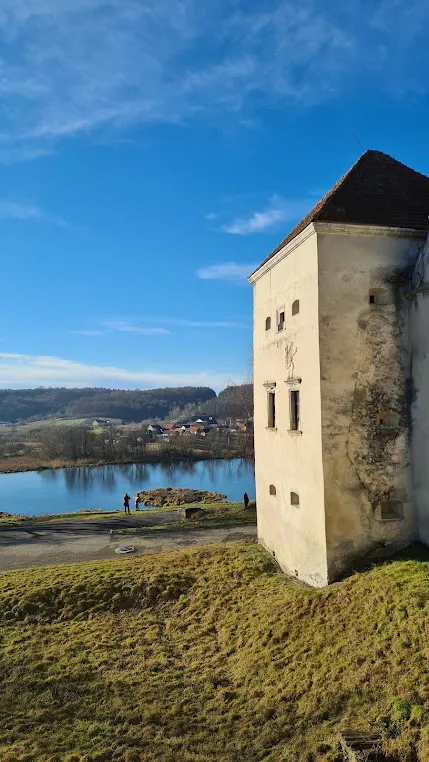
The castle is generally well preserved: four corner towers, an inner courtyard, and the gatehouse tower with the carved date 1530. Renaissance details survive: white-stone portals, carved window surrounds, stone vases by the staircase flight, and the griffin on the façade.
Beside the castle stands the restored Church of the Dormition of the Mother of God.
What Not to Expect
Do not expect the museum-quality accessibility of Olesko or Palanok. Condition and opening hours depend on the current concession holder. Confirm the visiting schedule before making the trip.
How to Include It in a Route
Svirzh is ~25 miles (~40 km) from Lviv, in Peremyshliany district.
- Olesko Castle (~15 miles / ~25 km) — birthplace of Jan III Sobieski
- Pidhirtsi Castle (~19 miles / ~30 km) — the finest Renaissance castle in Galicia
- Zolochiv Castle (~28 miles / ~45 km) — the NKVD and the Golden Horseshoe
Svirzh Castle is the fourth point of the extended “Golden Horseshoe of Lviv Region” — after Olesko, Pidhirtsi, and Zolochiv.
Part of the Golden Horseshoe of Lviv Region route.
Practical Information
- Address: village of Svirzh, Peremyshliany district, Lviv region
- Entry: paid; confirm current hours locally
- From Lviv: ~25 miles (~40 km) via Peremyshliany
- Time on site: 1–1.5 hours (castle + church + ponds)
Conclusion
“1530” was carved in stone so no one would forget.
Lyamezán de Salins carved “1917” — for the same reason.
Cetner founded a botanical garden and a city district in Lviv.
D’Artagnan rode into the courtyard in 1978.
The castle still stands.