Brody is a town with an exceptionally rich architectural legacy: a 17th-century fortress, the Potocki palace, synagogues, townhouses. And amid all of it — on what used to be the village of Stari Brody — stands another palace, one that’s talked about far less.
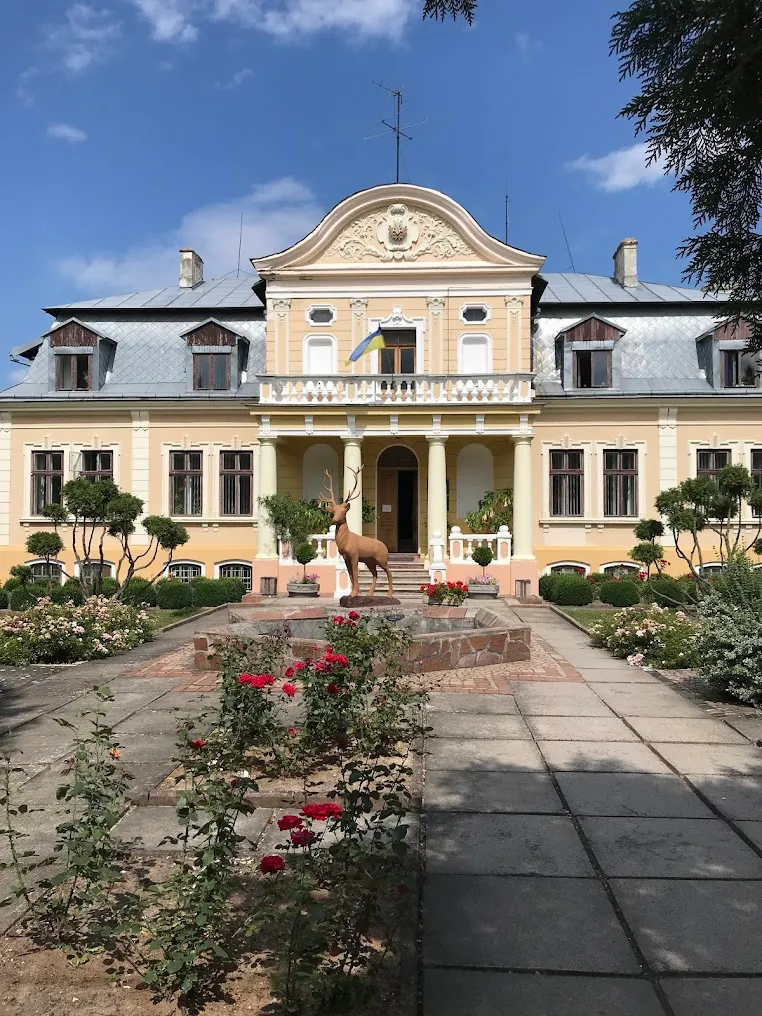
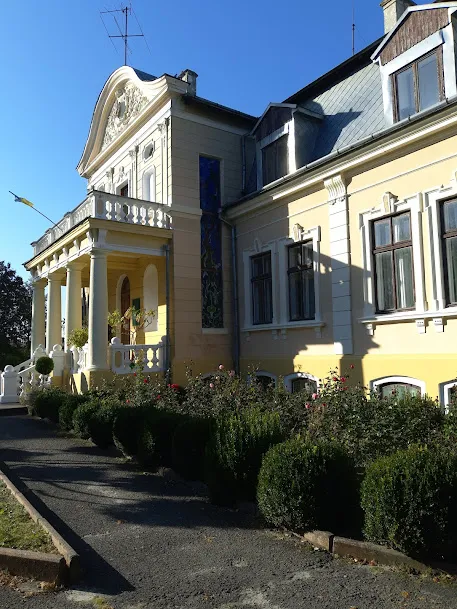
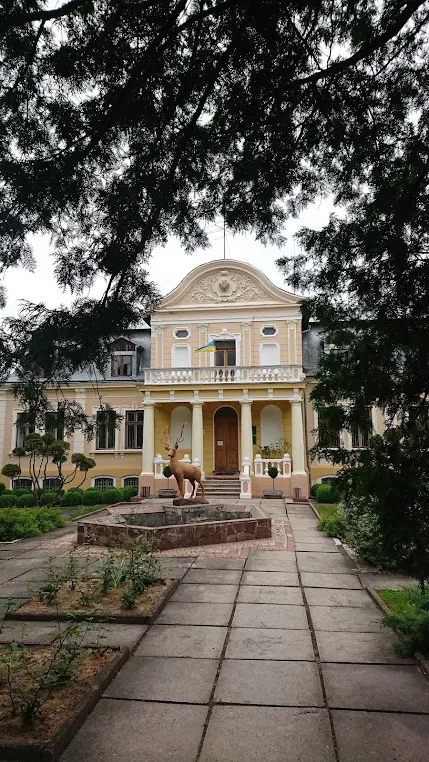
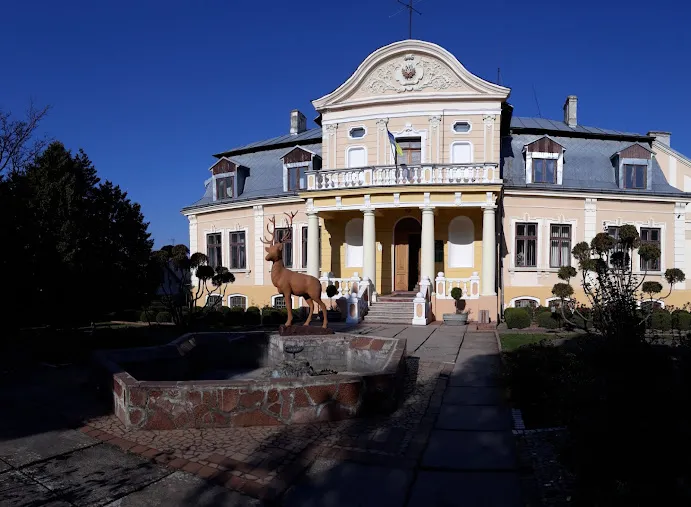
The 1912 Tyszkiewicz Palace: restrained, neoclassical, with a Tuscan-order colonnade and a family coat of arms on the pediment — replaced, as of 2024, with the coat of arms of Ukraine.
General Information
| What? | Description |
|---|---|
| Name | The Tyszkiewicz Palace |
| Address | Nyzka St., Brody (former Stari Brody village), Zolochiv district, Lviv Oblast |
| Built | 1912 (an earlier early-20th-century palace on the site was dismantled) |
| Style | neoclassicism (English) |
| Commissioned by | Countess Wanda Tyszkiewicz |
| Status | architectural monument of local significance |
The Tyszkiewicz Family in Brody: Brief Context
The Tyszkiewicz family is one of the oldest and most extensive aristocratic dynasties of Lithuania and Poland, holding estates across Central and Eastern Europe in the 19th–20th centuries — from Lithuania to Volhynia and Galicia.
The Tyszkiewiczs came to Brody relatively late. In the early 20th century, the Potocki family, then the major landowners in Brody, began selling off their holdings in Stari Brody. It was then that the Tyszkiewicz family acquired one of the parcels.
The first building on the site went up in the early 20th century — but was soon dismantled. In 1912, at the initiative of Countess Wanda Tyszkiewicz, a new stone palace was built on the same spot — the one that stands today.
Architecture: Neoclassicism in Detail
The palace is single-story (with a functional basement level), covered by a hipped roof. It’s set back from the red line of Nyzka St. — not flush against the street, but with a small setback, giving it a “manor” feel even within the town’s built-up area.
The main façade is centrally symmetrical. The entrance is marked by a projecting Tuscan-order colonnade, supporting a stone balcony at the mansard level. The balcony’s balusters are cast stone. The balcony’s entrance is masonry, rusticated, and topped with a shaped pediment featuring a profiled cornice and pilasters. The pediment’s tympanum is decorated with plant-motif stucco.
The ground-floor pilasters are rusticated. The windows have surrounds.
Until recently, the cartouche on the central avant-corps’s pediment held the Tyszkiewicz family coat of arms. It has since been replaced with the coat of arms of Ukraine.
Plan structure: corridor-based, centrally symmetrical.
What Happened to the Palace: Between the World Wars and After
The building survived World War I and the interwar period as property of the Tyszkiewicz family.
During World War II, the palace suffered damage but was restored.
Its subsequent fate follows a familiar pattern for Galician aristocratic houses: changes of state, transfer to state or communal institutions, and the loss of its original interiors.
Brody: What Else to See
Brody is one of the richest towns in the Lviv region for landmarks, and the Tyszkiewicz Palace is only one of its points of interest:
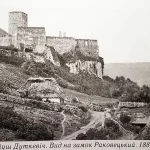
- Brody Castle (1630–1635) — a fortification monument of national significance, designed by Andrea dell’Aqua and Guillaume Le Vasseur de Beauplan; inside, the Potocki palace and a museum
- The Great Synagogue (1742) — one of the best-preserved synagogues in Galicia
- The old market square and 17th–19th-century townhouses
- The Nativity of the Mother of God Church (1600) — a defensive church, the oldest stone one in town
A route through Pidhirtsi → Brody → Pochaiv makes for a rich single-day “triangle” of Galicia and Volhynia.
Practical Information
- Exterior viewing: free; the building is clearly visible from Nyzka St.
- Interior: confirm current use
- Time needed: 20–30 minutes (exterior); 2–3 hours if combined with the castle and Brody’s town center
- From Lviv: ~56 miles (~90 km) via the M06 (E40) highway → Pidhirtsi → Brody, or via Zolochiv
Little-Known Details
- The Tyszkiewicz family coat of arms on the pediment is the palace’s one openly “personal” detail. It survived for a long time; today it has been replaced with the state coat of arms.
- The palace was built on the site of an earlier building, erected and dismantled before 1912 — meaning today’s structure isn’t the first Tyszkiewicz palace on this plot.
- The Tyszkiewiczs bought the land from the Potocki family — the same family whose castle-palace stands at the other end of Brody and holds status as a national monument.
- Brody also has a Schmidt Palace — a separate building sometimes confused with the Tyszkiewicz Palace. They’re different structures.
- In the 19th–20th centuries, the Tyszkiewicz family held palaces across Central Europe: besides Brody, notable examples survive in Pluzhne (Rivne region), Lahoysk (Belarus), and Vilnius — each with its own architecture and fate.
Conclusion
The Tyszkiewicz Palace in Brody isn’t the town’s most outstanding landmark. But it stands exactly where the Tyszkiewicz family decided to buy land from the Potockis and build a new residence — a year before World War I.
A town with a 17th-century fortress, an 18th-century synagogue, and a 1912 palace within walking distance of each other is worth the stop on that basis alone. Everything around it keeps changing — sometimes it’s exactly places like this that speak to history more precisely than the grandest facades.