Koropets is a small village above the Dniester. Quiet, hills, slow-moving water below.
And then, suddenly — a palace.
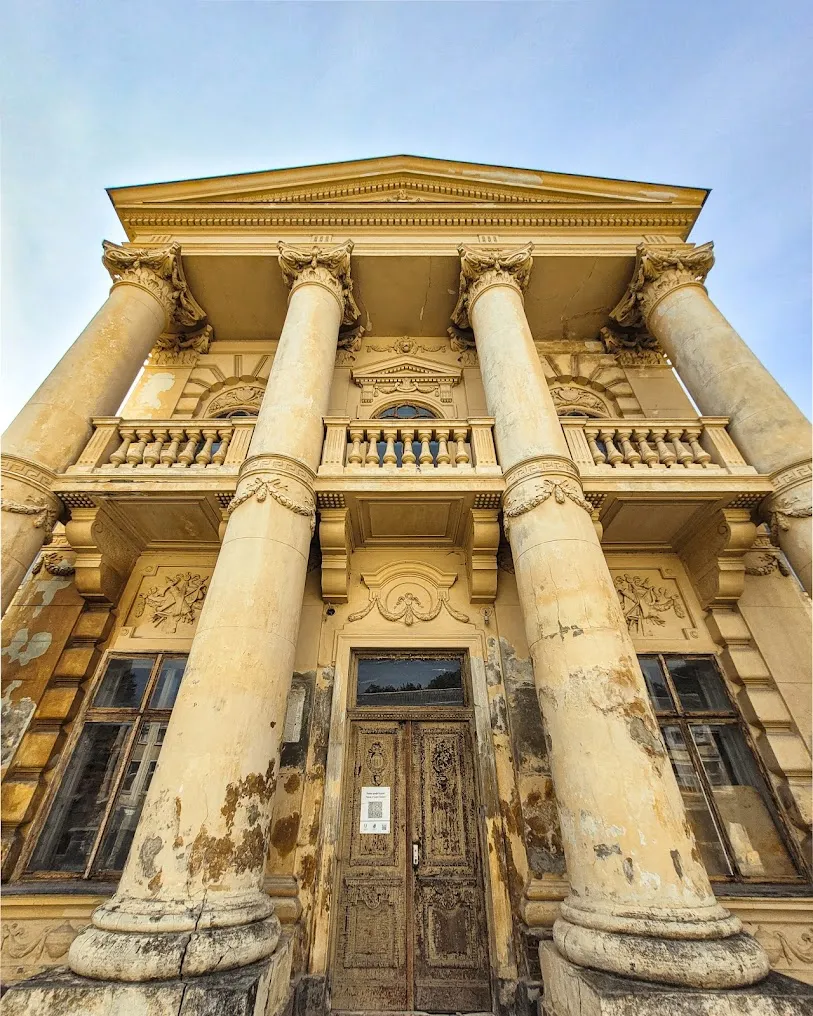
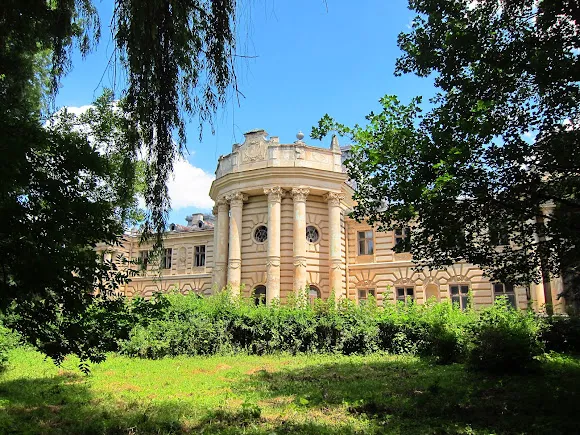
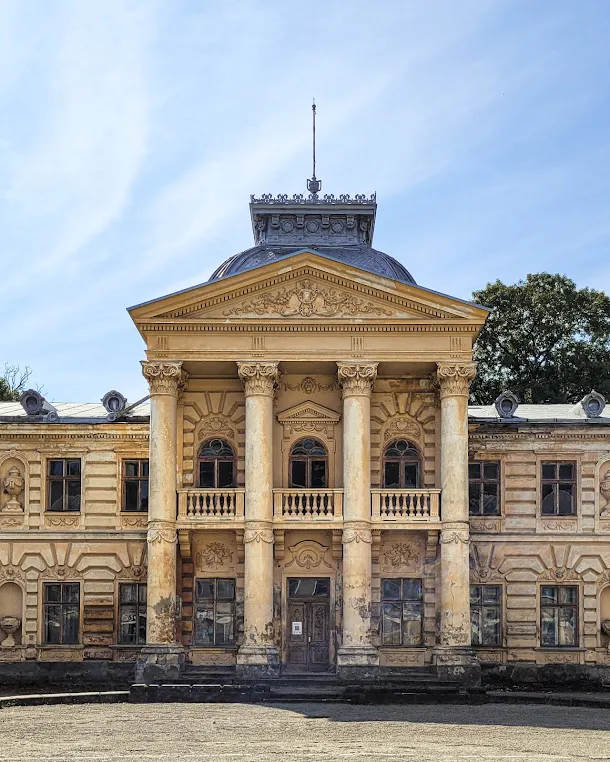
It appears out of nowhere, as if someone had transplanted a piece of Vienna into the Podillia landscape. Massive, with three projecting bays, a shaped roof, and lion masks on the cornices, the Badeni family palace makes no attempt at modesty. It simply stands, the way things built to last tend to stand.
General Information
| What? | Description |
|---|---|
| Name | Badeni Palace (Count Badeni Palace and Park Complex) |
| Location | Koropets urban-type settlement, Chortkiv district, Ternopil Oblast |
| Address | 3a Kahantsia St. |
| Type of site | noble palace, summer residence |
| Year rebuilt | 1906 |
| Style | Viennese Renaissance Revival |
| Status | architectural monument; currently the Koropets Regional Boarding Lyceum with enhanced military-physical training |
From the Mysłowskis to the Badenis
Koropets is one of Galicia’s old towns. Its first written mention dates to 1421, when the Polish king Władysław Jagiełło founded a parish church here. The town successively belonged to the Buchacki, Potocki, and Mysłowski families.
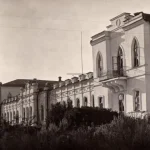
It was the Mysłowskis who built the first palace in Koropets in the early 19th century — a two-story building with single-story side wings in the classicist style.
In 1893, Koropets was purchased by Count Stanisław Marcin Badeni (1850–1912), Land Marshal of the Galician Sejm for three terms and one of the region’s influential Polish aristocrats. His older brother, Kasimir Felix Badeni (1846–1909), served as Governor of Galicia from 1888 to 1895 and as Minister-President of Austria-Hungary from 1895 to 1897.
Stanisław set about rebuilding the palace right away. The work took more than a decade and was completed in 1906.
Architecture: a “Little Vienna” Above the Dniester
The palace was built in the Viennese Renaissance Revival style — contemporaries called it “a scaled-down copy of the imperial palace in Vienna.”
The building is two stories high, with three projecting bays and a shaped roof. The cornices are decorated with frescoes of plant motifs and lion masks. The façade features baroque stucco heraldry and a bas-relief of a crossed scythe and flail among rifles and hunting horns — typical noble “coat of arms” decoration.
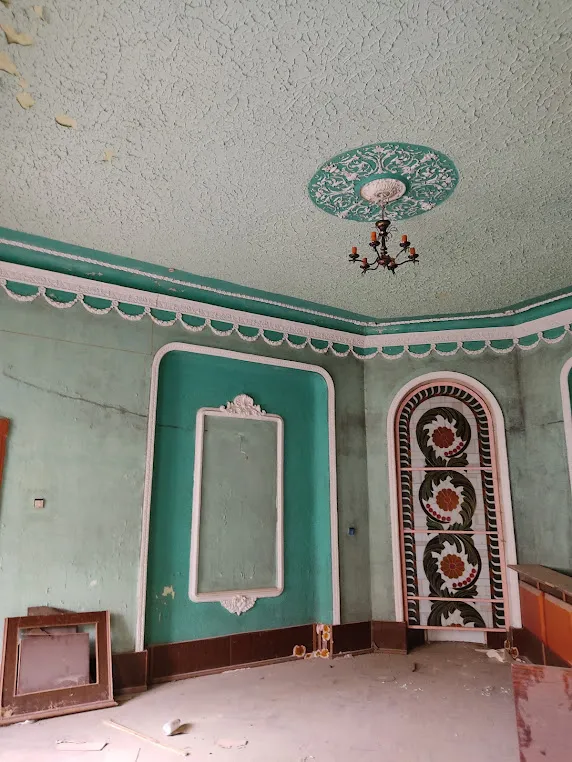
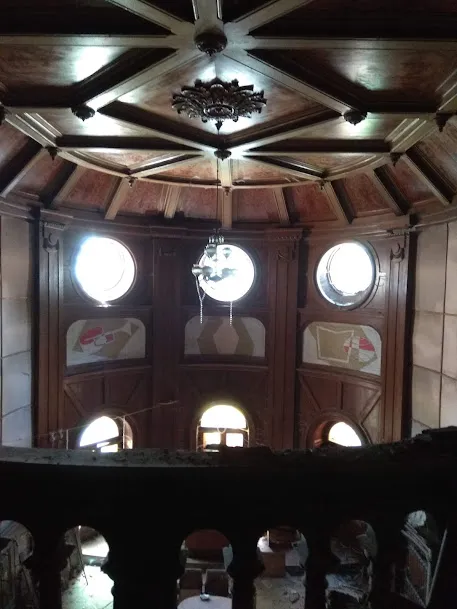
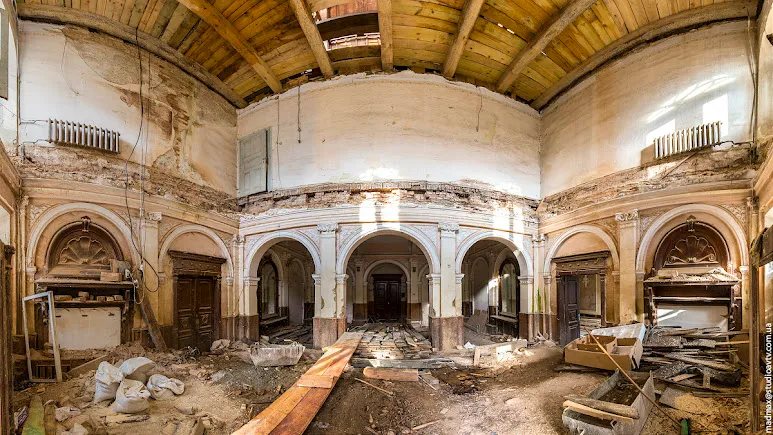
Inside, an oval ballroom survives on the first floor, with oak paneling on the walls; portraits of Polish kings once hung here. Besides the ballroom, there’s a library and a small chapel.
Alongside the palace, Badeni laid out a park with a pond, an orangery, a greenhouse, and footbridges over the Koropchyk and Mlynivka streams. The park’s redesign was the work of Arnold Röhring, an inspector of municipal parks and the creator of Stryiskyi Park in Lviv. At its height, the park covered ~49 acres (20 ha). Before Soviet rule arrived, it was tended by 30 gardeners. Today the park has partly gone wild, but it still holds rare trees: a maidenhair ginkgo (Ginkgo biloba) and an Oriental plane — both exotic even at the time they were planted.
Legends and the Owner’s Character
Specific stories circulate about Stanisław Badeni — not mystical ones, but very human.
It’s said he wanted to pave the floor of the new palace with gold coins, for effect and to display his wealth. The plan never came off: the coins bore state symbols. Someone in his circle suggested standing the coins on edge instead — but even then, the owner didn’t have enough gold coins to go around.
Legend or fact, it’s unclear. But it certainly captures the atmosphere: the Badenis built to impress.
The Palace’s Fate After 1914
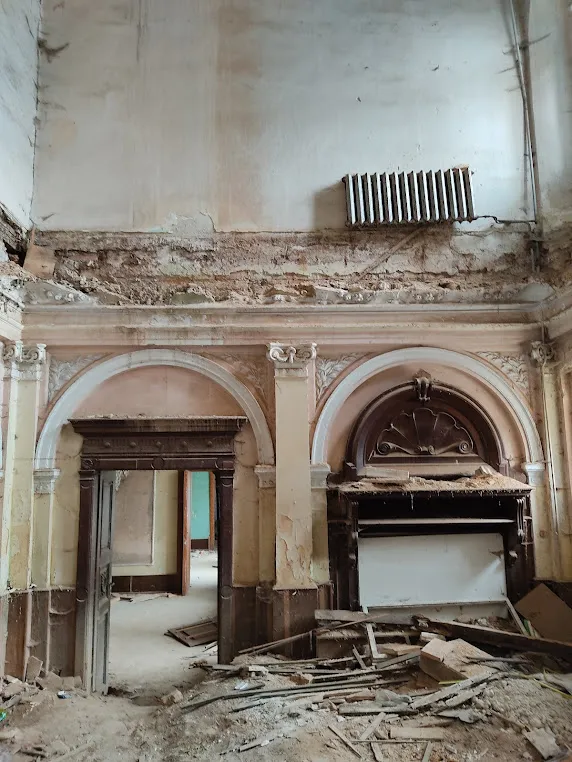
World War I caused serious damage. Portraits were torn from the walls, windows and doors destroyed. In the interwar period, the family restored the palace to nearly its original state — except for the portraits, which were never recovered.
1939 marked the end. When Soviet authority arrived in Koropets, the last owner, Stefan Badeni (1885–1961), Stanisław’s youngest son, emigrated with his family to Budapest. He was later imprisoned by the Nazis in the Mauthausen concentration camp, survived, and lived out his life in Dublin.
After the war, the palace housed administrative offices, and in 1959 a boarding school opened there. Additions to the park grounds gradually ate into the landscape. Today it houses the Koropets Regional Boarding Lyceum with enhanced military-physical training.
The building is in disrepair. Visitors are not allowed inside.
What to See Nearby
Koropets is a good stop on a route along the Dniester canyon:
- Dzhurynsky Waterfall (~7 miles / ~12 km) — the largest lowland waterfall in Ukraine
- Chervonohorod Castle (~9 miles / ~15 km) — ruins above the canyon
- The Dormition of the Mother of God wooden church (1772) and St. Nicholas Church (1860) — right in Koropets
- Buchach (~16 miles / ~25 km) with its town hall and castle ruins
All of this fits naturally into the “Dniester Panoramas of Ukraine” route, with Koropets as one of its central stops.
Practical Information
- Exterior viewing: free, around the clock
- Interior: closed — the building is unsafe and in active use as a school
- Park: partly accessible on foot
- Time needed: 30–60 minutes (façade, park, and rare trees)
How to Get There
Koropets is in Chortkiv district, Ternopil Oblast.
- From Ternopil: ~62 miles (~100 km) via Buchach and Monastyryska, or via Berezhany and Buchach.
- From Ivano-Frankivsk: ~56 miles (~90 km) via Halych and Nyzhniv.
- Bus: there’s an “Ivano-Frankivsk–Koropets” route from the Ivano-Frankivsk bus station, with a stop about a 10-minute walk from the palace. Note: no buses run from Ternopil on Saturdays.
- Coordinates: 3a Kahantsia St., Koropets.
The roads to Koropets are paved; the stretch from Nyzhniv to Koropets (~1.9 miles / ~3 km) is newly paved.
Little-Known Details
- The palace owner’s brother, Kasimir Badeni, as Minister-President of Austria-Hungary, ordered the armed dispersal of protests in 1897, which cost 10 lives and 769 arrests — and effectively ended his premiership.
- The ginkgo biloba in the park is a relict species that has barely changed in 200 million years. In 19th-century Galicia, it was planted as a symbol of exoticism and wealth.
- Stefan Badeni ended up in Dublin after Mauthausen — an ending that would be hard to invent even in a novel.
- The gold-floor legend isn’t the only story about the Badenis’ extravagance; according to local accounts, even in the interwar period the Koropets estate was considered “exemplary in scale.”
- Koropets is first mentioned in documents from 1421 — before half of today’s “ancient” castles were even founded.
Conclusion
The Badeni Palace isn’t really about luxury. It’s about the confidence in tomorrow that people had when they built “to last” — and got the timeline wrong.
It survived two world wars, three changes of state, and decades as a school. It’s still standing, even in disrepair. From the outside, it’s still striking. The park with its ginkgoes and plane trees is a reminder of the 30 gardeners who are long gone.
It’s worth the drive along the Dniester — to see what remains of grand ambitions.