The Mykolaiv region is genuinely flat. Fields, wind, steppe to the horizon.
And then, suddenly — a 125-ft (38 m) bell tower.
To understand why it’s here, you need to know one word: Blumenfeld.
General Information
| What? | Description |
|---|---|
| Name | St. George’s Church (St. Georg Kirche) |
| Village’s former name | Blumenfeld (“Flower Field”) |
| Location | Krasnopillia village, Berezan urban community, Mykolaiv district, Mykolaiv Oblast |
| Built | 1900–1902 |
| Style | neo-Gothic |
| Material | hewn stone |
| Dimensions | 118 ft (36 m) long, 49 ft (15 m) wide, bell tower 125 ft (38 m) tall |
| Construction cost | 30,000 rubles |
| Consecrated by | Bishop A. Zerr |
| Status | ruin; architectural monument |
Blumenfeld: Where This Place Came From
In 1862, on land then part of Odesa district, Kherson Governorate, a group of German colonists founded a new settlement. They named it Blumenfeld — “Flower Field.” A practical and pretty name for land that needed working.
The colonists were Catholic. So once the community had grown and become established, its first major collective decision was to build its own church.
In 1900, construction began on a stone Catholic church. It was finished in 1902. The build cost the community 30,000 rubles — a substantial sum for a rural colony. Once completed, Bishop A. Zerr consecrated the church, dedicating it to St. George.
That’s how a 125-ft neo-Gothic bell tower rose from the steppe between Mykolaiv and Kherson.
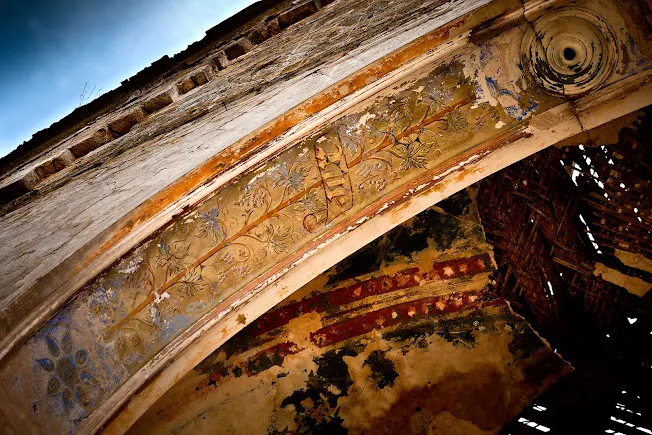
Architecture: Dimensions and Details
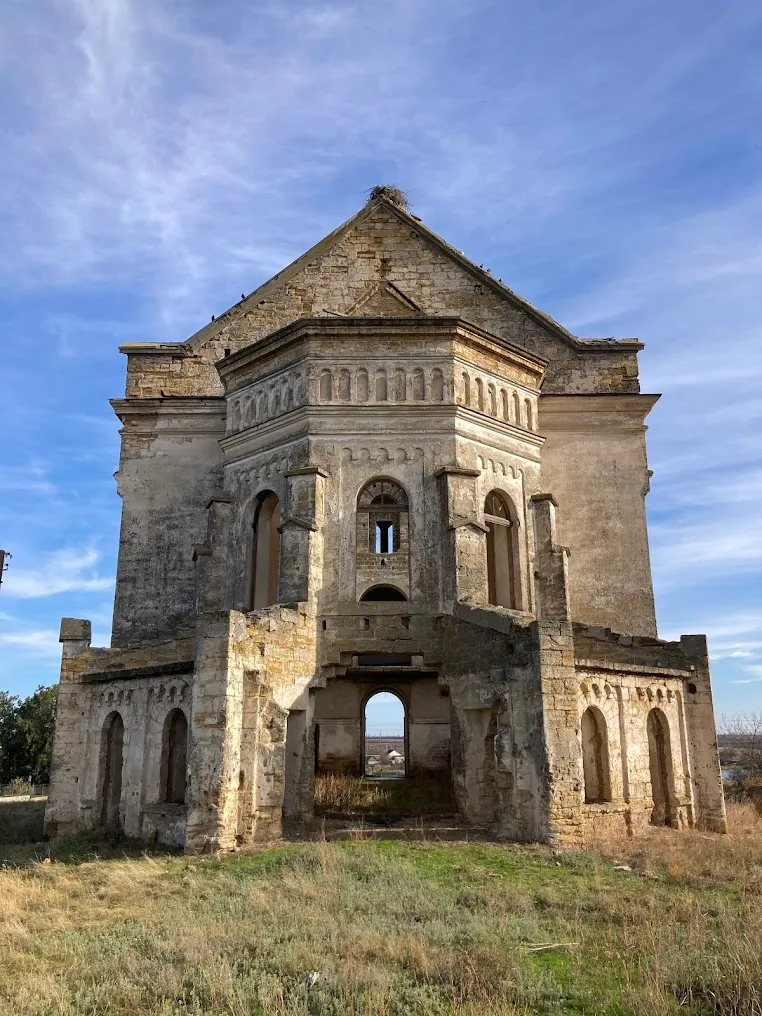
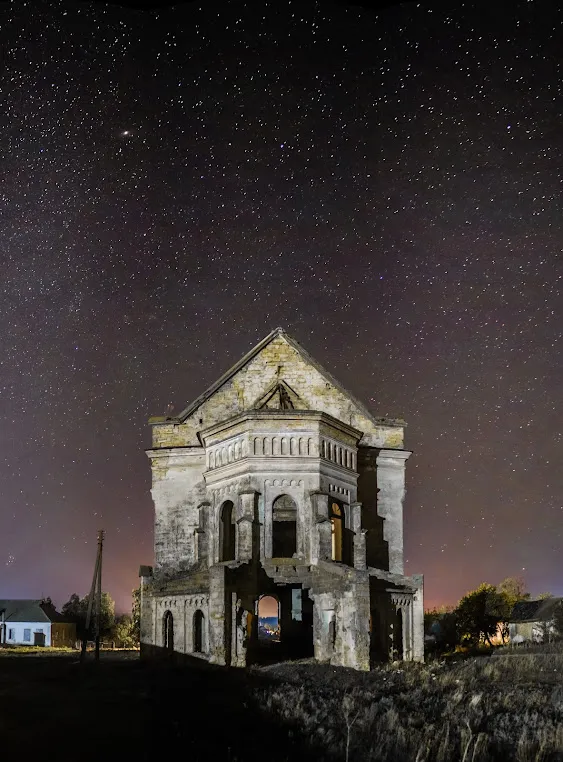
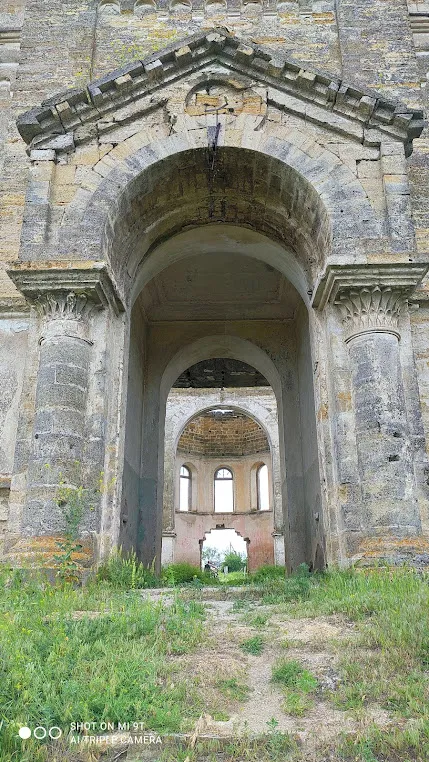
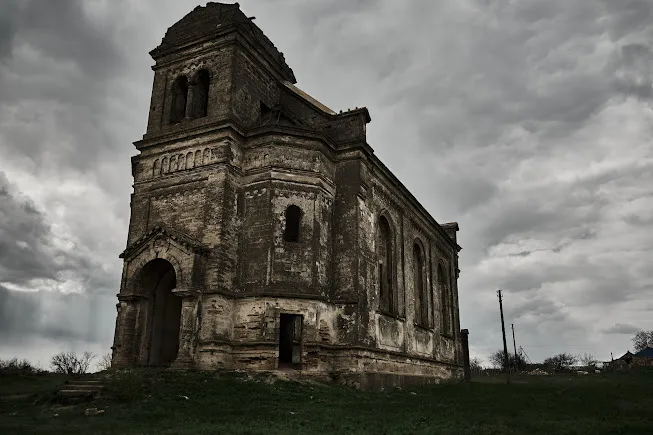
The church is an elongated stone structure: 118 ft (36 m) long, 49 ft (15 m) wide. The bell tower stands 125 ft (38 m) tall — visible before you can even make out the village itself.
Its style is neo-Gothic: pointed-arch windows, a vertical façade, a sharp spire. The material is hewn stone rather than brick, giving the walls a more severe, massive texture.
Inside: Three Altars and the Stations of the Cross
Before World War II, the interior held three altars:
The main altar — 9.3 ft (2.85 m) tall, 4.7 ft (1.42 m) wide. Its altar section held a gilded oak sculpture of St. George. Carved and gilded — the height of craftsmanship, something only a prosperous community could commission.
Two side altars — each with its own images and objects.
Above the entrance was a space for the organ.
The walls were decorated with the Stations of the Cross — 14 stops along Christ’s Via Dolorosa, a tradition characteristic of Catholic churches since the Middle Ages.
During World War II, the church suffered serious damage. The sculpture of St. George, the organ, the images, the icons — all vanished in the postwar years.
1944: an Empty Church
In 1944, Soviet authorities deported all the Germans from Krasnopillia — as from every other colonist village in southern Ukraine. The community was gone. The church was closed.
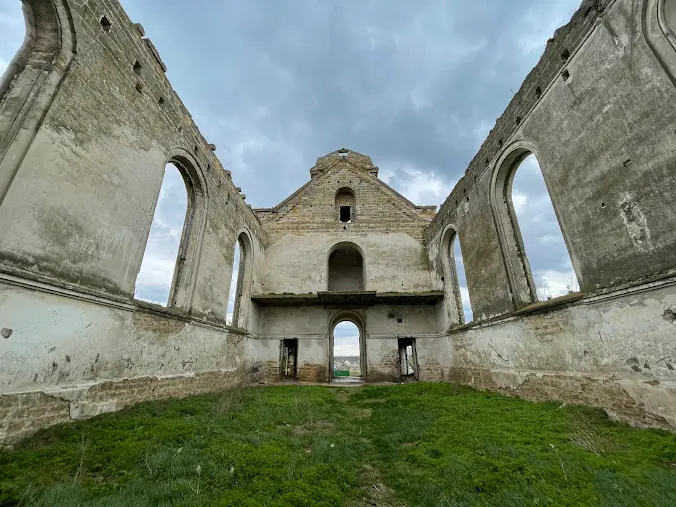
What followed was standard: a warehouse, then a culture house. From the 1970s, the building went entirely unused. The roof gradually collapsed, and the walls began to fail.
2013: Descendants Return
In 2013 — the 150th anniversary of Blumenfeld’s founding — descendants of the former residents traveled from Germany to Krasnopillia. To mark the occasion, they installed a memorial cross, inscribed in Ukrainian and German:
“To all the German colonists who were buried in this land, expelled, tortured, and shot in NKVD dungeons. Their grieving descendants.”
No more services are held in the church. As of 2020, it remains a ruin. There has been talk of transferring the building to an Orthodox community, but nothing concrete has come of it.
What to See Nearby and How to Fit It Into a Route
Krasnopillia sits in Mykolaiv district, between Mykolaiv and Kherson, where dozens of colonist villages — Catholic, Lutheran, and Mennonite alike — were once concentrated before World War I.
St. George’s Church is one of the most thoroughly documented and striking examples of colonist sacred architecture in southern Ukraine.
Practical Information
- Condition: a ruin, freely accessible
- Exterior viewing: safe
- Interior: structurally unsafe — be careful
- Time needed: 20–40 minutes
- Infrastructure: none
How to Get There
- From Mykolaiv: ~37 miles (~60 km), via Ochakiv or Berezan
- From Kherson: ~62 miles (~100 km)
- Road: paved to Krasnopillia; parking by the church
Little-Known Details
- The colony’s official name, Blumenfeld — “Flower Field” — gave no hint of the village’s eventual fate.
- The church cost 30,000 rubles — for a colonist community of only a few hundred people, that meant years of donations and serious financial effort.
- The 125-ft (38 m) bell tower is roughly the height of a 12-story building. In the completely flat steppe, it’s visible for miles.
- The 2013 memorial cross, with its bilingual inscription, is the only visible result of the 150th anniversary. Nothing else has changed.
- In 2024, a photo of the church by Oleksandr Moiseiev represented Mykolaiv Oblast in the “Wiki Loves Monuments” competition — and won a prize. It was the first time this particular site represented the region in that competition.
- The exact name of the bishop who consecrated the church appears abbreviated in sources: A. Zerr. His full name would require confirmation from diocesan archives.
Conclusion
St. George’s Church in Krasnopillia isn’t just a striking silhouette. It’s a document: 82 years of a community that raised 30,000 rubles, built a 125-ft bell tower, and vanished within a single year.
By 1944, no one remained — neither to pray, nor to maintain it. A ruin.
In 2013, descendants came to raise a cross. That’s all that could be done.
But it’s worth the trip, to see it for yourself.